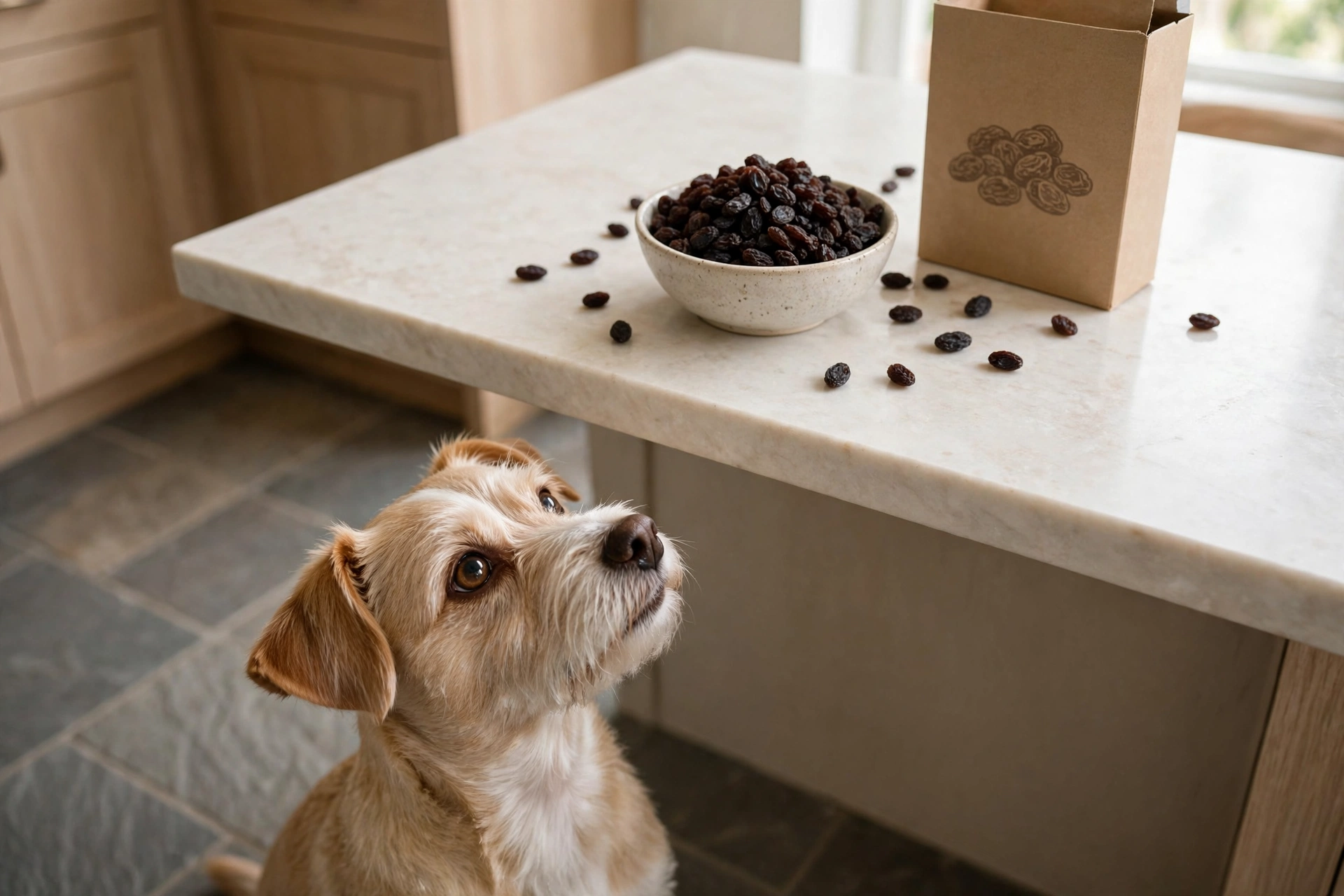

Yes. Raisins are bad for dogs, and this isn’t one of those “a little bit won’t hurt” foods where the internet is being dramatic. Raisins can cause sudden kidney failure in dogs, they can do it in small amounts, and vets still can’t predict which dogs will react badly. A big dog might eat a bowl of them once and seem fine, while a small one ends up in intensive care after a toddler shared a snack box.
So if you’ve just caught your dog with his nose in the trail mix, stop reading here, phone your vet or ASPCA Poison Control on (888) 426-4435, and come back to this page later. Everything below explains why that call matters, which foods count as raisins in disguise, and what treatment actually looks like.
Are raisins bad for dogs? The short answer, with no wiggle room
Some human foods are unhealthy for dogs in the way cake is unhealthy for people. Raisins aren’t in that category. They’re in the same group as chocolate and xylitol: normal pantry items that can poison a dog.
VCA Animal Hospitals puts grapes, raisins and Zante currants on its list of foods that can cause kidney failure in dogs, and its guidance is blunt: there’s no well-established safe dose, and some dogs are poisoned by amounts that wouldn’t trouble another dog at all. That unpredictability is the real problem. You can’t do the maths on your dog’s weight, count the raisins, and decide it’s probably fine, because nobody — including your vet — can tell you in advance whether your dog is one of the sensitive ones.
Dried fruit makes it worse. A raisin is a grape with the water taken out, so the part that does the damage is packed into a much smaller piece. Gram for gram, raisins deliver more of the toxin than fresh grapes do, and they turn up in far more foods than most owners realise.
Why are raisins so dangerous for dogs?
For years, vets honestly didn’t know. Dogs would arrive in kidney failure after eating grapes or raisins, the pattern was clear, but the culprit refused to show itself. Fungus toxins and an aspirin-like compound in the fruit were both suspects at different times.
The explanation most toxicologists now work with is tartaric acid, a natural acid found in grapes. ASPCA toxicologists identified it as the suspected toxin in research published in 2022, and it fits the evidence well: dogs handle tartaric acid poorly compared with people, it concentrates in exactly the part of the kidney that gets damaged in these cases, and the amount of it varies a lot between grape varieties and ripeness — which would explain why one dog gets sick and another doesn’t. Tartaric acid is also found in tamarind and in cream of tartar, which is why those are on the avoid list too.
Treat tartaric acid as the leading explanation rather than a closed case, because the practical advice doesn’t change either way. The outcome vets are trying to prevent is the same: injured kidneys that start to fail, leaving waste products to build up in the blood.
Which fruits count as raisins in disguise?
If it’s a grape in any form, fresh or dried, it belongs on the banned list for your dog. That includes a few things that don’t look like raisins at first glance:
| Food | Why it counts |
|---|---|
| Raisins (any colour, seeded or seedless) | Dried grapes; the toxin is concentrated |
| Grapes, fresh | The original fruit — red, green, black, organic or homegrown, all risky |
| Sultanas | Dried white grapes, so the same problem in a golden colour |
| Zante currants | Tiny dried grapes used in baking — not the same plant as fresh currants |
| Currants in cakes and buns | Almost always the dried grape kind when they’re in baked goods |
| Grape pressings and vines | Leftover skins and pulp from winemaking have poisoned dogs too |
One genuine point of confusion: fresh blackcurrants and redcurrants, the berry kind from the Ribes family, are a different plant entirely, and VCA notes they aren’t linked to kidney damage. The trouble is that the word “currant” on a packet of dried fruit nearly always means the grape kind. If you’re standing in your kitchen unsure which currant you’ve got, don’t gamble. Keep it away from the dog and check with your vet if any has already been eaten.
Cooking doesn’t rescue anything, by the way. A raisin baked into a cookie is still a raisin.
What are the symptoms of raisin poisoning in dogs?
The nasty detail here is the gap between cause and effect. A dog can eat raisins, look completely normal, and still be in trouble, because the kidneys take time to show damage. That’s why vets don’t use symptoms as the trigger to act — by the time a dog looks ill, some of the damage is usually already done.
When signs do appear, they tend to follow a rough order:
| When | What you might see |
|---|---|
| First few hours to 12 hours | Vomiting (often with bits of raisin in it), diarrhea, drooling, tummy pain, going off food |
| Around 12–24 hours | Tiredness, weakness, wobbliness, drinking more than usual, dehydration |
| 24–48 hours and beyond | Peeing a lot at first, then peeing less or stopping altogether, bad ammonia-smelling breath, mouth ulcers, tremors |
| Severe cases | Collapse, seizures, coma — this is kidney failure, and it’s life-threatening |
Vomiting is usually the first thing owners notice, and if your dog is being sick and there’s any chance raisins were involved, that combination is an emergency, not a wait-and-see. A dog throwing up after stealing plain food is often just a dog with a sore stomach — our guide on why dogs throw up yellow walks through the everyday causes — but throw raisins into the story and the rules change completely.
What should you do if your dog eats raisins?
Speed matters more than anything else you do. Work through these steps in order:
- Get the food away from your dog and, if you can, count or estimate what’s missing. A rough number is genuinely useful to the vet.
- Phone your vet immediately. If they’re closed, call an emergency clinic or ASPCA Poison Control on (888) 426-4435. Pet Poison Helpline is another 24/7 option on (855) 764-7661. Tell them what was eaten, roughly how much, when, and your dog’s weight.
- Don’t wait for symptoms. A dog who looks fine an hour after eating raisins is not a dog in the clear. The window where treatment works best is before signs start.
- Don’t make your dog vomit unless a vet tells you to. Induced vomiting is often part of treatment, but it has to be done safely, with the right method and timing. Kitchen experiments with salty water or anything similar can add a second problem on top of the first.
- Take the packaging with you if you’re heading to the clinic. The ingredients list and the total weight of the box help the team work out the exposure.
Then let the professionals take it from there. PetMD gives the same advice for grapes: any amount, any dog, phone a vet straight away.
What will the vet do?
Treatment depends on how much was eaten and how long ago, but the shape of it is consistent.
If the raisins went down recently, the vet will usually empty the stomach first, either with an injection that makes your dog vomit or, in some cases, by pumping the stomach under sedation. Activated charcoal may follow, to bind anything left in the gut before it can be absorbed.
After that, it’s about protecting the kidneys. Most dogs are put on intravenous fluids — a drip — for around 48 hours, to keep urine flowing and give the kidneys the best chance of clearing the toxin without permanent damage. The team will run blood tests to track kidney values, and those tests are usually repeated over the following two to three days, because the numbers can worsen before they improve even in a dog who’s doing well.
A dog who’s already showing kidney trouble needs more: closer monitoring of urine output, medication for nausea and blood pressure, and in the most serious cases, dialysis. This is the part nobody wants to reach, and it’s the strongest argument for making that first phone call while your dog still looks perfectly healthy. Dogs treated early, before symptoms, generally do well. Once the kidneys have shut down and urine stops, the outlook becomes poor, and dogs who survive a bad episode can be left with long-term kidney disease.
Where do raisins hide? The sources owners forget
Most grape poisonings aren’t a bunch of grapes handed over on purpose. They’re accidents, and they usually involve food nobody thought of as “raisins.” Run through this list and check your own kitchen:
- Trail mix — the classic. It falls off hiking bags and out of coat pockets, and dogs hoover it up whole.
- Breakfast cereal — raisin bran and muesli, eaten by kids at low tables, spilled on floors.
- The lunchbox — those little red snack boxes of raisins handed out as a “healthy” school snack get traded, dropped and fed to dogs all the time.
- Fruitcake, panettone and Christmas cake — dense with raisins, sultanas and currants, and often sitting within dog reach for weeks over the holidays.
- Hot cross buns and teacakes — same problem, spring edition.
- Oatmeal raisin cookies — they look like chocolate chip cookies, which confuses everyone, including the person who left them on the coffee table.
- Granola bars — raisin paste is a common sweetener and binder, even in bars that don’t advertise raisins on the front.
- Chocolate-covered raisins — a double hazard, because now chocolate is in the mix too.
- Mince pies — mincemeat is largely dried fruit, despite the name.
- The compost bin and the vine — dogs have been poisoned by fallen grapes under a garden vine and by grape skins in compost.
Kids deserve a special mention. Most children share food with the dog as an act of pure love, and raisins are exactly the size and shape of thing a four-year-old offers a hopeful face under the table. If there are small children in the house, they need to know that raisins are on the never-share list, along with grapes and chocolate.
How do you keep your dog safe from raisins?
None of this needs to be complicated. It mostly comes down to storage and habit.
- Keep dried fruit in a closed cupboard or a sealed container, not in a bowl on the counter. Plenty of dogs counter-surf, and a fruit bowl is an open invitation.
- Sweep the floor after children have eaten cereal or packed lunches anywhere near the dog. Five dropped raisins is a nothing amount to you and a vet visit for a small dog.
- Check the label on anything new you bring home, including “healthy” snack bars and bakery items. Raisins sneak in under names like “dried vine fruit.”
- Tell dog sitters, grandparents and anyone who feeds your dog that grapes and raisins are never treats, no exceptions. Most accidental feedings come from kind people who simply didn’t know.
- If you grow grapes, fence the vine off or pick up windfalls promptly, and keep the compost bin latched.
There’s a longer list of kitchen hazards in the ASPCA’s guide to people foods to avoid feeding your pets, and it’s worth ten minutes of your time if your dog is the opportunistic type.
Conclusion
So, are raisins bad for dogs? Yes — not “best avoided,” not “only in large amounts,” just plain bad. There’s no known safe quantity, no way to tell in advance which dogs will react, and the damage they cause is to the kidneys, which don’t forgive easily.
The hopeful part is that outcomes are usually good when owners act fast. The dogs who do badly are overwhelmingly the ones whose treatment started after symptoms appeared. So keep the dried fruit shut away, brief the kids and the grandparents, and if the worst happens and a handful disappears into your dog, make the call while he’s still bouncing around looking pleased with himself. That’s exactly when the call does the most good.
Frequently asked questions
How many raisins does it take to make a dog sick?
Nobody knows, and that’s the honest answer. There’s no established safe dose for grapes or raisins, and reported cases range from dogs who ate a pile of them with no ill effects to dogs who became seriously ill after a very small amount. Because there’s no way to predict your dog’s sensitivity, vets treat every raisin-eating incident as worth a phone call, whatever the count.
My dog ate one raisin and seems fine. Should I still call the vet?
Yes. One raisin is a low exposure, and the likely outcome is that your vet reassures you, advises you on what to watch for over the next couple of days, or asks you to come in to have your dog made sick as a precaution. What you shouldn’t do is use “he seems fine” as your test. The early hours are exactly when a poisoned dog looks fine, because kidney damage shows up later.
Are sultanas and golden raisins safer than regular raisins?
No. Sultanas are dried grapes, golden raisins are dried grapes, and the colour makes no difference to the toxin. Anything that started life as a grape and ended up small and wrinkly in a packet carries the same risk as the standard dark raisin.
Can dogs eat a little bit of raisin bread or cereal?
They shouldn’t, and if yours has helped himself to some, treat it the same way you’d treat plain raisins: call the vet. The raisin content of a slice of fruit loaf is smaller than a handful of loose raisins, but “smaller” isn’t the same as “safe,” and cereal in particular gets eaten by dogs in much bigger quantities than one slice — a spilled box is half a bowl of raisins. If your dog has diarrhea after raiding the cereal cupboard, our guide on what to give a dog for diarrhea covers home care, but with raisins involved, the vet call comes first, always.
How long do I need to watch my dog after he’s eaten raisins?
Vets typically want monitoring for at least 48 to 72 hours after an exposure, because that’s the window in which kidney problems usually declare themselves. If your dog was treated, the clinic will schedule the repeat blood tests for you. If you were advised to watch at home, the things you’re watching for are vomiting, appetite loss, unusual tiredness, drinking or peeing much more or much less than normal, and any wobbliness. Any of those means you stop watching and start driving.
Related Articles



[…] Are Raisins Bad for Dogs? Yes — and Even a Handful Can Be an Emergency […]
[…] Are Raisins Bad for Dogs? Yes — and Even a Handful Can Be an Emergency […]