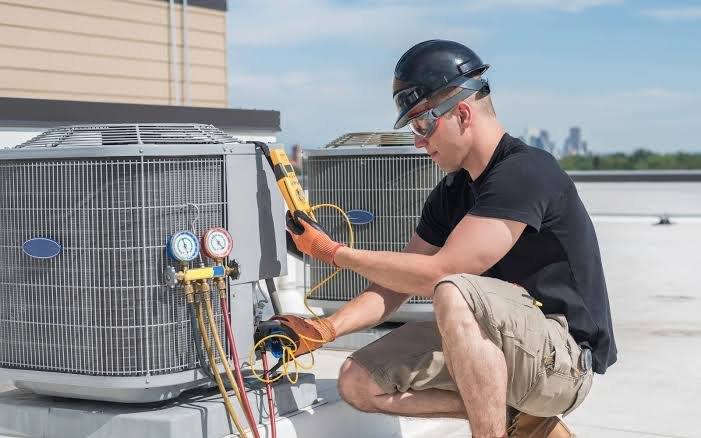

You make money in the heating and air conditioning business by pricing every job above its full cost, selling maintenance agreements that keep customers coming back, earning a solid margin on equipment replacements, and keeping your technicians on paid work all year. A well-run residential HVAC company keeps about 12 cents of profit from every dollar it brings in.
Being busy is not the same as being profitable. A shop can run full schedules all summer and still end the year with little left, usually because its prices were copied from competitors instead of built from its own costs.
Below is where HVAC profit actually comes from, how to price for it, and the numbers to watch, using current figures for 2026.
Where does the money in an HVAC business come from?
Most residential HVAC profit comes from three kinds of work: repair calls, maintenance agreements, and system replacements. Each one does a different job for the business, and a healthy company needs all three.
| Revenue stream | What it is | What it does for profit |
|---|---|---|
| Repair and service calls | Finding and fixing problems in broken systems | Steady daily cash and strong earnings per hour when priced by the task |
| Maintenance agreements | A yearly plan with tune-ups, priority service, and repair discounts | Predictable income and a steady flow of repair and replacement leads |
| System replacements | A new furnace, air conditioner, heat pump, or full system | The biggest tickets, with equipment carrying the highest margin |
| Add-ons | Air cleaners, humidifiers, smart thermostats, duct sealing | A bigger average ticket with little extra drive time |
Replacements bring in the largest checks. The U.S. Department of Energy’s business model guide for HVAC contractors puts the gross margin on equipment at about 45 percent, while the margin on labor runs much lower. That is why profitable installers plan jobs tightly and don’t let labor hours drift.
Repair work is mostly labor and small parts, so it pays well only when you price it by the task rather than by the clock. Maintenance agreements earn modest money on their own. Their real value is the repair and replacement work they lead to.
Tip: Track profit by job type, not just in total. A strong install month can hide a service department that loses money on every call.
What profit margin should an HVAC company aim for?
Aim for a net profit of about 12 percent of revenue. That is the operating income target the Department of Energy’s guide describes as a solid, average benchmark for HVAC contractors. On $1 million in sales, it means about $120,000 left after every cost is paid.
Two terms matter here, and confusing them costs real money:
- Gross margin is what is left after the direct cost of a job: parts, equipment, and the technician’s pay for those hours.
- Net margin is what is left after everything else too, including trucks, insurance, rent, office staff, marketing, software, and your own salary.
Markup and margin are also different. If a job costs you $200 and you add a 50 percent markup, you charge $300. Your margin on that sale is $100 out of $300, or 33 percent, not 50. To earn a true 50 percent gross margin, you have to double your cost.
Margin = (Price − Cost) ÷ Price. Check this number, not the markup, every time you set a price.
How do you price HVAC jobs so they actually pay?
Build your prices from your own fully loaded cost per billable hour, then turn that into flat-rate prices for each task. A billable hour is an hour a customer pays for. Drive time, training, callbacks, and paperwork are not billable, even though you still pay for them.
- Total your yearly overhead. Include rent, trucks, fuel, insurance, licenses, software, office staff, marketing, and a fair salary for yourself.
- Find the loaded cost of each technician. Start with wages, then add payroll taxes, workers’ comp, and benefits. The national median wage for HVAC mechanics and installers was $61,010 in May 2025.
- Count real billable hours. A full-time year is 2,080 hours, but far fewer get billed. Use your own job records. If you don’t have them yet, 1,200 hours per technician is a cautious starting point.
- Divide total cost by billable hours. This gives your break-even cost per hour.
- Add your target profit and build a price book. Price each common task, such as a capacitor swap, a drain line clear, or a tune-up, as a flat rate based on its typical time plus parts with markup.
Here is a simple worked example for one technician’s share of a business. The numbers are for illustration, so swap in your own.
| Cost item | Yearly amount |
|---|---|
| Technician wage | $61,010 |
| Taxes, workers’ comp, and benefits (about 30%) | $18,300 |
| Truck, tools, fuel, and share of overhead | $70,000 |
| Total cost | $149,310 |
| Billable hours | 1,200 |
| Break-even cost per billable hour | About $124 |
Any hour sold below about $124 loses money. To keep a 12 percent net profit, the labor in your prices needs to average about $141 per billable hour, with parts marked up on top.
Flat-rate pricing helps the customer too. They agree to the price before work starts, so the invoice holds no surprises, and a fast technician earns the company more instead of less.
Why are maintenance agreements the profit engine?
Maintenance agreements turn one-time callers into customers who pay you every year and call you first when something breaks. HVAC contractors treat about 500 active service contracts as a reasonable threshold for a sustainable business. Most of the money from those contracts comes not from the tune-ups but from the repairs and replacements sold to those customers over time.
In early 2026, homeowners typically paid between $150 and $500 a year for an HVAC maintenance contract, while a single one-off tune-up averaged about $275. At an average of $250 a year, 500 agreements bring in $125,000 of predictable revenue before a single repair is sold.
A strong residential plan usually includes:
- Two visits a year: a cooling check in spring and a heating check in fall
- Priority scheduling when the weather turns and the phones get busy
- A set discount on repairs
- Automatic renewal, billed monthly or yearly
Price the plan so the fee covers both visits at your real hourly cost. If the plan only breaks even with heavy repair sales, a mild summer can turn it into a loss.
Tip: Offer the agreement on every repair call and every new install. A brand-new system is the easiest agreement you will ever sell.
How do you earn more on each system replacement?
Give every homeowner choices, size the system properly, offer financing, and quote add-ons that solve a real problem. Replacements are where one good conversation can be worth several thousand dollars.
Offer three options. A good, better, and best proposal lets the customer pick a price and efficiency level they are comfortable with. It also turns the question from “yes or no” into “which one.”
Size it right. A load calculation (a room-by-room estimate of how much heating and cooling the home needs, often called Manual J) prevents oversized systems that switch on and off too often, which leads to comfort complaints and callbacks.
Lead with monthly payments. The federal 25C tax credit, which covered 30 percent of a heat pump’s cost up to $2,000, ended for installations after December 31, 2025. Homeowners now carry more of the upfront cost, so a financing option and any state or utility rebates matter more than they did a year ago.
Quote useful add-ons. Air cleaners, humidifiers, smart thermostats, and duct sealing raise the ticket with little extra drive time.
Stay current on refrigerants. Since January 1, 2025, new residential AC and heat pump systems are built for lower-impact refrigerants such as R-454B and R-32. These are A2L refrigerants, which are mildly flammable and need specific handling, so train every installer on them. In May 2026, the EPA finalized a rule that removed the January 1, 2026 installation deadline for R-410A equipment built or imported before 2025, though New York still enforces that deadline under its own state rule. The EPA’s HFC reduction page tracks these rules as they change. Equipment and refrigerant prices can move during the transition, so update your price book whenever distributor costs change.
How do you keep cash flowing in the slow months?
Plan for slow seasons before they arrive: book maintenance visits for spring and fall, sell planned work, and keep a line of credit ready. In many climates the busy season for repairs and replacements lasts only about seven months, but payroll, truck payments, and insurance don’t stop when the weather is mild.
A few moves keep technicians billable all year:
- Schedule agreement tune-ups for the mild months, not the peak weeks.
- Suggest that homeowners book non-urgent work, like duct sealing or air quality upgrades, for the off-season.
- Add a few light commercial maintenance accounts, which pay on a schedule whatever the weather.
- Keep marketing steady. Update your Google Business Profile, ask every happy customer for a review, and pay a reward for referrals.
Track what each lead costs you. A channel that brings cheap leads but few booked jobs is more expensive than it looks.
Which numbers should you check every month?
Check a short list of numbers every month so problems show up while they are still small:
- Net profit percentage, measured against the 12 percent target
- Gross margin by job type, kept separate for service, installs, and agreements
- Revenue per billable hour for each technician
- Active maintenance agreements and how many renew each year
- Close rate on replacement estimates
- Average ticket on service calls
- Cost per booked job for each marketing channel
If net profit slips, look at gross margin by job type first. It usually shows whether the problem is pricing, labor time, or a marketing channel bringing in the wrong jobs.
Conclusion
To make money in the heating and air conditioning business, price every job from your own fully loaded cost, not from what competitors charge. Build toward about 500 maintenance agreements so repeat customers feed your repair and replacement work. Earn a strong equipment margin with clear options and financing, and keep technicians billable through the slow months. A good result is a net profit near 12 percent, with steady income in every season instead of one big summer spike.
Frequently asked questions
Is an HVAC business profitable?
Yes, when it is priced and run well. A solid target is about 12 percent net profit. Shops that copy competitor prices or depend only on summer installs often earn far less, so pricing from your own costs and building maintenance agreements make the biggest difference.
How much does it cost to start an HVAC business?
Buying everything up front can cost up to about $100,000, mostly for a truck, tools, and equipment. Leasing the truck and buying some tools secondhand brings that down a lot. Budget separately for licenses, insurance, and a few months of operating cash.
How many maintenance agreements does an HVAC company need?
About 500 active agreements is a common threshold for a sustainable residential HVAC company. That base brings steady yearly income and, more importantly, a reliable flow of repair and replacement work from customers who already trust you.
Should HVAC companies charge flat-rate or hourly?
Flat-rate pricing works best for most residential service work. The customer approves the price before work starts, invoices are rarely disputed, and efficient technicians earn the company more. Hourly billing still suits some commercial jobs and projects that are hard to predict.
Can HVAC contractors still install R-410A systems in 2026?
Yes, in most of the U.S., as long as the equipment was made or imported before January 1, 2025. The EPA’s final rule in May 2026 removed the earlier January 1, 2026 installation deadline. New York keeps that deadline under its own state rule.
Related Articles
Can Dogs Eat Salmon Skin? Benefits, Risks and How to Serve It Safely
What Is IVDD in Dogs? Symptoms, Stages and Treatment Explained



[…] How to Make Money in the Heating and Air Conditioning Business? […]
[…] How to Make Money in the Heating and Air Conditioning Business? […]
[…] How to Make Money in the Heating and Air Conditioning Business? […]