
If your dog has just come in from the yard with a scraped leg or a small cut, you want to know how to heal a dog wound fast at home — and the truthful answer is that “fast” is mostly about doing a few basic things promptly and correctly. Clean the wound well, keep your dog’s tongue off it, watch it like a hawk for the first few days. That unglamorous routine heals minor wounds faster than any wonder cream.
Home care has a firm border around it, though. Everything in this guide applies to minor scrapes and small, shallow cuts. Deep cuts, bites, and wounds that won’t stop bleeding belong to the vet, and we’ll be clear about where that line sits before we touch a single bandage.
Which wounds can you treat at home, and which need a vet?
This is the decision that matters most, so make it first, before anyone reaches for the first-aid kit.
Usually fine to handle at home: surface scrapes and grazes where the top layer of skin is scuffed, small shallow cuts that stop bleeding on their own or with a few minutes of pressure, torn or broken nails, and minor pad nicks where your dog is still walking comfortably.
Straight to the vet, no home trial: any cut that’s deep, gaping open, or shows fat or muscle underneath; any bite wound from another animal, however small it looks on the surface; wounds near the eyes, over a joint, or on the face; anything with an object embedded in it; wounds that keep bleeding after 10 to 15 minutes of steady pressure; and any wound on a dog who seems unwell, quiet, or off his food.
| Wound | Home care or vet? |
|---|---|
| Scrape or graze, surface only | Home care |
| Small shallow cut, bleeding stops with pressure | Home care, then monitor |
| Deep or gaping cut, edges won’t meet | Vet — may need stitches |
| Bite wound from another animal, any size | Vet, same day |
| Wound near an eye or over a joint | Vet |
| Something stuck in the wound | Vet — don’t pull it out |
| Bleeding that won’t stop after 10–15 minutes of pressure | Emergency vet |
| Wound plus fever, lethargy, or appetite loss | Vet, same day |
Bite wounds deserve a special warning because they fool everyone. Two neat little puncture holes can hide crushed tissue and bacteria injected deep under the skin, and they have a nasty habit of sealing over on top while an abscess builds underneath. A vet will usually want to see any bite the same day, even if the dog seems fine.
How to heal a dog wound fast at home, step by step
Work through these steps in order, and don’t rush. A calm owner makes for a calmer patient, and most dogs take their cue from you.
Step 1: Settle your dog and protect yourself. Talk quietly, get him lying down somewhere with good light, and have a helper gently hold him if you can. Even a sweet dog may nip when something hurts, so work slowly and stop if he’s really distressed. If the wound is somewhere he can reach your hands easily, a helper’s steady hold matters more than speed.
Step 2: Stop any bleeding with pressure. Press a clean gauze pad or a clean cloth directly on the wound and hold steady pressure. VCA Animal Hospitals’ first-aid guidance makes a point owners get wrong: keep the pressure on for at least three minutes before you lift the pad to peek. Lifting every twenty seconds breaks the clot that’s trying to form. If blood soaks through, add another pad on top rather than removing the first one, and keep pressing on the way to the vet if it won’t stop.
Step 3: Trim the fur around the wound. Once the bleeding is under control, clip or carefully trim the hair back from the edges with blunt-ended scissors or clippers. Fur falls into wounds, mats into scabs, and hides what’s going on underneath. A small margin of short fur lets you clean properly and actually see the wound over the next few days.
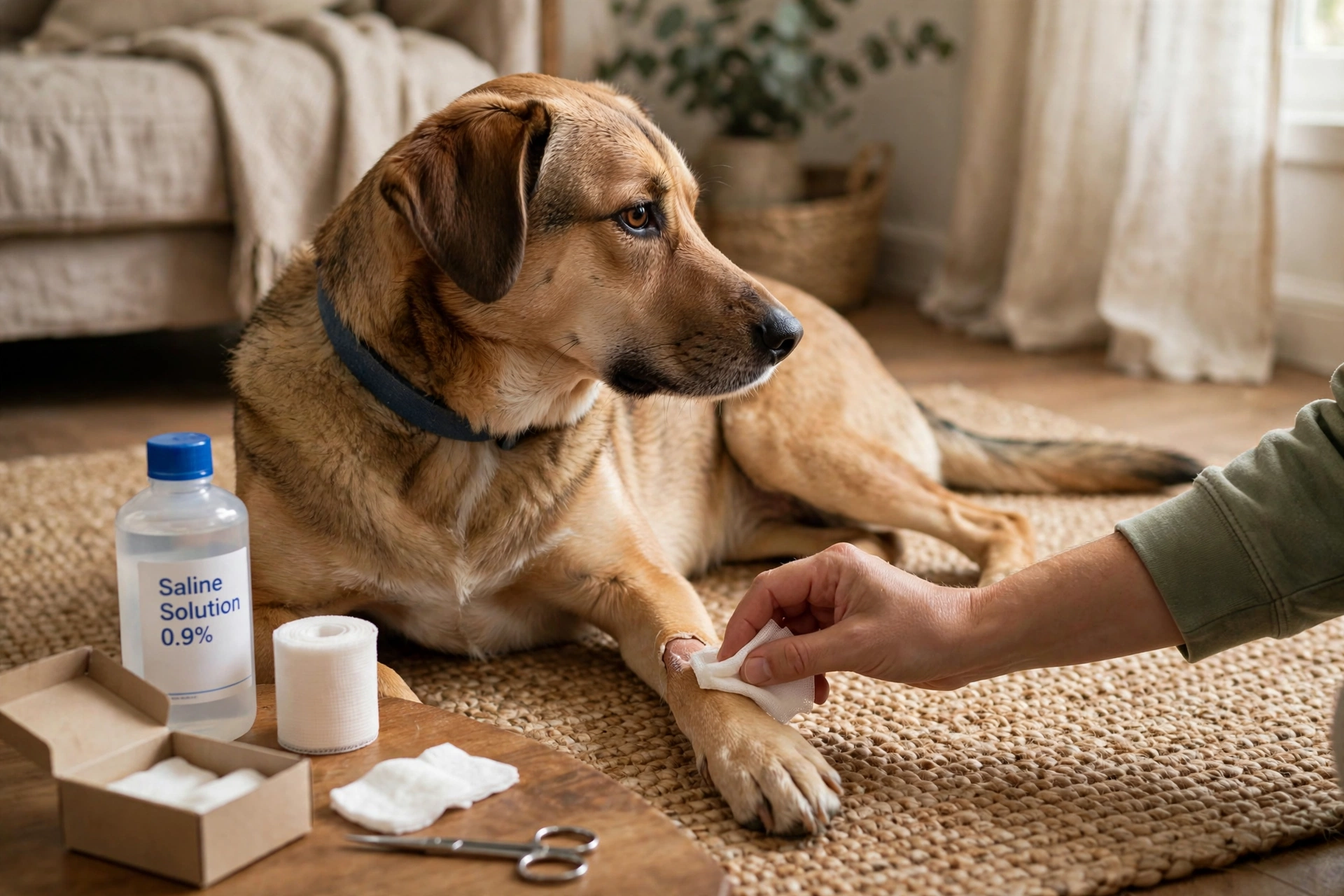
Step 4: Flush the wound, and be generous about it. This is the step that does the real healing work. Run clean lukewarm water or saline over the wound for a good minute or two, washing grit, dirt, and debris out rather than wiping at it. Wound-care guidance for owners, including PetMD’s step-by-step dog wound care guide, starts with exactly this: water first, to clear away most of the dirt before anything else touches the wound. A shower head on a gentle setting, a jug, or a sports bottle all work fine. Plain shop-bought saline is ideal if you have it; homemade saline (one level teaspoon of salt in two cups of water that’s been boiled and left to cool) is a decent stand-in.
Step 5: Clean the skin around the wound. With the wound itself flushed, gently clean the surrounding skin with a dilute, dog-safe antiseptic such as chlorhexidine solution, diluted according to the bottle, applied with gauze. Work outward from the wound, not into it, and don’t scrub the raw surface itself. The open wound bed gets water or saline only.
Step 6: Decide on ointment and cover. If you’d like to use a plain triple-antibiotic ointment on a minor cut, our guide on whether you can use Neosporin on your dog walks through which versions are safe (the plain one, never the pain-relief formula) and how to stop it being licked straight off. A thin smear is plenty. Then protect the spot with a nonstick pad if it’s somewhere that will get dirty, or leave it to the air if it’s somewhere clean and hard for your dog to reach — and make sure he can’t reach it, which brings us to the cone.
What should you never put on a dog’s wound?
The bathroom cabinet is full of things that feel like they should help and genuinely don’t.
Hydrogen peroxide heads the list. The fizzing looks like cleaning, but peroxide damages the healthy new tissue your dog’s body is trying to build and slows healing down. It had a long run in old first-aid advice; modern veterinary guidance has dropped it, and one cleaning session with it does more harm than the dirt it removes.
Rubbing alcohol has the same problem, plus it stings fiercely on open skin, which teaches your dog that wound care means pain and makes day two’s dressing change a wrestling match.
Random kitchen and bathroom remedies — butter, honey from the pantry shelf, essential oils, leftover creams of any kind, human antiseptic sprays with painkillers in them — range from useless to actively toxic. Tea tree oil in particular is dangerous for dogs. If a product isn’t made for dogs or your vet hasn’t said to use it, keep it off the wound. Clean water does the heavy lifting here, not chemistry.
And the mirror rule from the medicine side: no human painkillers either. A sore dog gets vet-prescribed pain relief, never a share of your ibuprofen.
How do you stop your dog licking the wound?
Here’s the part owners find hardest to believe: the single biggest threat to a healing wound usually isn’t dirt or germs. It’s your dog’s tongue.
The old idea that dog saliva cleans wounds is a myth, and a persistent one. A dog’s mouth carries plenty of bacteria, and licking delivers them straight into the wound while the rough tongue tears at new tissue and pulls out the early scab. Vets see the same scene constantly — a wound that was nearly healed on Friday, licked raw by Monday.
So the cone, the inflatable collar, the recovery suit, or a clean t-shirt over a torso wound isn’t optional equipment for wounds your dog can reach. It’s the treatment. Fit the cone before you need it if you can, feed him in it, let him sulk in it. Most dogs accept it within a day and sleep in it fine. The owners hold out longer than the dogs do.
For the times he’s supervised and settled, brief cone breaks are fine. The moment your attention wanders, it goes back on. It only takes one unattended minute.
Should you bandage the wound or leave it uncovered?
It depends on where the wound is and what your dog does all day. Bandage a wound that’s on a leg or paw and will be walked through mud, grass, and kitchen floors. A wound on the chest or shoulder of a mostly indoor dog, once it’s clean and he’s coned, often does better with air and easy inspection.
If you do bandage, keep it simple and safe:
- Nonstick pad directly on the wound, then a layer of gauze wrap to hold it
- Finish with a self-adhesive wrap, snug but never tight — you should be able to slide two fingers underneath it
- Check toes below any leg bandage a few times a day; swelling or cold toes mean it’s too tight, so take it off and redo it looser
- Change the dressing at least once a day, and immediately if it gets wet, slips, or starts to smell
That last point matters. A damp, day-old bandage is a warm, dark incubator strapped to the wound. It undoes your careful cleaning in hours. And if wrapping a leg feels fiddly and uncertain — it genuinely is easy to wrap a limb too tight — there’s no shame in letting the clinic dress it and copy what they did.
How long does a minor wound take to heal, and what does healing look like?
A clean, minor scrape or small cut that’s kept clean and unlicked usually follows a predictable path:
| Stage | Roughly when | What you’ll see |
|---|---|---|
| Settling down | Days 1–2 | Mild redness and swelling around the edges, a scab or dry surface forming |
| Closing up | Days 3–7 | Swelling fades, edges draw inward, pink new tissue in shallow wounds, scab firms up |
| Finishing off | Weeks 2–3 | Surface closed, scab falls away on its own, hair starts regrowing, a faint scar may remain |
Healthy healing should look a little better every day. Not dramatically — wounds heal in millimeters — but the direction should always be toward calmer, drier, and smaller. The day the direction reverses is the day you call the vet: spreading redness, fresh swelling after things had settled, heat in the skin, yellow or green discharge, a bad smell, the wound reopening, or your dog going quiet and off his food. If you’re worried he may be running a temperature too, our guide on how to tell if a dog has a fever explains how to take it properly.
One more habit worth building: take a photo of the wound on day one, and one every couple of days after. Memory is hopeless at this — every owner swears it’s “about the same” — and a photo series shows you, and your vet if it comes to that, exactly how things are moving.
Conclusion
Healing a minor dog wound fast at home is less about products than about sequence: decide it’s genuinely minor, stop the bleeding with patient pressure, trim the fur, flush it generously with clean water or saline, keep human remedies and peroxide off it, and then guard it from your dog’s tongue like it’s your job — because for the next two weeks, it is. Do that, and most scrapes and small cuts close up quietly inside two to three weeks.
The moment a wound falls outside the “minor” box — deep, gaping, bitten in, near an eye or joint, or showing any sign of infection — home care stops being the treatment and becomes the thing you did in the car on the way to the vet. No owner has ever regretted getting a wound checked a day early.
Frequently asked questions
Can I put Neosporin on my dog’s wound?
For a minor cut, a thin layer of plain triple-antibiotic ointment like original Neosporin is widely considered acceptable, provided your dog can’t lick it off — which usually means a cone. Skip the “plus pain relief” versions completely, as their added ingredients aren’t meant for dogs. Our full guide to Neosporin on dogs covers the safe way to use it, amounts, and the situations where you should skip ointment altogether.
How often should I change my dog’s bandage?
At least once a day for the first few days, and straight away if the bandage gets wet, muddy, slips out of place, or develops a smell. Each change is also your inspection: the wound should look calmer and drier than the day before. If bandage changes stretch beyond three or four days because the wound still needs covering, it’s worth having the vet take a look.
Is it really that bad if my dog licks the wound a few times?
A lick or two while you’re fitting the cone isn’t a disaster. Sustained licking is. A few dedicated minutes with that rough tongue can strip off a forming scab, reopen edges that had started to seal, and seed the wound with mouth bacteria. It’s the difference between a wound that closes in a week and one that’s still open in three.
Can I clean the wound with hydrogen peroxide just once, to be safe?
No — even once works against you. Peroxide damages the healthy cells at the wound edges that healing depends on, and it doesn’t clean better than a thorough flush with water or saline. Generous flushing is both gentler and more effective. If all you have in the house is peroxide and water, choose the water.
How do I make saline solution at home for wound flushing?
Dissolve one level teaspoon of ordinary table salt in two cups (about 500 ml) of water that has been boiled and allowed to cool until it’s lukewarm. Use it the same day, and make a fresh batch rather than keeping leftovers. It should never sting more than clean water does — if your dog flinches hard at it, plain lukewarm water is perfectly fine instead.
Related Articles