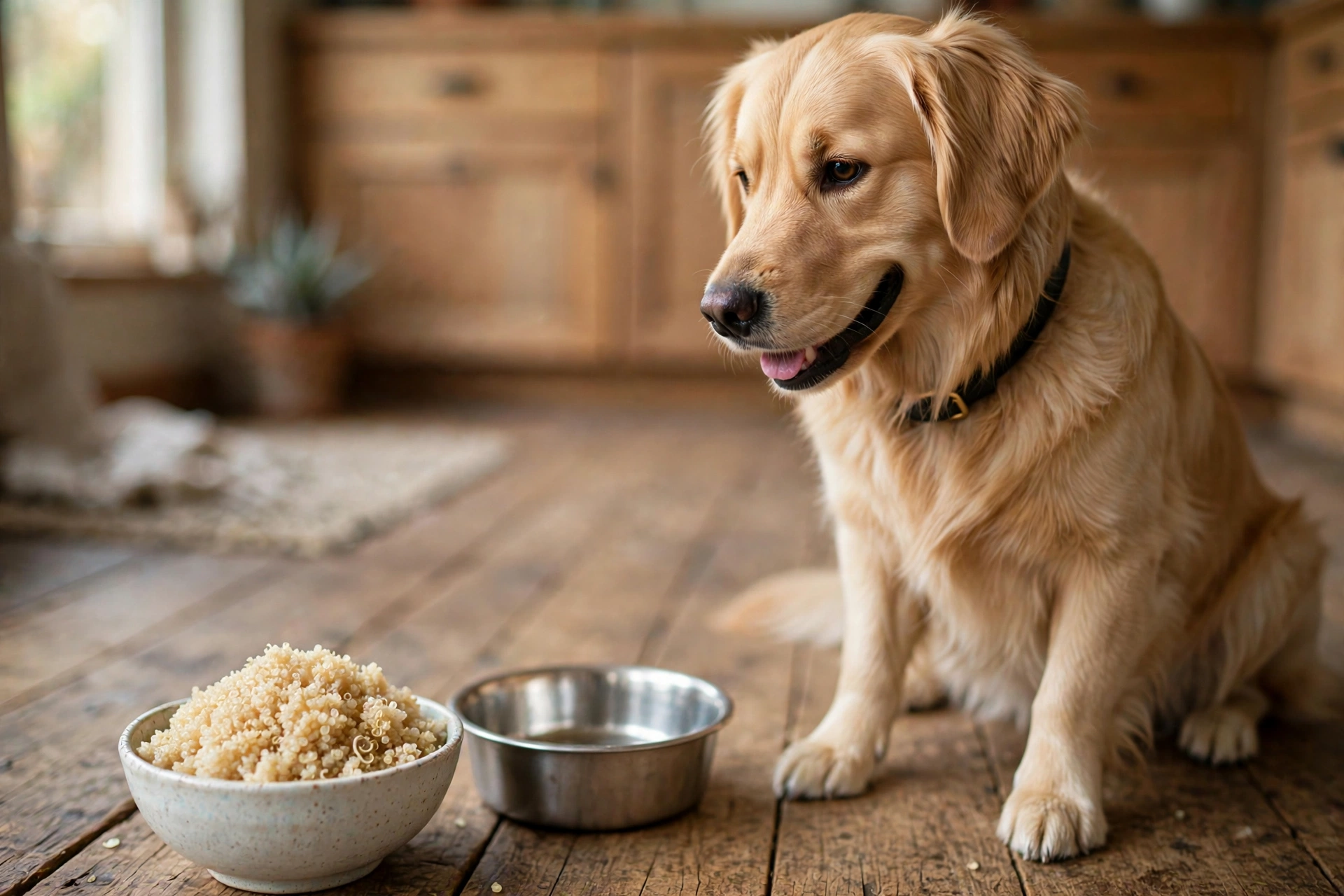

You’ve cooked too much quinoa again. There’s a bowl of it cooling on the counter, a dog sitting in the exact spot where dropped food lands, and a familiar question forming: can he have some?
So, is quinoa good for dogs? Yes — genuinely good, as long as it’s cooked, plain, and rinsed well before cooking. Quinoa is one of the more nutritious things you can spoon over a dog’s dinner: proper protein, decent fiber, and a mineral list that puts most grains to shame. It’s no accident that it turns up as an ingredient in some high-quality dog foods. The rules around it are simple, but they do matter, so here’s the full picture: what’s in it, how much to serve, how to prepare it properly, and the few dogs who are better off skipping it.
What makes quinoa so nutritious for dogs?
Quinoa isn’t technically a grain at all. It’s a seed, cooked and eaten like one, which is why you’ll sometimes see it called a pseudocereal. That technicality is part of why its nutrition looks different from a bowl of rice.
The headline act is the protein. Most plant foods are missing one or more of the essential amino acids dogs need, but quinoa provides the full set, which makes it a complete protein — a rare thing in the plant world. It won’t replace the meat in your dog’s bowl, and it isn’t meant to, but as plant proteins go, this one brings its paperwork in order.
Beyond that, per the American Kennel Club and PetMD, a serving of cooked quinoa offers:
| Nutrient | What it does for your dog |
|---|---|
| Complete protein | Supplies all the essential amino acids for muscle maintenance and repair |
| Fiber | Supports steady digestion and firm, regular stools |
| Magnesium | Involved in muscle and nerve function, and bone health |
| Phosphorus | Works with calcium to build and maintain bones and teeth |
| Iron | Helps red blood cells carry oxygen around the body |
| Complex carbohydrates | Slower, steadier energy than refined grains |
It’s also naturally gluten-free, which is the detail that matters most for a specific group of dogs — more on them in a moment.
One honest footnote: these nutrients are a supporting act, not the main event. A good complete dog food already covers them. Quinoa earns its place as a topper and a variety-booster, not as the foundation of the bowl.
What are the benefits of quinoa for dogs?
It’s a real alternative to the usual fillers. The AKC points out that quinoa is used in some premium dry dog foods precisely because its nutritional profile is a step up from the corn, wheat and soy that bulk out cheaper kibbles. If you’re adding a spoonful at home, you’re borrowing that same upgrade.
It suits many grain-sensitive dogs. Because it’s gluten-free and not a true grain, quinoa often agrees with dogs who don’t do well on wheat-heavy foods. Often, not always — a dog can be sensitive to almost anything — but it’s a sensible first candidate when you’re looking for a gentler carbohydrate.
The fiber helps the gut do its job. A small amount of fiber from foods like quinoa can firm things up and keep stools regular. This cuts both ways, though: pile in too much, too fast, and you’ll get the opposite result, which is why the portion section below exists.
It’s useful in home-cooked diets — with supervision. Owners who cook for their dogs under a vet’s direction often reach for quinoa as the carbohydrate base of a recipe, because it brings protein and minerals along for the ride instead of just starch. The supervision part is non-negotiable: a bowl of quinoa and chicken is not a balanced diet on its own, however virtuous it looks.
How do you prepare quinoa for a dog?
Three steps, and the first one is the one people skip.
1. Rinse it. Really rinse it. Quinoa seeds grow with a natural coating called saponin. It’s the plant’s own insect repellent, it tastes bitter, and it can irritate a dog’s intestines. The amount on store-bought quinoa is small — the AKC notes it’s typically too little to cause real harm — but dogs’ stomachs may be more sensitive to it than ours, and rinsing under running water in a fine sieve washes most of it away. Thirty seconds under the tap. That’s the whole job. Some brands are sold pre-rinsed; rinse anyway if your dog has a delicate stomach.
2. Cook it plain, in water, until it’s soft and fluffy. No salt, no stock cubes, no oil, no butter. Cooked quinoa has little white tails that pop out of the grains when it’s done — that’s your visual cue. Never serve it raw or undercooked: hard, uncooked quinoa is tough to digest and still carries its saponin coating.
3. Cool it, then serve it separately from your own portion. This is the rule that catches people out. Your quinoa salad — the one with the garlic dressing, the chopped red onion, the salty feta — is not dog food. Garlic and onions are toxic to dogs, and salt has no business in his bowl either. If you want to share, set his spoonful aside before yours gets dressed, or cook him his own small batch. PetMD’s advice is the same: only ever offer plain, cooked quinoa, cooled down and mixed into his usual meal.
How much quinoa can a dog eat?
Think topper, not takeover. Quinoa should sit on top of a complete dog food in spoonfuls, and like all extras, it should stay within roughly 10% of your dog’s daily calories — the rest needs to come from food that’s actually balanced for dogs. PetMD publishes portion guidance along these lines:
| Dog size | Cooked quinoa per day (or less) |
|---|---|
| Extra-small (2–20 lb) | 1 tablespoon |
| Small (21–30 lb) | 2–3 tablespoons |
| Medium (31–50 lb) | ¼ cup |
| Large (51–90 lb) | ⅓ cup |
| Extra-large (91 lb and over) | ½ cup |
Treat those numbers as ceilings for a dog who already eats quinoa happily, not as day-one targets. The first serving for any dog, of any size, is a single teaspoon stirred into dinner. Then you wait a day and inspect what comes out the other end. No drama? Move up slowly over the next few servings. Soft stools, gas that clears the room, or a skipped meal are your dog’s review of the new menu, and the review says: less, or none.
Batch-cooking makes this painless. Cook a cup of plain quinoa on Sunday, keep it in the fridge, and spoon from it through the week. It also freezes well in small portions, which suits the teaspoon-at-a-time phase perfectly.
Which dogs suit quinoa best?
- Dogs who don’t get on with wheat. If grain-heavy kibbles leave your dog itchy or loose-stooled and your vet suspects a wheat or gluten issue, quinoa is one of the first alternatives worth trialing
- Dogs whose owners home-cook under vet guidance, where quinoa does duty as a nutritious carbohydrate base inside a properly balanced recipe
- Dogs who need more fiber to stay regular, where a spoonful or two can help things along gently
- Fussy dogs who are bored of their bowl. A warm spoonful of quinoa mixed through kibble changes the texture and smell enough to renew interest, without resorting to gravy toppers full of salt
And a word for puppies: a tiny taste of cooked, plain quinoa does a weaned puppy no harm, but puppies are growing on a schedule and their calories should come overwhelmingly from a complete puppy food. Keep tastes tiny and occasional, and check with your vet before making it a habit.
When can quinoa be bad for dogs?
Quinoa’s rap sheet is short, but it’s real. Four things to watch.
The seasoned versions. This is the big one, and it’s about what travels with the quinoa rather than the quinoa itself. Pilaf mixes, quinoa salads and packet blends routinely contain onion, garlic, stock, chili and salt — several of which are genuinely dangerous to dogs. Plain or nothing.
Too much, too fast. A large dog who inhales half a cup on his first day is a dog you’re likely to be apologizing to at 2 a.m. Fiber plus novelty equals gas and loose stools if you rush the introduction. If your dog does end up with an upset stomach after a new food, our guide on what to give a dog for diarrhea covers the bland, gentle feeding vets usually suggest while things settle.
Stone-prone dogs should check in first. Quinoa naturally contains oxalates, the compounds involved in one common type of bladder stone. For a healthy dog this is a non-issue at topper-sized portions, but if your dog has a history of calcium oxalate stones, ask your vet before quinoa becomes a regular thing rather than an occasional spoonful.
The occasional dog just doesn’t agree with it. The AKC notes that some dogs have trouble digesting quinoa and will let you know with vomiting, diarrhea or constipation after eating it. A dog who reacts that way isn’t missing out on anything essential — take the hint, cross it off his list, and don’t keep retrying to prove a point. Repeated vomiting after any new food deserves a vet conversation anyway; our article on why your dog is throwing up yellow explains which vomiting is a wait-and-see and which is a phone call.
Quinoa vs rice: which is the better topper?
Since rice — especially white rice — is the traditional spoonful for dogs, here’s the honest comparison:
| Quinoa | White rice | |
|---|---|---|
| Protein | Higher, and complete (all essential amino acids) | Lower, and incomplete |
| Fiber | More | Less |
| Gluten | None | None |
| Best at | Everyday nutrition boost as a small topper | Bland, ultra-gentle feeding during a stomach upset |
| Prep | Must be rinsed, then cooked | Just cooked |
Rice keeps its crown for sick days, when bland and boring is exactly what a sore stomach wants. For ordinary healthy dogs on ordinary days, quinoa brings more to the bowl. Plenty of owners rotate the two, which is a perfectly sensible way to avoid overthinking it.
Conclusion
So, is quinoa good for dogs? Yes — it’s one of the better human foods you can share: a complete protein, a decent source of fiber, magnesium, phosphorus and iron, and a genuinely useful alternative for dogs who don’t thrive on wheat. The conditions are few and easy. Rinse it well to wash off the bitter saponin, cook it plain with nothing added, let it cool, and serve it in spoonfuls on top of his normal food rather than instead of it.
Do that, and the dog sitting hopefully beside the counter has earned his spoonful. Just remember to take his out before the garlic dressing goes anywhere near yours.
Frequently asked questions
Can dogs eat quinoa every day?
In the small amounts in the portion guide above, yes, most healthy dogs can have quinoa daily as a topper. It sits comfortably inside the rule that extras make up no more than about 10% of a dog’s daily calories. That said, there’s no prize for monotony — rotating quinoa with other dog-safe toppers keeps meals interesting and spreads the nutritional bets. If your dog ever starts leaving it, itching, or producing loose stools, daily quinoa is the first suspect to drop.
Does quinoa need to be rinsed before cooking it for a dog?
Yes, every time. The seeds carry a natural coating called saponin that tastes bitter and can irritate a dog’s gut. Running the dry quinoa under water in a fine-mesh sieve for about thirty seconds removes most of it. Some packets are labeled pre-rinsed, and for most dogs that’s sufficient, but an extra rinse costs you nothing and is the safer habit for dogs with sensitive stomachs.
Can dogs eat quinoa raw or uncooked?
No. Uncooked quinoa is hard, difficult to digest, and still wearing its full coat of saponin. It should always be cooked in plain water until the grains are soft, fluffy and showing their little white tails. The same goes for quinoa flour treats and mixes — check they’re fully cooked through, and scan the ingredient list for onion, garlic or sweeteners while you’re there.
Can puppies eat quinoa?
A weaned puppy can have a tiny amount of cooked, plain quinoa without any problem in most cases, but it should stay a taste, not a serving. Puppies are building a body on a deadline and need their calories from a complete puppy food formulated for growth. If you want quinoa to be a regular part of a young dog’s diet, raise it at the next vet visit and let them sanity-check the overall diet.
Is quinoa safe for dogs with kidney or bladder stone problems?
It depends on the type of stone, which is why this one goes to your vet rather than a search engine. Quinoa contains natural oxalates, and dogs with a history of calcium oxalate bladder stones are often managed on diets that watch oxalate intake carefully. An occasional spoonful may be perfectly fine, or your vet may prefer you choose a different topper altogether. Dogs on any prescription urinary or kidney diet shouldn’t get new additions without the vet’s nod.
Related Articles