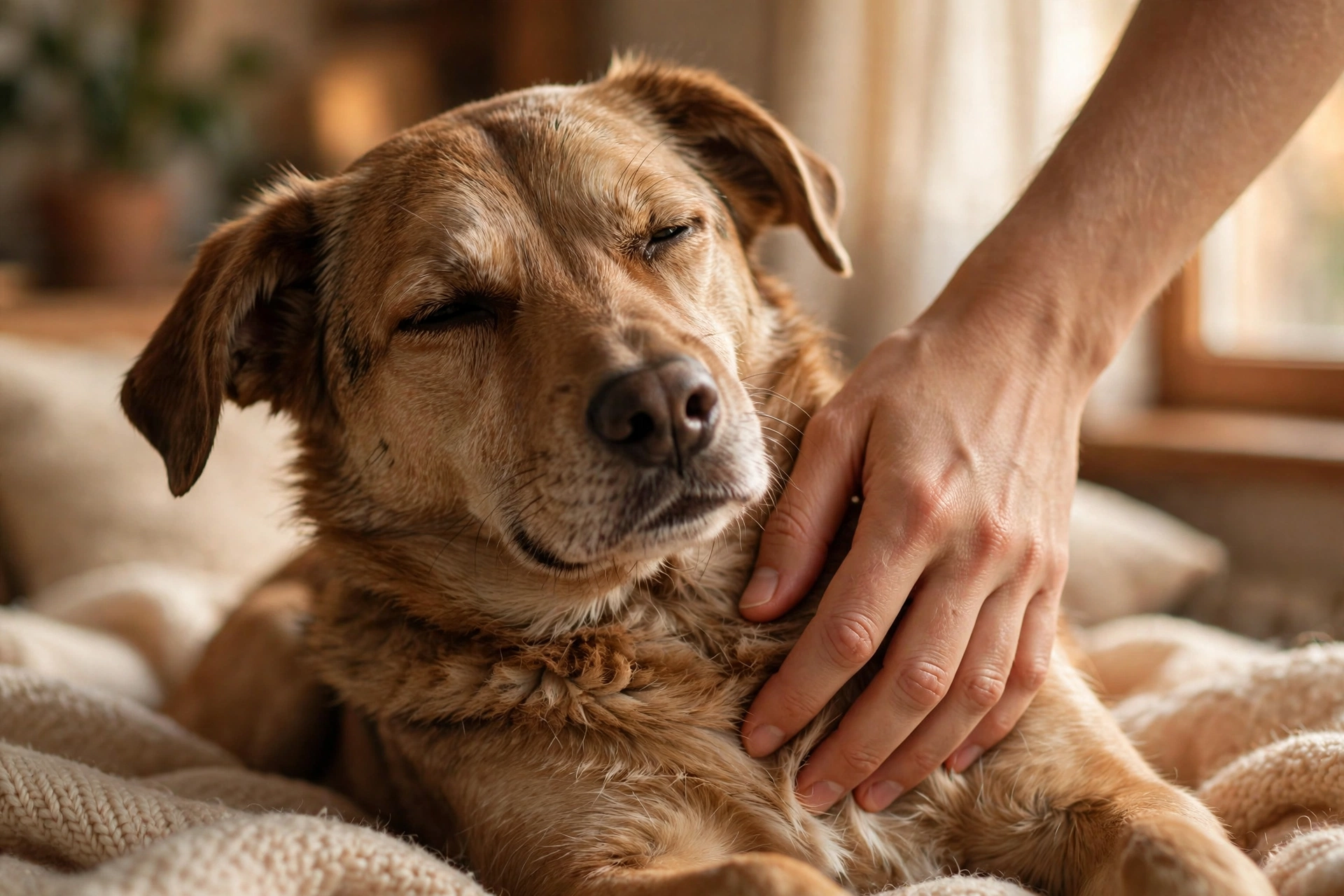

Watch a dog in the middle of a good chest scratch and there is no mystery about whether it feels good. The eyes go soft and half-closed, the whole body leans into your hand like a book sliding off a shelf, and if you stop, a nose appears under your palm to restart the process.
But why do dogs like to be pet at all? It is not just a nice sensation. Stroking triggers real chemical changes in a dog’s brain, it taps into the way puppies are raised from their first day of life, and it acts as a kind of glue between the two of you. It also has limits, and knowing where they are is the difference between a dog who melts and a dog who merely puts up with you.
What actually happens inside a dog when you pet them?
This part has been measured, not just guessed at. In a widely reported 2015 study from Azabu University in Japan, owners spent half an hour interacting with their dogs while researchers tracked a hormone called oxytocin in both species. The pairs who spent the longest gazing at each other and in gentle contact showed the biggest rises — in the dogs and in the people. Oxytocin is the same hormone that floods a mother’s system when she bonds with a newborn, and the researchers described a loop: the dog looks at you, your oxytocin rises, you stroke the dog, and the dog’s rises again. Wolves raised by hand in the same setup showed none of it. That loop looks like something dogs picked up on the road to living with us.
Stroking itself does its own work. Studies that measured dogs during gentle petting sessions have found their oxytocin climbing afterwards, and older research on human-dog interaction found petting can nudge a dog’s heart rate and blood pressure down — the physiology of an animal settling, not just sitting still. And dogs vote with their feet on the question. In a University of Florida experiment, dogs given the choice between a person petting them and a person praising them chose the petting every time, and kept choosing it even when the praise came from their own owner and the petting came from a stranger. Kind words, it turns out, rank somewhere near no interaction at all unless the hands join in.
None of that means every dog is having a chemical party every time a hand lands on them. It means petting a dog who wants to be petted is doing something deeper than filling an idle minute.
Where does it start? In the litter, before their eyes open
A puppy’s first experience of the world is touch. Puppies are born blind and deaf, and for the first two weeks their mother’s tongue is their whole climate: she licks them to clean them, to warm them, to get their digestion working, and her littermates are the warm bodies they pile against to sleep. Being touched, for a newborn puppy, is quite literally what being safe feels like.
That is why the early weeks echo so loudly in an adult dog. Puppies handled gently and briefly by people during their first weeks, and then properly socialized with friendly humans through roughly the first three months, tend to grow into dogs who seek out hands. Puppies who miss that window — raised in a barn, a puppy farm, or just left alone in a yard — can reach adulthood finding touch strange or alarming, through no fault of their own and no lack of niceness in them. When an adult rescue dog flinches from a raised hand, you are often looking at a puppyhood that never taught him hands are safe.
Breed plays a part too. Generations of selection for close companionship have produced dogs who actively orbit their people and solicit contact. Independent working breeds were selected for the opposite skill set, and many of them like you enormously while still preferring to show it from three feet away. Both are normal dogs.
Why do dogs like to be pet in some places more than others?
Ask ten dogs and you will get ten slightly different answers, but the map is more predictable than most owners realize. PetMD’s guide to petting a dog properly, written by a veterinary behaviorist, puts the chest, shoulders, under the chin, and the side of the neck at the top of the list for most dogs — and warns against assuming the top of the head belongs there.
| Usually a hit | Fine for many, read the dog | Often just tolerated, or disliked |
|---|---|---|
| Chest, between the front legs | Along the back, in the direction of the fur | Top of the head (thumping pats especially) |
| Shoulders and the side of the neck | Belly — only when the dog rolls over loosely and stays for it | Hugs: arms wrapped around the neck or body |
| Under the chin | Base of the tail — adored by many, annoying to some | Paws and legs |
| Behind or under the ears, gently | Hindquarters and thighs | The tail itself, and the muzzle |
The head pat deserves its own note because it is the gesture every human reaches for first. A hand coming down over a dog’s eyes blocks his vision and looms over him, and while most family dogs learn to shrug it off from people they trust, plenty never learn to enjoy it. The belly is the other misunderstood one. A dog rolled on his back might be issuing an invitation, or might be showing you his most vulnerable side as a way of saying he is no threat and would like some space. PetMD’s look at why dogs like belly rubs makes the point well: if he stays loose, paws at your hand when you stop, or nudges you, rub away. If the roll came with a tucked tail, flat ears and a tense, closed mouth, that was not a request.
Hugs belong in the same honest category. We hug to show love; dogs do not. An embrace pins a dog in place and takes away his option to leave, which is why the AKC’s guide to hugging dogs flatly notes that most dogs tolerate hugs rather than enjoy them, and why so many of those adorable family photos show a dog with stiff posture and worried eyes while the humans beam. Leaning against you on the couch is a dog’s version of a hug, and it is the one to return.
What is the consent test, and how do you do it?
Here is the single most useful habit you can build, with your own dog and doubly so with anyone else’s. Pet for three to five seconds. Then stop. Take your hand away and just wait.
If the dog leans into the empty space where your hand was, nudges it with his nose, paws gently at your arm, or shuffles closer — that is a yes, in writing. Carry on. If the dog does nothing, turns his head away, shakes off, or gets up and finds something else to do, that is also an answer, and it is no. A dog who walks away after the pause was probably tolerating the last ten seconds rather than enjoying them.
It feels rude the first few times, like interrupting a conversation to ask if it’s still welcome. Then you watch a dog light up at being asked, and start asking for more on purpose, and it stops feeling rude. Consent-based petting turns a one-sided gesture into an actual exchange, and dogs who get a choice tend to choose contact more often, not less — because they have learned it ends the moment they want it to.
Use the test with strangers’ dogs too, after asking the owner, letting the dog approach you and sniff first, and starting at the chest rather than the head. And re-run it every so often in a long session. A yes at minute one is not a lifetime pass.
How can you tell a dog is loving it — or has had enough?
Dogs announce both states clearly. We are just not always listening, partly because the “enough” signals are quiet ones that look like nothing much.
| “More of that, please” | “That’s enough now” |
|---|---|
| Leans his weight into your hand or leg | Moves away, or shifts just out of reach |
| Soft, squinty, half-closed eyes | Lip licking or yawning when not tired |
| Loose, wiggly body; tail sweeping wide | Head turned away, ears pinned back |
| Nudges or paws at your hand when you pause | Whale eye — the whites of the eyes showing |
| A long, sighing breath out | Mouth snaps shut, body goes still and stiff |
| Rolls loosely onto one hip, belly offered | Tucked tail, crouching, trying to look small |
The still one matters most. A dog who freezes under your hand is not a dog who has relaxed into bliss; he is a dog deciding what to do next, and the polite reading is that the interaction is over. Growling, when it comes, is information, not naughtiness — never scold it away, because a dog who has been taught not to warn is a dog who may skip straight to the next step. Lip licking and yawning are the everyday early warnings, and they are easy to spot once someone has pointed them out to you, much like the stress panting covered in our guide to why a dog breathes fast — heavy breathing in a cool, resting dog is another quiet “I’m not comfortable” that owners often miss.
Why are some dogs simply not cuddlers?
Every so often an owner confides, slightly guiltily, that their dog just does not like being petted much, as if love had been measured and found short. It says nothing about the bond. Some dogs are touch-sensitive the way some people are ticklish or hate having their hair touched — it is wiring, not rejection.
The usual reasons are a mix of temperament and history. An independent breed doing its own thing in the same room as you. A rescue whose early weeks had no kind hands in them. A dog who was handled roughly, or grabbed at by a stream of visitors as a puppy, and decided hands were unpredictable. And sometimes the reason is physical and fixable: sore ears, arthritic hips, a bad tooth, itchy inflamed skin. A dog who suddenly goes off being touched in a place he used to enjoy has told you something worth checking, and a home once-over like the one in our guide on how to tell if a dog has a fever plus a vet visit is the right response, in that order.
For the genuinely not-cuddly dog, affection just changes shape. Play is the love language of a great many of them — a thrown ball, a tug game, a walk where you actually pay attention to each other. Training with rewards, sniffy decompression walks, and simply being allowed to choose your company without being grabbed at build as strong a bond as any sofa cuddle. Let them come to you, and one day many of them do, on their own terms, which makes it worth more.
Conclusion
Dogs like to be pet because touch is wired into them from their first blind days in the litter, because it settles their heart rate and stirs up the same bonding chemistry that glues a mother to her baby, and because — in the plainest finding of all — when researchers gave them the choice, dogs picked petting over praise every single time.
But the word doing the work in that sentence is like. Petting delights a dog when it lands in the places he enjoys, at the pace he enjoys, and for exactly as long as he enjoys it. Learn your dog’s map, run the three-second consent test, and watch the quiet signals, and you will end up with more of those leaning-in, half-closed-eyes moments, not fewer. Which is, after all, what both of you were after.
Frequently asked questions
Do dogs like being pet while they are sleeping?
Best not to. A dog woken by a hand landing on him can startle and snap before he is even properly awake — the old “let sleeping dogs lie” warning comes from somewhere real. Plenty of dogs also simply sleep better untouched. If your dog chooses to fall asleep against your leg and stir happily when you shift, that’s his invitation, not a general rule. For any dog you don’t know well, and for children with any dog at all, sleeping dogs are off limits.
Why does my dog paw at me the moment I stop petting him?
Because it works. Pawing, nose-nudging and the chin dropped pointedly onto your knee are learned requests: he tried them once, the hand came back, and the lesson stuck. It is genuine communication, and there is no harm in saying yes. If it gets relentless, the kind fix is to give the pawing no payoff and instead invite him to settle beside you, then pet on your schedule for a bit — he learns that calm, not tapping, is what restarts the good stuff.
Do dogs prefer petting to treats?
Different currencies. In studies, petting clearly beat verbal praise — dogs would leave a praising owner to stand with a petting stranger. Food is a separate and powerful motivator, and most dogs would not rank a chest scratch above a piece of chicken in a training session. Where petting wins is in everyday life: it costs nothing, needs no preparation, and never fills the dog up. The honest summary is that praise alone is cheap change, touch is real money, and treats are the bonus round.
Why does my dog lean on me when I pet him?
Leaning is one of the clearest compliments in dog body language. He is putting his weight — his trust — into you, staying close on purpose, and usually asking for the contact to continue. Some dogs lean when they are anxious and looking for reassurance, and the rest of the picture tells you which it is: a soft, wiggly lean is affection, while a tense lean with ears back and a tucked tail is a dog asking for help. Either way, he’s come to the right place.
Can you pet a dog too much?
You can certainly pet a dog past the point he is enjoying it, even a dog who adores you. Marathon sessions, rough handling, face-smooshing, and hands that never pause will wear out most dogs’ patience, and puppies can tip over into overexcited mouthing if the fuss goes on too long. Short sessions with pauses built in, watching for the “enough” signals, and stopping while it’s still good — that rhythm keeps petting something your dog asks for instead of something he endures.
Related Articles