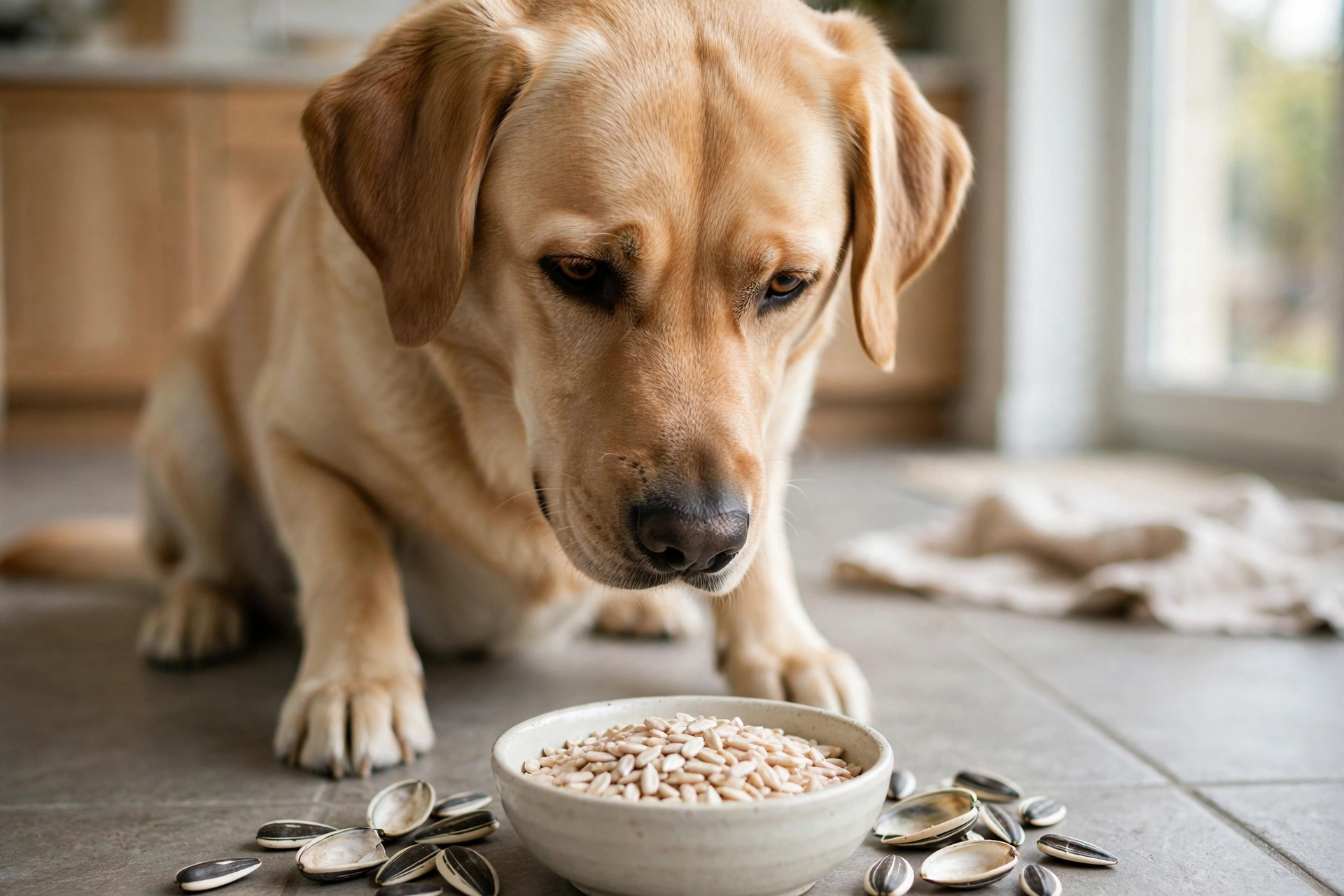

You’re on the couch with a bag of sunflower seeds, cracking them one-handed like a pro, and your dog is watching every single shell hit the bowl. The question writes itself: can dogs have sunflower seeds too?
Yes — but not the way you’re eating them. Dogs can have sunflower seeds when the kernels are shelled, plain and unsalted, served in small amounts as an occasional treat. The seed itself is genuinely nutritious. The problems all live in the packaging around it: the hard shell, the salt, the flavorings and the fat. Get those four things right and you’ve got a safe little snack. Get them wrong and you’ve got a stomachache at best.
Here’s the full picture: why the shell has to come off, why your ballpark snack bag is off the menu, how much your dog can actually have, and one garden trap almost nobody thinks about.
Can dogs have sunflower seeds? The short answer
The kernel — the soft, pale seed inside the striped shell — is not toxic to dogs, and both the American Kennel Club and PetMD treat plain, unshelled kernels as a safe occasional treat for healthy adult dogs. Raw or lightly toasted is fine, so long as there’s no salt, no seasoning and no oil-roasting involved.
Three conditions, and they are not optional:
- Shelled. Never serve seeds in the shell.
- Plain. No salt, no flavors, no sugar coatings, no spicy anything.
- Small amounts. A few kernels as a treat, counted against the day’s food — never a free-pour into the bowl.
Meet those three, and sunflower seeds are one of the more nutritious human snacks you can share. Miss any of them and the risk profile changes fast, starting with the shell.
Why do the shells have to come off?
Dogs don’t crack shells the way you do. You work the shell with your teeth, eat the kernel and spit the husk out. A dog crunches the whole thing and swallows the lot, sharp pieces and all.
Sunflower shells are tough, fibrous husks that a dog’s digestive system basically cannot break down. The AKC is blunt about what happens next: swallowed shell pieces can irritate the stomach and intestines, cause belly pain, vomiting and diarrhea — and in the worst case they can bunch up and obstruct the digestive tract. A blockage is not a wait-and-see problem; it can mean emergency surgery. The hard edges are also a straightforward choking hazard, particularly for small dogs who gulp first and chew later.
Signs that shells are causing real trouble include:
- Repeated vomiting, or retching without bringing anything up
- Refusing food they would normally inhale
- A hunched, painful-looking belly or whining when it’s touched
- Lethargy that’s out of character
- Straining to pass stool, or nothing coming out at all
If your dog has hoovered up a pile of shells and you see several of those signs together, that’s a vet call the same day. Vomiting on its own has plenty of causes — our article on why dogs throw up yellow explains how to read what comes up — but vomiting plus a known shell binge is a combination to take seriously.
Why are salted, flavored and roasted seeds off the menu?
Open a typical snack bag of sunflower seeds and the kernels inside have been soaked in brine, roasted in oil, and in the flavored versions coated with seasonings. Every part of that processing is aimed at human taste buds, and every part of it is a problem for a dog.
Salt is the big one. Dogs need far less sodium than we do, and the salt load in packaged seeds can cause real harm — the AKC warns it can lead to salt toxicosis, with signs like muscle tremors, weakness and gastroenteritis. A stolen seed or two won’t do it, but a dog that gets into the bag and works through a serious quantity of salted seeds is in genuine trouble, and that’s a vet call, not a shrug.
Oil roasting piles on fat. The kernels are already rich. Roasting them in more oil pushes a fatty treat into greasy territory, and greasy food is the fast lane to an upset stomach.
Flavorings are a mixed bag of no. Ranch, dill pickle, barbecue, “crackin’ pepper” — these coatings can include onion and garlic powders, both toxic to dogs, along with spices that will wreck a dog’s digestion even when they’re technically safe. There’s no upside in decoding a seasoning label for a handful of seeds. Just don’t share the bag.
What are the benefits of sunflower seeds for dogs?
Strip away the shell and the salt and the kernel itself earns its place. For something so small, it carries a lot:
| Nutrient in sunflower kernels | What it does for your dog |
|---|---|
| Vitamin E | Antioxidant that supports the immune system, skin and cell health — one ounce of kernels covers a dog’s daily vitamin E requirement |
| Healthy fats (linoleic acid) | Linked in studies to better skin condition and a shinier coat |
| Selenium | A trace mineral that works alongside vitamin E as an antioxidant |
| B vitamins (B1, B3, B6) | Support energy metabolism and the nervous system |
| Magnesium, copper and manganese | Everyday mineral support for bones, blood and enzymes |
| Protein and fiber | A quarter cup of kernels has about 5.5 g of protein and 3 g of fiber |
That quarter-cup figure cuts both ways, though. The same quarter cup carries roughly 163 calories and 14 grams of fat. For a big dog, that’s a treat. For a ten-pound dog whose whole day runs on a few hundred calories, a careless handful of kernels can be a fifth of everything he eats. Small seed, serious calories — which brings us to portions.
How many sunflower seeds can a dog have?
Two yardsticks work well together. PetMD’s serving guidelines for healthy adult dogs, given two to three times a week, look like this:
| Dog size | Shelled, unsalted kernels per serving |
|---|---|
| Extra-small (2–10 lb) | ½ teaspoon |
| Small (11–20 lb) | 1 teaspoon |
| Medium (21–50 lb) | 2 teaspoons |
| Large (51–90 lb) | 1 tablespoon |
| Extra-large (91 lb and up) | 2 tablespoons |
The AKC counts it in individual seeds instead: roughly 10 to 20 kernels a week for a small dog, and 20 to 40 a week for a large one. Either way you measure it, the answer is “a sprinkle, not a serving.”
Keep the 10 percent rule in the back of your mind as well: all treats combined — kernels, biscuits, the bit of cheese from your sandwich — should stay under a tenth of your dog’s daily calories. Sunflower seeds are so calorie-dense that they eat into that budget faster than almost any other treat in the cupboard.
Start with two or three kernels the first time, not the full portion. A dog whose stomach handles them fine will show you nothing at all, and that’s exactly what you want to see. Loose stool the next day means the portion was too generous or the food is too rich for that particular dog, and our guide on what to give a dog for diarrhea will help you settle things down while you cut seeds from the menu for a while.
Which dogs should skip sunflower seeds altogether?
For some dogs the sensible portion is zero:
- Dogs prone to pancreatitis. This is the firmest rule on the page. Fat is the trigger, sunflower kernels are about half fat, and the AKC advises avoiding them completely for these dogs. A flare-up means vomiting, lethargy and a dog in real pain.
- Overweight dogs. When every calorie is being counted on purpose, spending the treat budget on something this dense makes the whole plan harder.
- Dogs with sensitive stomachs. Rich, fatty extras are usually the first thing to set them off.
- Dogs on prescription or low-fat diets. Don’t freelance around a diet your vet built for a reason — ask first.
- Tiny puppies. Not a toxicity issue, but immature digestion plus a choking-sized snack is a poor combination. Wait until they’re older and stick to puppy treats meanwhile.
Watch out for the birdseed trap
Here’s the sunflower risk that never appears on a treat label. If you keep a bird feeder, the ground underneath it is a buffet of dropped seeds — and your dog has almost certainly noticed.
Seed that’s been sitting on damp ground goes stale and can grow mold, and moldy seed can carry mycotoxins that damage the liver. The spillage is also mostly shells, the exact part you don’t want your dog eating, mixed in with bird droppings and whatever else has landed there. Some fruit-and-nut bird blends even contain raisins, which are toxic to dogs in their own right.
None of this means giving up the feeder. It means fencing off or regularly sweeping up the drop zone, and calling your dog away when he starts grazing under it like it’s a snack bar. Fresh kernels from a sealed bag in your kitchen are a treat. Whatever’s fermenting under the feeder is not.
How do you serve sunflower seeds to a dog?
Once you’ve got plain shelled kernels, you’ve got options:
- As a tiny hand-fed treat. A few kernels during training or as a random good-boy bonus. Hand-feeding makes portion control automatic.
- Sprinkled over dinner. A pinch over the regular bowl turns an ordinary Tuesday meal into an event, as far as your dog is concerned.
- Lightly ground first. Crushing the kernels makes them easier to digest and is a smart move for small dogs. A quick bash in a mortar or a zip bag with a rolling pin does it.
- As sunflower seed butter. Plain sunflower butter works like peanut butter in a stuffable toy — but read the label twice. It must have no xylitol (also listed as birch sugar), no added salt and no sugar. Xylitol is extremely toxic to dogs, and it hides in “healthy” spreads more often than you’d think.
Store kernels in a sealed container somewhere cool. The same fats that make them nutritious also go rancid, and rancid seeds smell off and taste worse — if the bag smells like old paint, it goes in the trash, not the dog.
Conclusion
Can dogs have sunflower seeds? Yes — the kernels are safe, nutritious and most dogs love them, provided you do the three things that matter: take the shells off, keep them plain and unsalted, and serve a few kernels rather than a bowlful.
Your own snack bag fails all three tests at once, and the pile under the bird feeder fails a few more besides. Buy a small bag of plain shelled kernels just for the dog, keep the portions at the teaspoon end of the scale, and sunflower seeds settle in as exactly what they should be — an occasional treat with real nutritional value, not a mealtime event.
Frequently asked questions
Can dogs eat sunflower seeds with the shell on?
No, and this is the single most common mistake with this treat. The shells can’t be digested, so they scrape and irritate the gut on the way through, and they can choke a dog or bunch into a blockage — a particular risk in small dogs. One or two stray shells usually pass without drama, but seeds should only ever be served with the shell already off.
Can dogs have sunflower butter?
Yes, in spoonfuls, with the same label discipline you’d use for peanut butter. Plain sunflower butter with no xylitol, no added salt and no sugar is a fine stuffing for a chew toy or a lick mat. It’s just as fatty as the kernels it came from, though, so a spoonful once in a while is the right scale — and dogs prone to pancreatitis should skip it just like the seeds.
Are sunflower plants poisonous to dogs?
No. The sunflower plant itself isn’t toxic to dogs, so a dog that nibbles petals or leaves from the garden is unlikely to come to harm beyond a possible mild stomach upset from eating a lot of any plant material. The seeds are where your attention belongs — and specifically how they’re served.
What happens if a dog eats a whole bag of salted sunflower seeds?
Treat it as a vet call, not a wait-and-see. Between the salt and the shells, a whole snack bag is a legitimate problem: watch for excessive thirst and urination, vomiting, diarrhea, weakness, wobbliness or tremors, and a painful or swollen belly. Call your vet or an emergency clinic, tell them roughly how much of the bag is gone and whether the seeds were in shells, and follow their lead from there.
Can puppies have sunflower seeds?
Older puppies can have a kernel or two, plain and shelled, but there’s little reason to bother. Puppy stomachs are easily upset by rich new foods, whole kernels are a lot for a small mouth, and a growing puppy needs its calorie budget spent on actual puppy food. If you do offer them, grind the kernels, keep it to a taste, and stop at the first sign of loose stool.
Related Articles