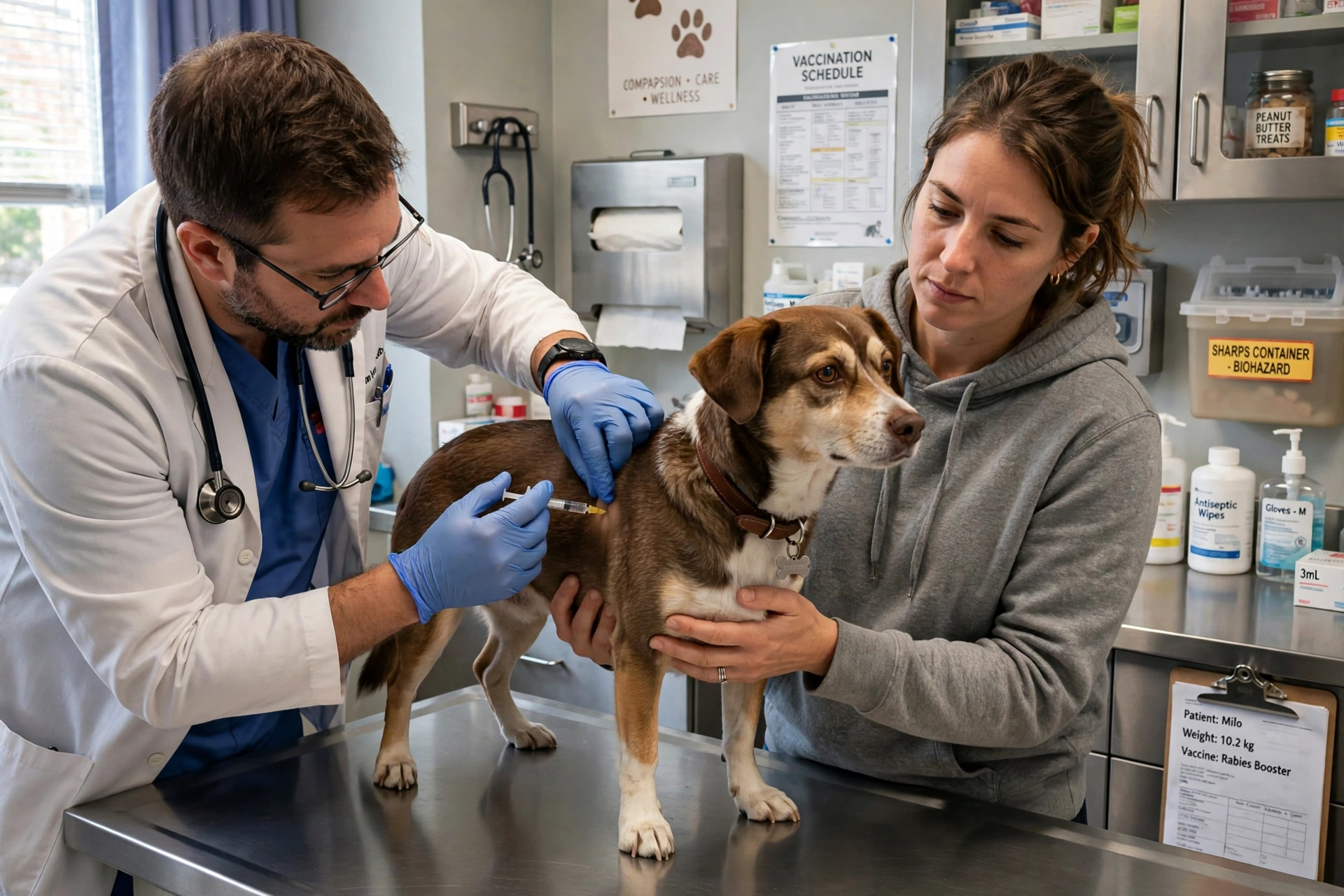

Open any puppy’s vaccination record and you’ll find the same four letters stamped again and again: DHPP. It looks like alphabet soup, so what is DHPP vaccine for dogs, exactly? It’s a single combination injection that protects your dog against four diseases at once: distemper, hepatitis, parainfluenza and parvovirus. Vets count it as a core vaccine, which is their way of saying every dog needs it, not just dogs with risky lifestyles. Puppies get it as a series of shots in their first few months, and adult dogs get boosters to keep the protection topped up.
Here’s what each letter stands for, what those four diseases actually do, when the shots happen, and what to expect afterward.
What does DHPP stand for?
Each letter is the initial of one disease the vaccine covers:
| Letter | Disease | Caused by |
|---|---|---|
| D | Distemper | Canine distemper virus |
| H | Hepatitis | Canine adenovirus (infectious canine hepatitis) |
| P | Parainfluenza | Canine parainfluenza virus |
| P | Parvovirus | Canine parvovirus |
One small wrinkle worth knowing, because it confuses a lot of owners: the “H” part of the shot doesn’t contain the hepatitis virus itself. Infectious canine hepatitis is caused by canine adenovirus type 1, and the vaccine actually uses its close cousin, adenovirus type 2, because it protects against both viruses with fewer reactions. That’s why the same vaccine is often labeled DA2PP instead, which is the next thing most owners ask about.
Is DHPP the same vaccine as DA2PP and DAPP?
Yes. DHPP, DAPP and DA2PP are different labels for the same four-way core vaccine. Clinics and vaccine manufacturers don’t all print the name the same way, so your dog’s records might show any of the three across different visits. The AAHA’s vaccination guidelines use the DA2PP spelling, while plenty of clinics still write DHPP out of habit.
You may also spot extra letters on some records. DA2PPL or DHLPP means leptospirosis has been added to the mix, DA2PPC adds canine coronavirus, and a “5-way” or “7-way” vaccine at a farm store is usually this same core shot with one or more extras bundled in. The four diseases in this article are always the core of it.
What diseases does the DHPP vaccine protect against?
These four aren’t on the core list by accident. Each one is contagious, each one can kill, and none of them has a cure once a dog is sick. Treatment is supportive care and hope, which is exactly why vets would rather prevent them.
Distemper. A virus related to human measles that attacks the airways, the gut and then the nervous system. It spreads through the air and on shared bowls and bedding. Dogs develop fever, runny eyes and nose, coughing, vomiting and diarrhea, and in bad cases seizures, twitching and paralysis. Many dogs don’t survive it, and some survivors keep permanent nerve damage.
Hepatitis (infectious canine hepatitis). Caused by canine adenovirus type 1, this one targets the liver, kidneys, spleen, lungs and eyes. Mild cases look like a fever and a dog who’s off his food. Severe cases bring vomiting, jaundice and belly pain, and they can kill a young puppy quickly. Dogs that recover sometimes keep a cloudy blue patch on the eye for a while, which owners often spot and worry about.
Parainfluenza. The mildest of the four, but very catching. This respiratory virus is one of the usual ingredients in kennel cough, the harsh, honking cough that races through boarding kennels and daycare. On its own it rarely kills a healthy adult dog, but it opens the door to worse chest infections and hits puppies and old dogs harder.
Parvovirus. The one every puppy owner has heard horror stories about, and the stories are fair. Parvo attacks the gut lining and the immune system at the same time. It causes loss of appetite, fever, vomiting and severe, often bloody diarrhea, and the dehydration that follows can kill a puppy within 48 to 72 hours. Unvaccinated dogs and puppies under four months old are at the highest risk, and the virus itself is tough: it survives in soil, on floors and on shoes for months.
What is the DHPP puppy vaccine schedule?
Puppies aren’t born with their own working defenses. They borrow antibodies from their mother’s first milk, and those borrowed antibodies fade somewhere over the first two to three months of life. The catch is that while mom’s antibodies are still circulating, they block vaccines from working properly, and nobody can test exactly when a particular puppy’s coverage runs out. So vets repeat the shot every few weeks to make sure at least one dose lands in the window after the borrowed protection fades but before real germs find the puppy.
The standard schedule from the American Kennel Club looks like this:
| Puppy’s age | What’s given |
|---|---|
| 6–8 weeks | First distemper/parvo shot (start of the DHPP series) |
| 10–12 weeks | DHPP booster |
| 16–18 weeks | DHPP booster, plus the rabies shot |
| 12–16 months | DHPP booster and rabies booster |
In plain terms, that’s at least three DHPP doses, spaced about 3 to 4 weeks apart, starting at 6 to 8 weeks and finishing at or after 16 weeks, which matches the schedule VCA Animal Hospitals publishes for its clinics. High-risk puppies, for example those in shelters or in areas with a parvo outbreak, may get an extra dose or start slightly earlier. Your vet adjusts the exact dates, so don’t panic if your puppy’s card shows 8, 12 and 16 weeks instead. The pattern matters more than the precise week.
Two more practical points. First, protection isn’t instant: it takes roughly 10 to 14 days after a shot for a decent level of immunity to build, so a puppy who got vaccinated yesterday isn’t fully covered today. Second, until the series is finished, carry your puppy in busy public places rather than letting him walk where unknown dogs have been, and skip the dog park. Socialization still matters at this age, but do it in clean gardens with dogs you know are vaccinated.
How often do adult dogs need a DHPP booster?
Once the puppy series and the one-year booster are done, most adult dogs only need DHPP every 1 to 3 years. VCA notes that adults who completed the full puppy series are generally revaccinated within that one-to-three-year window based on a lifestyle risk assessment, and many clinics have settled on every 3 years for the distemper and parvo components in a healthy, low-risk adult.
What if your dog’s booster lapses? A few weeks or months late usually isn’t a disaster. Call the clinic, and in most cases they’ll simply give the booster rather than restarting the whole series. Long gaps, or adopting an adult dog with no records at all, are different: vets often give two doses a few weeks apart to rebuild protection properly. And keep the vaccination certificate somewhere findable. Boarding kennels, groomers, training classes and some landlords ask for it, and “he had it done sometime last spring” doesn’t cut it.
Is DHPP a core vaccine? And what about rabies, lepto and the rest?
DHPP is core, full stop. Core vaccines are the ones recommended for every dog because the diseases are widespread, severe, or both. Rabies is also core, but it is not inside the DHPP shot. It’s a separate injection, usually given once at 12 to 16 weeks, and it’s required by law in most of the United States, with boosters every 1 to 3 years depending on your state. Owners mix these two up constantly, so check the record for both.
Everything else is matched to the individual dog:
| Vaccine | Core or lifestyle? | Who usually needs it |
|---|---|---|
| DHPP (distemper, hepatitis, parainfluenza, parvo) | Core | Every dog |
| Rabies | Core, and legally required in most states | Every dog, on a separate shot |
| Leptospirosis | Recommended for most dogs in current AAHA guidance | Dogs who swim, hike, or meet wildlife or farm animals; spread through water and urine |
| Bordetella (kennel cough) | Lifestyle | Boarding, daycare, grooming and training classes often require it |
| Lyme disease | Lifestyle | Dogs in tick-heavy regions who spend time in woods and long grass |
| Canine influenza | Lifestyle | Social dogs in areas with active outbreaks |
Leptospirosis sits in a gray zone that confuses people. It used to be treated as optional, but newer guidance recommends it for nearly all dogs because cases are rising and it can pass to people. It needs two starter doses a few weeks apart, then a yearly booster, and it’s sometimes rolled into the DHPP appointment as DA2PPL. If your vet suggests it, that’s the reasoning.
What side effects can the DHPP vaccine cause?
Most dogs are slightly off for a day and then completely themselves again. The usual mild reactions are:
- Sleepiness and less interest in playing for 24 to 48 hours
- Eating a bit less than usual
- A mild fever (our guide on how to tell if a dog has a fever shows you how to check properly)
- Soreness or a small, soft lump where the needle went in
That lump is common with some vaccine types and usually shrinks away over a few weeks. If it hurts, keeps growing, or is still there after about three weeks, have the clinic take a look.
True allergic reactions are rare, but they’re the reason many clinics ask you to wait nearby for a short while after a puppy’s first shots. Reactions typically show up within minutes to a few hours:
| Sign | What to do |
|---|---|
| Swollen face, muzzle or eyelids; hives; intense itching | Call your vet right away, even if your dog seems okay otherwise |
| Repeated vomiting or diarrhea | Call your vet the same day |
| Trouble breathing, collapse, pale gums | Emergency vet, immediately |
This is also why vets ask about past reactions before vaccinating. A dog who has reacted before may get an antihistamine beforehand or have vaccines split across visits, and vets sometimes reach for antihistamines such as the ones covered in our guide to giving a dog Benadryl when a mild reaction does happen. Never pre-dose your dog on your own, though. Tell the clinic what happened last time and let them plan it.
Can a titer test replace the DHPP booster?
Sometimes, and it’s a fair question to raise with your vet. A titer test is a blood test that measures the antibodies still circulating from earlier vaccinations. If the levels for distemper, parvo and adenovirus come back protective, many vets are comfortable skipping that round’s booster and re-testing in a few years instead. It can be a sensible option for older dogs, dogs with immune problems, and dogs who have had a vaccine reaction in the past.
The limits matter, though:
- Rabies is the exception. As the AKC points out, a titer is not an option for rabies. The law wants a vaccination certificate, not a blood result, no matter how good the numbers look.
- Titers don’t work well for the short-lived vaccines. Bordetella, lepto and flu protection fades fast and isn’t measured meaningfully by these tests.
- A low titer isn’t proof of zero protection. Immune memory cells can still respond to the real virus even when circulating antibodies look low, so results aren’t a simple pass or fail.
- It usually costs more than the booster. Weigh the blood test fee against the shot itself before assuming it’s the cheaper road.
Conclusion
So, what is DHPP vaccine for dogs? It’s the four-in-one core shot that stands between your dog and distemper, hepatitis, parainfluenza and parvovirus, four diseases that are common, miserable and largely untreatable once caught. Puppies need a series of doses through about 16 to 18 weeks because their mothers’ antibodies block early shots, adults need a booster at one year and then every one to three years, and rabies is always a separate, legally required injection on top.
If you’re not sure where your dog stands, dig out the vaccination record or ask your clinic to check. A ten-minute phone call beats guessing, and it beats a parvo bill by a very long way.
Frequently asked questions
Is DHPP the same as the 5-way vaccine?
Pretty much, yes. The “5-way” sold at farm and pet stores is the same four core diseases, distemper, hepatitis, parainfluenza and parvo, plus one extra, which varies by brand. Vet records may call any of them DHPP, DAPP or DA2PP. What matters is that the four core diseases are covered and the vaccine was stored and given properly, which is one reason clinic-given shots come with an exam attached.
Does the DHPP vaccine include rabies?
No. Rabies is always a separate injection with its own certificate, because it’s tracked by law. Puppies usually get their first rabies shot at 12 to 16 weeks, around the same appointment block as the later DHPP boosters, which is why owners assume they’re one thing. Check your paperwork for both: DHPP on its schedule, rabies on its.
How much does the DHPP vaccine cost?
Prices vary a lot by city and clinic. The AKC puts the full core series for a puppy at roughly $75 to $100 total across the three visits, with rabies usually another $15 to $20, and shelters and low-cost clinics often charge less. Adult boosters every few years cost less than the puppy year. Ask your clinic what’s included, since some bundle the exam in and some don’t.
Can the DHPP vaccine make my dog sick?
It can’t give your dog distemper or parvo. The vaccine contains killed or weakened organisms that train the immune system without causing the disease. What it can do is make a dog sleepy, sore and a little off his food for a day or two, which is the immune system doing its homework. Serious allergic reactions exist but are rare, and they’re the reason to mention any past reaction before the needle comes out.
Does a dog who stays indoors still need DHPP?
Yes. Parvovirus survives for months in soil and on surfaces and happily rides home on your shoes. Distemper spreads through the air and from wildlife like raccoons and skunks that wander through yards at night. An indoor dog with a garden and the occasional visitor is exposed plenty, and puppies and seniors, the very dogs least able to fight these diseases, are the ones who suffer most when protection lapses.
Related Articles