
It usually happens late at night. You glance over at your dog, expecting the usual curled-up snoring, and instead get a half-open, glassy stare from an animal who is clearly fast asleep. He doesn’t blink. He doesn’t react. For about three seconds, it’s genuinely unsettling.
So, do dogs sleep with their eyes open? Yes, plenty of them do, and in most cases it’s completely normal. Dogs have a built-in protective layer called the third eyelid that slides across the eye during sleep, which means an eye can look wide open while actually being covered and safe. Add in dream-filled REM sleep, where eyes move and lids drift apart, and the zombie stare turns out to be standard dog equipment.
Here’s what’s really going on behind those half-open eyes, how to tell a dreaming dog from one having a seizure, and the small set of signs that do deserve a vet visit.
Do dogs sleep with their eyes open? What’s actually happening
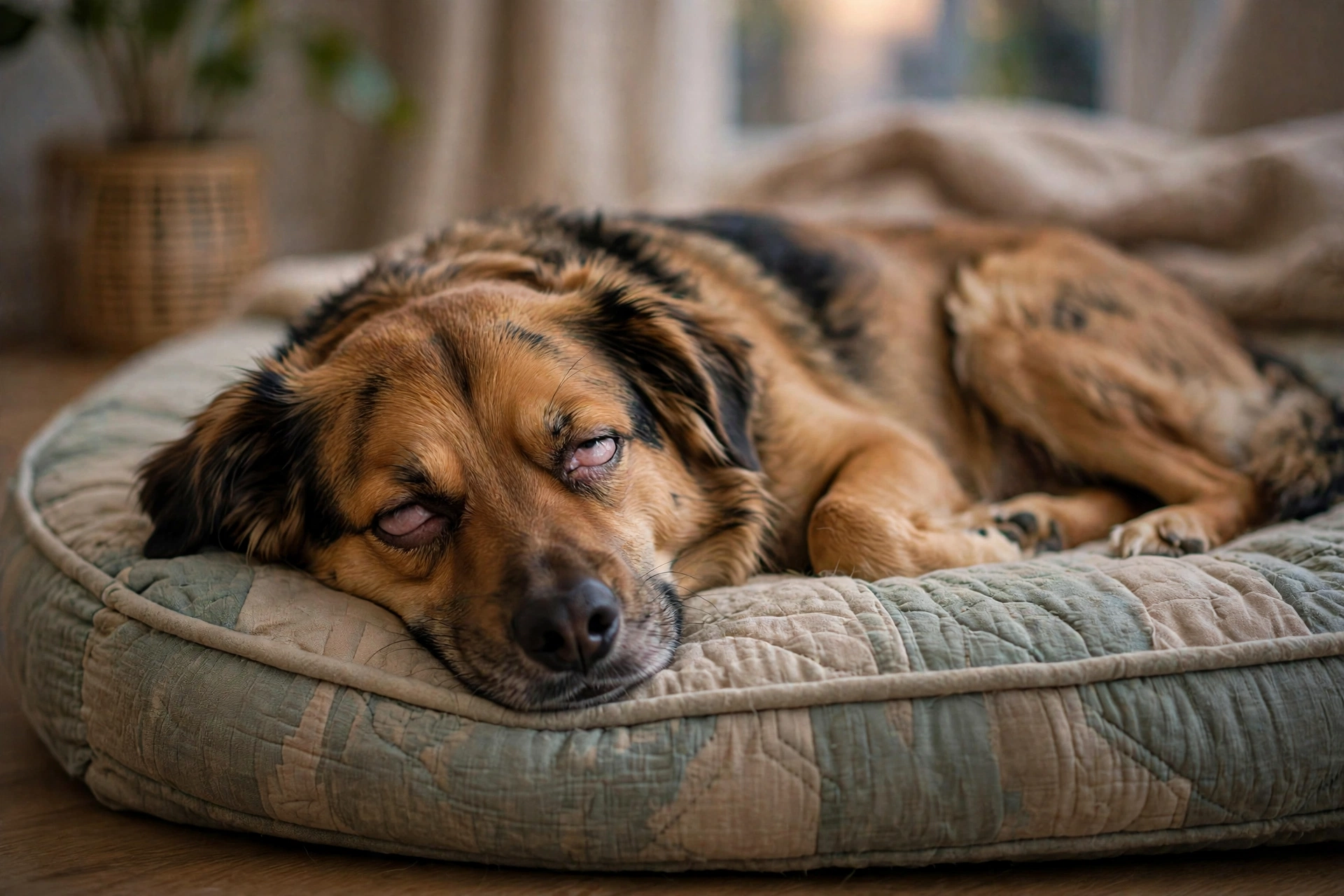
Most of the time, a sleeping dog’s eyes aren’t truly open and exposed. They’re half open at most, with the lids relaxed partway and a pale, filmy layer visible across the eye. That layer is the third eyelid doing its job.
When a dog falls asleep, the muscles that hold the eyeball forward and the lids shut relax. The eyeball settles slightly back, the regular lids drift partway down, and the third eyelid slides across from the inner corner to cover what’s left. From your angle on the sofa, you see an open-looking eye with a whitish-pink film over it. From the dog’s point of view, everything is covered, moist and dark, and he is out cold.
Some dogs do it every single nap. Others only in the deepest sleep, or in certain positions, sprawled on their backs with their faces stretched in ways that pull the lids apart. Puppies and seniors often seem to do it more, partly because they sleep hard and twitch more in their dreams. It’s a habit worth knowing about precisely because it looks so wrong the first time you catch it.
What is the third eyelid, and what does it do?
Every dog has one. The third eyelid, properly called the nictitating membrane, is a thin, pale sheet of tissue that lives tucked into the inner corner of the eye, nearest the nose. Most of the time you’d never know it’s there.
It works like a windscreen wiper with a built-in sponge. When it sweeps across the eye it spreads tears over the surface, clears away dust and debris, and shields the eyeball underneath. It even contains a gland that produces a good share of the eye’s tears, so it’s part of the plumbing as well as the protection. PetMD describes it rising from the corner of the eye, often with a pinkish tint, and in a relaxed or sleeping dog it can cover a large part of the eye without anything being wrong at all.
Dogs aren’t unusual in having one. Cats have third eyelids too, and so do many other animals. Humans are the odd ones out; all we kept is the tiny pink fold in the corner of the eye, a leftover of the same structure.
The useful rule for owners is timing. A third eyelid that’s visible during sleep and vanishes the moment the dog wakes is normal. A third eyelid that’s still up an hour after waking, on one side only, or paired with redness or discharge is the eye asking for attention, and there’s a section on that below.
Why do dogs’ eyes drift open during dreams?
The other half of the story is REM sleep, the stage where dreaming happens. Dogs cycle through sleep stages much like we do, drifting from light dozing into deeper sleep and then into REM, where the brain lights up and dreams roll. The American Kennel Club notes that dogs reach REM after roughly ten minutes of settling, and spend only about a tenth of their total sleep there, far less than our share. Because they dip in and out of it so often, you get plenty of chances to watch it.
REM is named for the rapid eye movements happening under the lids, and in dogs the whole production can be visible:
- Eyes rolling or flicking beneath lids that have drifted partway open
- Little paddling or running motions in the paws and legs
- Twitching in the face, ears and whiskers
- Soft barks, whines, growls or whimpers, sometimes through closed lips
- Breathing that speeds up, slows down or goes briefly irregular
That last one worries owners, and it’s worth separating sleep breathing from waking breathing. A dreaming dog’s breathing can flutter all over the place for a minute and then settle, and that’s normal. Breathing that’s fast while your dog is awake and resting is a different matter, and our guide to why your dog is breathing fast covers which patterns need checking the same day.
Through all of this, a dreaming dog is relaxed. His body stays loose and floppy, his eyes look soft and half-lidded rather than wide and staring, and if you say his name, he wakes. Keep those details in mind, because they’re exactly what separates a dream from the thing owners fear it might be.
Is it a dream or a seizure? How to tell the difference
This is the question underneath almost every late-night search on this topic, and it’s a fair one. Dogs can have seizures in their sleep, and a full-blown dream can look dramatic. Vets draw the line in consistent places, and PetMD’s guide to sleep twitching lays out the contrast clearly:
| A dreaming dog | A dog having a seizure | |
|---|---|---|
| Body | Loose, soft and relaxed | Stiff and rigid, sometimes trembling hard |
| Legs | Gentle paddling, twitches that come and go | Stiff paddling or locked straight, more violent |
| Eyes | Half open, soft, may roll or flicker | Wide open, staring, not reacting to anything |
| Waking up | Wakes easily to your voice or a gentle noise | Cannot be woken or roused during the episode |
| Breathing | Varies, may flutter, then settles | Often labored or strained |
| Other signs | Maybe soft noises, nothing else | Drooling or foaming, chomping, possible loss of bladder or bowel control |
| Afterwards | Wakes normally, maybe a bit sleepy | Often confused, wobbly, clingy, drooling or panting for a while |
The single most useful test is the wake-up test. Call your dog’s name in a normal voice, not a shout. A dreaming dog surfaces, blinks, looks at you, and usually sighs and goes straight back to sleep. A dog mid-seizure doesn’t respond, and that’s your answer.
If you ever do watch something that looks like a seizure, don’t put your hands near the dog’s mouth, don’t try to hold him down, and don’t try to wake him by shaking. Move anything hard or sharp out of reach, keep other pets and kids back, and if you can do it safely, film it. A thirty-second video, plus a note of how long the episode lasted, is the most valuable thing you can hand a vet. Anything lasting more than a couple of minutes, or repeating within a day, is an emergency rather than a wait-and-see.
Which dogs are most likely to sleep with their eyes open?
Any dog can do it, but some are built for it. The standout group is the short-faced, big-eyed breeds: Pugs, Boston Terriers, Shih Tzus, Cavalier King Charles Spaniels, French Bulldogs and similar round-eyed dogs. Their eye sockets are shallow and their eyeballs sit further forward, and in some of them the eyelids simply aren’t large enough to meet in the middle. Vets call an incomplete blink or closure lagophthalmos, and a dog with it sleeps with a visible slit of eye showing every night, because closing fully isn’t physically on offer.
You may also notice it more in:
- Deep sleepers and sprawlers, whose facial muscles fully switch off and whose sleeping positions stretch the skin around the eyes
- Puppies, who spend huge amounts of time in dream-heavy sleep and twitch their way through it
- Senior dogs, who sleep more, dream vividly, and sometimes have slightly looser eyelids than they did in their prime
- Dogs sleeping in an odd position, chin propped on a bed edge or face squashed into cushions, where the pose itself holds a lid partway up
For the flat-faced breeds especially, sleeping half-open is a lifelong trait rather than a new symptom. What matters is change. A dog whose eyes always slept shut and suddenly don’t, or one whose eye looks different from the other, is telling you something has shifted.
Can sleeping with eyes open harm a dog’s eyes?
Usually not, and the third eyelid is the reason why. An eye that looks open but is covered by that membrane is still being kept moist and protected, rather like sleeping behind a translucent curtain. The dog wakes, the membrane slides away, and the eye underneath is fine.
The risk appears when an eye is genuinely exposed, hour after hour, without full cover. Drying is the enemy. An eyeball that can’t be fully covered can’t spread its tear film properly, and the exposed patch can turn dry, irritated and red, and over time develop sores on the surface. This is the real concern with pronounced lagophthalmos, and it’s why vets take “his eyes never close, even when he’s awake” seriously while shrugging at “his eyes drift open when he naps.”
At home, just keep half an eye on the eyes themselves. A comfortable sleeping-open eye looks clear and moist, with no redness, no gunk in the corner, and a dog who opens both eyes fully and brightly when awake. If the exposed-looking eye starts looking dry, cloudy or sore on waking, that’s crossed the line from quirk to check-up.
When should you see a vet about a dog sleeping with eyes open?
Most open-eyed sleeping needs no vet at all. Book an appointment if you see any of the following:
- Redness, swelling, or yellow or green discharge in one or both eyes
- The third eyelid staying up while your dog is awake, especially on one side only
- Pawing or rubbing at the eye, squinting, or flinching from light
- An eye that never fully closes, even when the dog is wide awake
- A cloudy, bluish or dry-looking surface on the eye
- The half-open sleeping starting suddenly in a dog who never did it before
- Any episode that matches the seizure column above: stiff body, unresponsiveness, drooling or loss of bladder control
Take your phone with you, or better, take a video on it. Vets say this constantly because it’s true: dogs rarely perform their worrying symptoms in the exam room, and a short clip of the sleeping face or the odd episode answers in seconds what ten minutes of description can’t quite pin down.
Conclusion
So, do dogs sleep with their eyes open? Regularly, yes, and for most dogs it’s a feature rather than a fault. Between the third eyelid sliding across to keep the eye covered and protected, and the lid drift that comes with vivid REM dreams, a half-open sleeping stare is standard equipment doing its job.
The picture to hold onto is a relaxed one: soft body, soft eyes, a dog who wakes when you call and blinks both eyes clear. The picture that earns a vet visit is a stiff, unresponsive dog, or an eye that’s red, discharging, or still covered by its third eyelid long after waking. Learn to tell those two apart, and the midnight zombie stare becomes what it usually is — just your dog, dreaming with the lights half on.
Frequently asked questions
Is it normal for a dog to sleep with one eye open?
Yes. One eye, both eyes, or one more than the other are all normal variations. The third eyelid doesn’t always slide across evenly, and sleeping position plays a part too, with the downside eye often looking more open than the other. As long as the eye looks clear and comfortable when your dog is awake, one open sleeping eye is nothing to worry about.
Why does my dog’s eye look white or filmy when he’s sleeping?
That pale film is the third eyelid, the nictitating membrane, drawn across the eye while your dog sleeps. It can look white, pinkish or slightly bloodshot, and it often covers most of the eye, which is why the eyeball itself seems to vanish. It’s doing protective work, keeping the eye moist and shielded. It should slide back out of sight within moments of your dog waking up.
Should I wake my dog if he’s twitching in his sleep?
Usually, no. Twitching, paddling and soft noises are the signs of a dog deep in a dream, and that stage of sleep is healthy and needed. Let him finish it. If you’re worried and want to check, call his name softly from where you are rather than reaching out to touch him. A deeply dreaming dog woken by a sudden hand can startle and snap before he’s fully awake, which isn’t his fault or yours. A dreaming dog will wake to your voice; that’s the reassurance you need.
Can sleeping with eyes open mean my dog is having a seizure?
The open eyes alone don’t point to a seizure. In a seizure, the eyes are typically wide open and staring and the dog is unresponsive, with a stiff body, hard trembling, drooling or foaming, and sometimes loss of bladder or bowel control. A dreaming dog, by contrast, is loose and relaxed and wakes when called. If an episode matches the seizure picture, film it if you can and call your vet, the same day if it repeats.
Do all dogs have a third eyelid?
Yes, every dog has one in each eye, and cats have them too. It sits tucked in the inner corner of the eye and is easy to miss in an alert dog because it stays mostly hidden. You see it most clearly during sleep, during certain illnesses, or when the eye is irritated, which is why a third eyelid that’s suddenly visible in a wide-awake dog is worth mentioning to your vet.
Related Articles