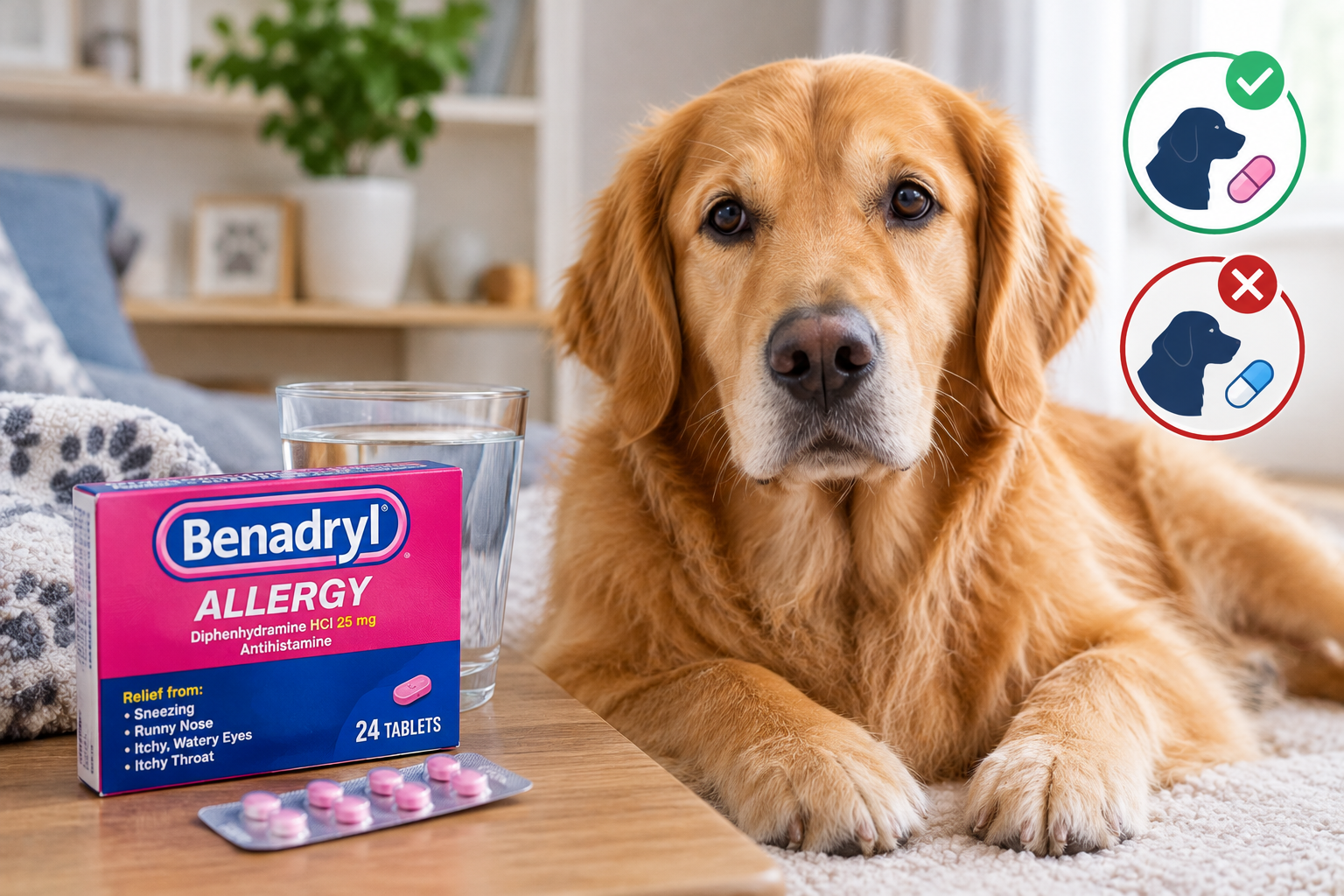
Yes, most healthy dogs can take Benadryl. The usual dose is 1 mg of diphenhydramine per pound of body weight, given two or three times a day. A 25-pound dog would get one standard 25 mg tablet. There are two catches.
The product has to be plain diphenhydramine with nothing else mixed in, and your dog needs to be free of a few health problems that make it risky. Call your vet before the first dose, especially if your dog takes any other medicine.
Below you’ll find what Benadryl does for dogs, how to dose it by weight, which products to keep away from your dog, and when it’s the wrong choice altogether.
What is Benadryl, and is it safe for dogs?
Benadryl is a brand name for diphenhydramine, an antihistamine. Histamine is a chemical the body releases during an allergic reaction. It’s what causes itching, swelling, hives, and watery eyes. Diphenhydramine blocks histamine, so those symptoms ease.
The FDA has not approved diphenhydramine for dogs, but vets use it all the time. This is called extra-label use, which simply means a human drug given to an animal under a vet’s guidance. At normal doses it has a wide safety margin in dogs, which is why it’s one of the few human medicines vets will often okay for use at home.
Safe for most dogs does not mean safe for every dog, though. A dog with glaucoma, heart disease, or a seizure disorder can react badly. So can a dog that’s already on certain medicines. That’s why a quick call to your vet matters, even for a drug you can buy at any pharmacy.
What does Benadryl help with in dogs?
Benadryl works best for short-term, mild allergy symptoms. Vets commonly suggest it for:
- Hives or mild face swelling after a bee sting or bug bite
- Mild seasonal allergy flare-ups, like sneezing or watery eyes
- Itchy spots from insect bites
- Motion sickness on car rides
- Preventing a reaction before a vaccine, in dogs that reacted to one before
Vets also use it in some dogs with mast cell tumors, since these tumors release histamine. That’s a treatment your vet plans, not something to start on your own.
It’s worth being realistic about its limits. For long-term itchy skin, the kind caused by environmental allergies (atopic dermatitis), diphenhydramine taken by mouth often does very little. Dogs with ongoing itch usually do much better on newer vet drugs such as Apoquel (oclacitinib) or Cytopoint injections.
Benadryl is also a weak fix for anxiety. It can make a dog sleepy, but sleepy and calm are not the same thing. A frightened dog may still be frightened, just groggy. A small number of dogs even get more wound up instead of drowsy. For fireworks, thunderstorms, or vet-visit stress, your vet has better options.
How much Benadryl can I give my dog?
The standard dose is 1 mg per pound of body weight, every 8 to 12 hours, with no more than three doses in 24 hours. The Merck Veterinary Manual lists a dog dose of 2 to 4 mg per kilogram. That works out to about 1 to 2 mg per pound, and 1 mg per pound is the usual starting point.
Here’s how that looks for common weights, using regular 25 mg tablets or children’s liquid (12.5 mg in each 5 mL):
| Dog’s weight | Dose | What to give |
| 5 lb | 5 mg | 2 mL children’s liquid |
| 10 lb | 10 mg | 4 mL children’s liquid |
| 25 lb | 25 mg | 1 tablet |
| 50 lb | 50 mg | 2 tablets |
| 75 lb | 75 mg | 3 tablets |
| 100 lb | 100 mg | 4 tablets |
A few tips make dosing easier and safer:
- Weigh your dog. Guessing is how dogs end up overdosed. A bathroom scale works: weigh yourself holding the dog, then subtract your own weight.
- Round down, not up. If your dog sits between two doses, go with the lower one.
- Use a syringe for liquid. A kitchen spoon is not accurate enough for a small dog.
- Give it with a bit of food. A pill pocket, cheese, or a dab of peanut butter works. Check that the peanut butter has no xylitol.
Benadryl usually starts working within about an hour. Watch your dog for the first few hours after the first dose, so you know how they react. Some dogs get a little sleepy, and some barely change. Either is normal.
Tip: Write down the time of each dose. It’s easy to lose track when more than one person in the house is giving medicine.
How long does Benadryl last, and how often can you give it?
One dose of Benadryl lasts about 8 to 12 hours in most dogs. That’s why the usual schedule is two or three doses a day, spaced evenly. For example, a dog on three doses might get one at 7 a.m., 3 p.m., and 11 p.m.
If you miss a dose, give it when you remember, then space the next one out from there. Don’t give two doses close together to catch up. Doubling up is one of the easiest ways to push a dog into the side effects covered below.
For a one-off problem, like hives after a bee sting, one or two doses may be all your dog needs. Swelling from a sting often goes down within a few hours. If the hives or swelling are still there the next day, or keep coming back, call your vet. Benadryl is meant for short-term relief. If your dog seems to need it for more than two or three days in a row, something else is going on, and your vet should take a look.
If a correct dose doesn’t seem to help at all, don’t raise it on your own. Higher doses mostly add side effects, not relief.
Which Benadryl products are safe for dogs?
Only products where diphenhydramine is the only active ingredient are safe to use. The brand name on the front of the box tells you very little. Turn it over and read the “Active ingredient” line in the Drug Facts panel.
Plain Benadryl Allergy tablets (diphenhydramine HCl 25 mg) and plain store-brand diphenhydramine are the right ones. Many related products are not. Keep these away from your dog:
- Decongestant formulas. Anything labeled “Plus Congestion,” “D,” or “Sinus” often contains phenylephrine or pseudoephedrine. These can raise a dog’s heart rate and blood pressure to dangerous levels and cause tremors or seizures.
- Pain and cold formulas. Products that include acetaminophen can damage a dog’s liver and red blood cells.
- Liquids or chewables with xylitol. Xylitol is a sugar substitute that drops a dog’s blood sugar fast and can cause liver failure. Check the inactive ingredients list on any liquid, chewable, or dissolving strip.
- Liquids with alcohol. Some adult liquid formulas contain alcohol. Children’s versions usually don’t, but check the label.
- Creams, gels, and sprays. Dogs lick these off, and the swallowed amount is hard to predict.
If you live outside the US, be extra careful. In the UK and some other countries, products sold under the Benadryl name contain acrivastine or cetirizine, not diphenhydramine. The 1 mg per pound dose does not apply to those drugs. Ask your vet before giving any of them.
Rule of thumb: If the active ingredient line lists anything besides diphenhydramine, don’t give it to your dog.
Which dogs should not take Benadryl?
Some dogs should skip Benadryl, or take it only if a vet says it’s okay. Talk to your vet first if your dog has:
- Glaucoma
- Heart disease or high blood pressure
- A seizure disorder
- An overactive thyroid (hyperthyroidism)
- An enlarged prostate or trouble peeing
- A blockage or slow movement in the stomach or bowel
Pregnant or nursing dogs and very young puppies also need a vet’s input first.
Drug interactions matter too. Diphenhydramine adds to the drowsy effect of other sedating drugs, such as trazodone, gabapentin, or tramadol. Combining them can make a dog much sleepier than you’d expect. Never stack Benadryl with another antihistamine either. If your dog takes any daily medicine, including for anxiety or pain, check with your vet before adding Benadryl.
What side effects can Benadryl cause in dogs?
The most common side effect is drowsiness. Most dogs get sleepy and rest more than usual for a few hours. That’s expected and harmless.
Other side effects you might see:
- Dry mouth, so your dog may drink more
- Holding urine longer or peeing less
- Less interest in food
- Mild vomiting or loose stool
- Faster breathing or heart rate
- Restlessness or excitement instead of sleepiness
These are usually mild and fade as the drug wears off. If your dog seems very agitated, can’t settle, or the effects don’t ease within a few hours, call your vet.
What are the signs of a Benadryl overdose in dogs?
Too much diphenhydramine overstimulates a dog’s nervous system and heart. Signs of an overdose include:
- Agitation, pacing, or unusual excitement
- Wide (dilated) pupils
- A very fast heartbeat
- Wobbly walking
- High body temperature
- Tremors or seizures
In severe cases, an overdose can lead to coma and death. It’s rare at normal doses, but it does happen, often when a dog chews open a blister pack or gets into the medicine cabinet.
If you think your dog took too much, call your vet or the ASPCA Animal Poison Control Center at (888) 426-4435 right away. The line is open 24 hours a day, every day, and a consultation fee may apply. Don’t make your dog vomit unless a vet tells you to.
When should you skip Benadryl and go straight to the vet?
Skip home treatment and get to a vet right away if your dog shows signs of a serious allergic reaction (anaphylaxis). Watch for:
- Trouble breathing or noisy breathing
- Swelling that spreads from the face to the throat
- Pale gums
- Weakness or collapse
- Repeated vomiting or diarrhea soon after a sting or new food
Benadryl works too slowly to stop a reaction like this. Vets use epinephrine and other emergency treatment. If your vet tells you to give a dose of Benadryl on the way in, do that, but don’t let it delay the trip.
You should also book a regular vet visit if itching lasts more than a few days, or comes with hair loss, red or scabby skin, or repeated ear infections. Those point to an ongoing allergy, a skin infection, or parasites. Benadryl might cover the symptoms for a short time, but the cause still needs a diagnosis and proper treatment.
Conclusion
You can give most healthy dogs Benadryl at about 1 mg per pound of body weight, two or three times a day, as long as the product contains diphenhydramine and nothing else. Check with your vet first, especially if your dog has a health problem or takes other medicine.
Use it for mild, short-term allergy symptoms, watch your dog after the first dose, and treat breathing trouble or major swelling as an emergency.
Frequently asked questions
Can I give my dog Benadryl to calm him down? You can, but it rarely works well. Benadryl makes many dogs drowsy, yet it doesn’t reduce fear, and some dogs get more restless instead. For fireworks, storms, or travel stress, ask your vet about medicines made for anxiety.
How long does Benadryl take to work in dogs? It usually starts working within about an hour. The effects last roughly 8 to 12 hours, which is why the dose is given two or three times a day.
Can I give my dog children’s Benadryl? Yes, the children’s liquid is handy for small dogs. It has 12.5 mg of diphenhydramine in each 5 mL. Check the label first and make sure it has no xylitol and no other active ingredients.
Can dogs take Benadryl every day? Some dogs take it daily for short periods under a vet’s guidance. If your dog needs it for more than a few days, see your vet. Ongoing itching usually has a cause that needs its own treatment.
Is it safe to give Benadryl to a small dog or puppy? Small adult dogs can take it at the same 1 mg per pound dose, measured carefully with a syringe. For young puppies, get your vet’s okay first, since their small size leaves little room for error.
Related Articles
Can I Use Neosporin on My Dog? Safe Use, Risks & How-To
2 thoughts on “Can I Give My Dog Benadryl? Safe Dose and Risks”