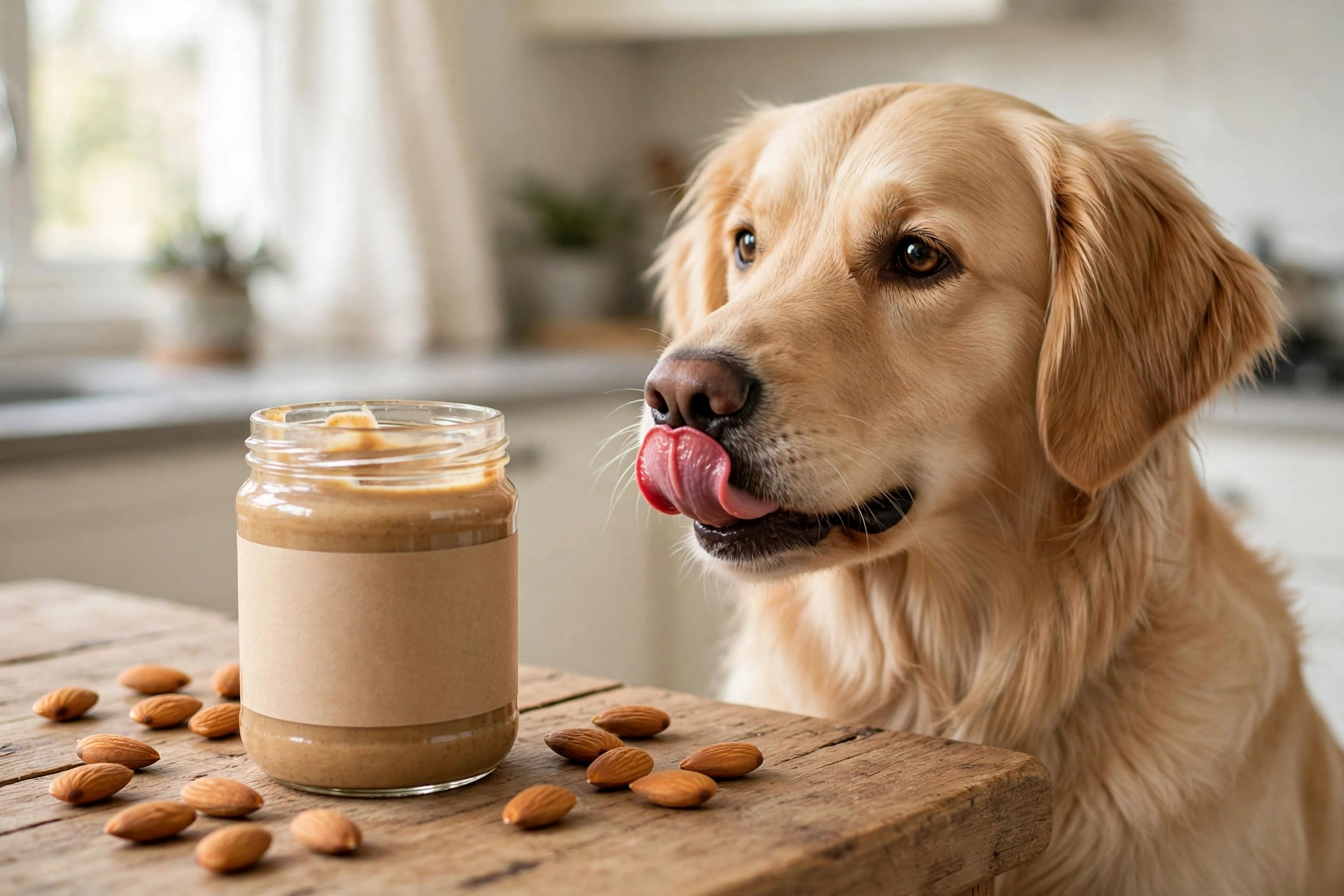

Can dogs have almond butter? Yes, with a few firm conditions attached. It has to be plain and unsweetened, it has to be completely free of xylitol, and it has to arrive in teaspoon-sized amounts as an occasional treat, not as a daily habit. Get those three things right and almond butter is one of the handiest treats in the cupboard: dogs love the taste, it hides pills like a charm, and a smear of it can buy you ten quiet minutes with a lick mat.
Get them wrong, though, and a harmless-looking jar can turn into a stomach ache, a slow weight problem, or, in the case of the wrong sweetener, a genuine emergency. Here is how to tell the difference.
Can dogs have almond butter? The short answer
Almonds themselves are not poison to dogs. PetMD is clear that almond butter isn’t toxic either, and that a lick here and there, or a spoonful used to get a pill down, is fine for most healthy dogs as long as the label is clean.
You might have heard that dogs shouldn’t eat almonds at all, and for the whole nut, that advice stands. The American Kennel Club advises against feeding almonds because dogs digest them poorly, they can lodge in the throat or gut of a small dog, and their fat content can stir up pancreatitis. Almond butter removes the choking and blockage problem, because there is nothing solid left to get stuck. What it doesn’t remove is the richness. Everything else in this article flows from that one fact: the butter is safe, but it is heavy stuff, and dogs’ stomachs know it.
The label check that matters most: xylitol
Before any jar of nut butter goes anywhere near your dog, turn it around and read the ingredients. You are hunting for one word above all others: xylitol.
Xylitol is a sweetener used in some “sugar-free” and “no added sugar” nut butters, gums and diet foods, and it is extremely toxic to dogs. A dog’s body mistakes it for real sugar and floods the system with insulin, which can crash blood sugar within the hour and, at higher doses, damage the liver. It takes very little. This is one of the few food label items where there is no safe amount to shrug about.
Two traps to watch for:
- It hides under other names. The same ingredient can appear on a label as “birch sugar” or “wood sugar.” If you see either, that jar is not for your dog, full stop.
- It turns up in “natural” brands too. Sugar-free marketing is aimed at people watching their weight, not at dogs. Never assume a premium or health-food jar is safe until you have read it with your own eyes, every time you try a new brand or flavour, because recipes change.
Once xylitol is ruled out, scan for the rest of the usual suspects. Added sugar, honey and syrups add calories your dog doesn’t need and do his teeth no favours. Chocolate or cocoa in any form rules the jar out completely, because chocolate is toxic to dogs. Heavy salt is a poor idea, particularly for dogs with heart trouble. Flavourings and spices belong in human snacks, not dog treats.
| On the label | Verdict |
|---|---|
| Just almonds (maybe a little oil) | The jar you want |
| Xylitol, birch sugar, wood sugar | Never feed this. Dangerous in tiny amounts |
| Sugar, honey, molasses, syrups | Avoid. Empty calories, bad for teeth and waistline |
| Chocolate or cocoa | Never feed this. Chocolate is toxic to dogs |
| High salt, flavourings, spices | Skip it. Your dog doesn’t need any of them |
The shorter the ingredient list, the better the jar. “Almonds.” is the perfect label. “Almonds, salt.” is acceptable. Anything that reads like a dessert recipe stays on the human shelf.
What’s actually in almond butter?
Almond butter does bring some genuine nutrition to the bowl, which is more than can be said for a lot of dog treats. It is rich in the monounsaturated fats that support skin and coat, and a spoonful carries vitamin E, magnesium and a little fibre and plant protein. That vitamin E is part of why dogs fed a tiny bit regularly often look noticeably glossy, although their normal food should already be covering the basics.
Then comes the number that keeps portions honest. A single tablespoon of almond butter holds roughly 100 calories. For a person, that’s a rounding error. For a 10-pound dog who might only need 350 to 400 calories in an entire day, one careless tablespoon is a quarter of everything he should eat, delivered in four licks. Nut butters are energy-dense because nuts are energy-dense, and no amount of “but it’s natural” changes the arithmetic.
The downside: fat, calories and pancreatitis
The same richness that makes almond butter tasty is what makes it trouble in quantity. Dogs handle fat less gracefully than we do, and the common results of overdoing it are unglamorous: vomiting, diarrhea, gas that clears the room, and a dog who skips his next two meals because his stomach is complaining. Our guide on what to give a dog for diarrhea is the one to keep handy if a treat experiment ever goes that way.
The more serious concern is pancreatitis. The pancreas can become painfully inflamed after a rich, fatty load, and some dogs are far more prone to it than others: dogs who have had it before, dogs carrying extra weight, and dogs whose vets have already put them on a low-fat diet. A dog with pancreatitis is typically miserable, off his food, hunched or stretching out to ease a sore belly, and vomiting. That is a vet visit, not a wait-and-see. For a prone dog, the sensible amount of almond butter is none at all, and no treat is worth the risk. Ask your vet if you’re unsure which camp your dog falls into.
Weight is the slow-motion version of the same problem. Nut butter sneaks in through a lick here and a stuffed toy there, several days a week, and six months later the vet is using words like “overweight” while your dog sits there looking betrayed. Treats of every kind should stay under about 10% of a dog’s daily calories, and almond butter uses that budget up faster than almost anything else in the kitchen.
How much almond butter can a dog have?
Think teaspoons, not tablespoons, and think “a few times a week,” not “with every meal.” These are sensible occasional-treat amounts for a healthy adult dog:
| Dog’s size | Amount per serving |
|---|---|
| Toy and extra-small (under 10 lbs) | About ½ teaspoon |
| Small (10–25 lbs) | About 1 teaspoon |
| Medium (25–50 lbs) | About 2 teaspoons |
| Large (over 50 lbs) | Up to 1 tablespoon |
First time you’ve offered it, serve half of that and wait a day. Dogs, like people, occasionally turn out to be sensitive to a new food, and a small trial tells you how his stomach handles it before you commit to a full portion. Watch for soft stools, itching, or ear scratching in the day or two after, and if any of those appear, almond butter comes off his menu.
Fun, safe ways to serve almond butter
This is where almond butter earns its cupboard space. A plain old spoonful is fine, but it lasts about four seconds. These last longer:
- On a lick mat. Spread a thin layer and press the mat to the floor or stick it to the tiles at bath time. Licking is genuinely calming for a lot of dogs, and a mat turns one teaspoon into ten minutes of occupation.
- Stuffed into a rubber toy. Smear it inside a Kong-style toy, then freeze the whole thing for a few hours. Frozen almond butter takes real work to shift, which is exactly what you want on a rainy afternoon. It is also the oldest trick in the book for keeping a dog busy while visitors arrive.
- As a pill disguise. A pea-sized blob moulded around a tablet gets medicine down dogs who can somehow eat around a pill hidden in cheese, ham and their dinner, and still spit it out clean. PetMD makes the same point: nut butter is a good vehicle for giving a dog a pill. If pill time is a battle in your house, our guide on giving a dog Benadryl covers checking medication doses safely before you wrap anything up.
- As a training jackpot. A lick off a spoon as the reward for nailing a hard recall at the park. High value, tiny amount, big impression.
- Baked into homemade treats. Stir a spoonful into oat-and-banana dog biscuit dough. The flavour carries a long way, so the whole batch stays sensible.
Skip the idea of stirring a big spoonful into every dinner to tempt a picky eater. You will create a dog who holds out for the topping, and quietly add a couple of hundred calories a week while you do it.
Almond butter vs peanut butter: which is better for dogs?
Most owners end up choosing between the two jars, so here is the honest comparison:
| Almond butter | Peanut butter | |
|---|---|---|
| Safety for dogs | Safe if plain and xylitol-free | Safe if plain and xylitol-free |
| Protein | A little less, roughly 7 g per 2 tablespoons | A little more, roughly 8 g per 2 tablespoons |
| Calories | About 100 per tablespoon | About the same, roughly 95–100 |
| Standout nutrient | More vitamin E, calcium and magnesium | More protein for your money |
| Price | Noticeably more expensive | Cheaper and easy to find |
| Taste, according to dogs | Loved | Loved, possibly by a nose |
Peanut butter wins on protein and price, which is why it is the default in most dog households. Almond butter wins on vitamin E and is a genuinely useful alternative for the occasional dog who doesn’t tolerate peanuts, or for owners who only have the almond jar in the house. Nutritionally they are close enough that the deciding factors are the label, your dog’s stomach, and your wallet, in that order. Either way, the xylitol check is identical, because peanut butter brands have used it too.
When should you skip almond butter altogether?
Some dogs should simply never get it:
- Dogs who have had pancreatitis, or who are on a vet-prescribed low-fat diet
- Dogs who need to lose weight, where every treat calorie is spoken for
- Dogs who showed an upset stomach or itchy skin after a first small taste
- Any dog, if the only jar in the house contains xylitol, chocolate, or a list of sweeteners and flavourings
- Puppies, beyond a tiny taste. A puppy’s stomach is easily upset and his food is carefully balanced for growth, so rich extras can wait until he’s older
Conclusion
So, can dogs have almond butter? Yes. Plain, unsweetened, xylitol-free almond butter, in a teaspoon-sized serving a few times a week, is a safe and genuinely useful treat for most healthy dogs. It hides pills, fills frozen toys, and makes a dog’s whole day.
What it is not is health food to pour on with a generous hand. It is one of the most calorie-dense things in your kitchen, and its fat content can mean an upset stomach today or pancreatitis in a dog who’s prone to it. Read the label every time, keep the spoon small, and the jar stays what it should be: a high-value treat your dog adores, that does him no harm at all.
Frequently asked questions
Can puppies have almond butter?
A tiny lick of plain, xylitol-free almond butter is unlikely to harm a puppy, but it isn’t a good idea to make it a habit. Puppy stomachs are easily upset by rich food, and a growing puppy’s meals are already balanced for exactly the nutrients he needs, so fatty extras mostly just risk diarrhea and picky habits. If you want a puppy-friendly reward, small pieces of his own kibble or treats made for puppies are the better bet until he’s an adult.
My dog ate a lot of almond butter. What should I do?
First, check the jar’s ingredients. If it contains xylitol, birch sugar or wood sugar, phone your vet or an emergency clinic immediately, even if your dog seems fine, because xylitol acts fast and waiting for symptoms is dangerous. If the jar was plain, the likely outcome is a stomach upset over the next day or so: vomiting, diarrhea and a loss of appetite. Offer water, skip the next rich treat entirely, and call the vet if the vomiting keeps going, your dog won’t eat at all, seems sore around the belly, or becomes unusually quiet, since those can point to pancreatitis.
Is almond butter better than peanut butter for dogs?
Not clearly, no. They are very close nutritionally. Peanut butter has slightly more protein and costs a lot less, while almond butter has more vitamin E and a bit more calcium and magnesium. Both are around 100 calories a tablespoon and both are safe only in their plain, xylitol-free forms. Pick whichever your dog prefers and your cupboard already holds, keep the portions small, and you’re not making a wrong choice either way.
Can dogs be allergic to almond butter?
They can, although true nut allergies in dogs are uncommon. Signs tend to show up as itchy skin, scratching at the ears, licking the paws, or a stomach upset that appears after each serving. That’s why the first serving should always be small: if your dog reacts, stop feeding it and mention it to your vet. A dog who has eaten almond butter happily several times without any of those signs is very unlikely to be allergic to it.
Can dogs eat whole almonds instead of almond butter?
Better not. Whole almonds are hard for dogs to digest, and they are just the right size and shape to get stuck in the throat or further down, especially in small breeds where an obstruction can become a surgical emergency. Salted and flavoured almonds add more problems on top. The AKC advises against feeding almonds to dogs at all. Butter gives your dog the flavour he wants in a smooth form that can’t block anything, which is the whole reason it’s the safer way to share.
Related Articles


[…] ❮ Previous Post: Can Dogs Have Almond Butter? What’s Safe and What’s Not […]