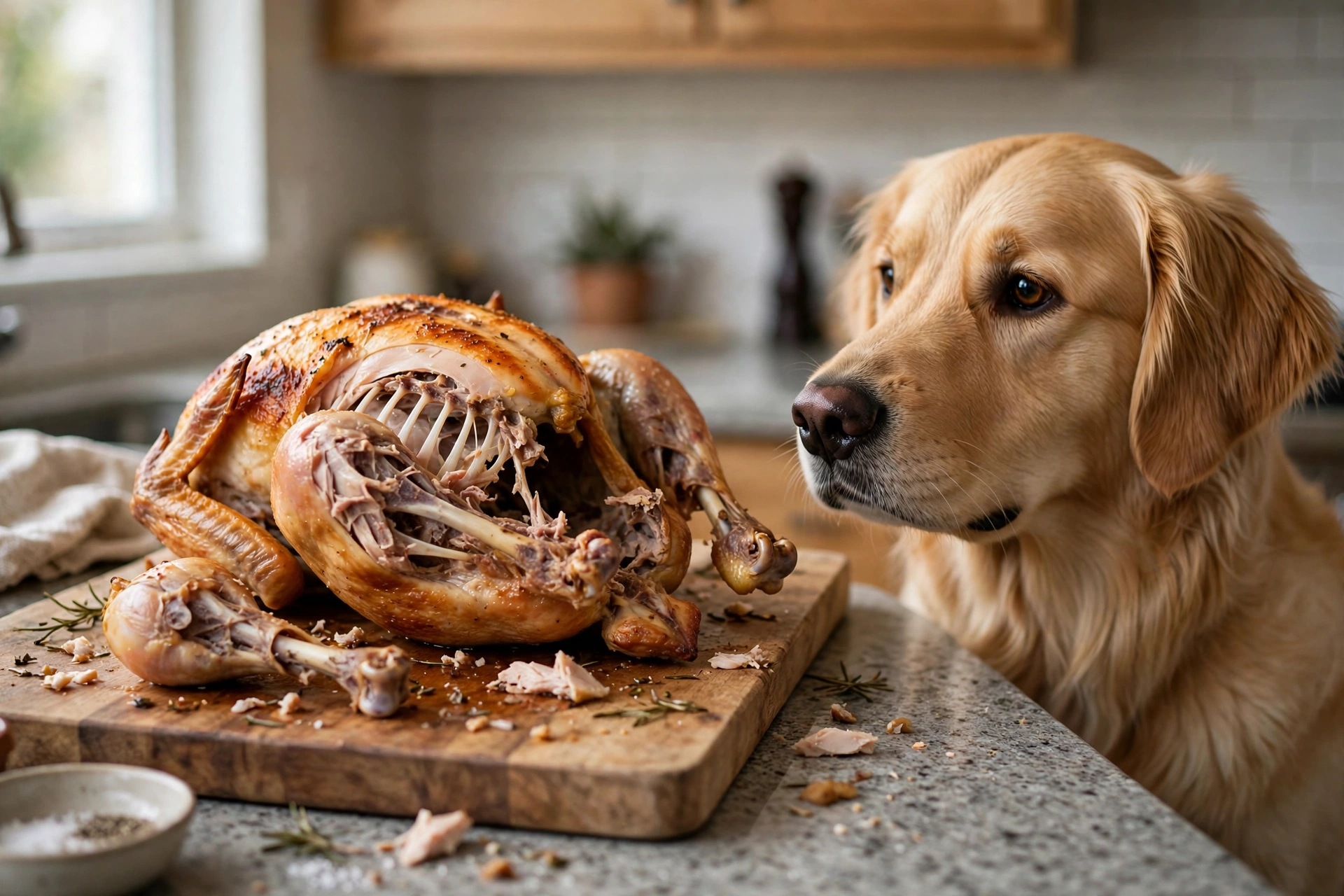

Can dogs eat chicken bones? No — and cooked chicken bones are the most dangerous version of all. The meat is fine: plain cooked chicken is a good food for dogs once it’s off the bone. The bones are where the trouble starts, because a roasted, grilled or fried chicken bone doesn’t crunch the way people imagine. It snaps into sharp shards that can cut, lodge and puncture their way through a dog.
If your dog has just stolen one off a plate or out of the trash, skip to the “what to do” section below — and whatever you do, don’t try to make him throw it back up.
Can dogs eat chicken bones? Why cooked bones are the real danger
Chicken bones are hollow and light, built for a bird that flies, and that structure is exactly the problem in a dog’s jaws. Raw bone has some flex in it. Cooking changes the bone: heat dries it out and makes it brittle, so instead of bending or crumbling, a cooked chicken bone breaks into splinters with edges like broken glass.
A dog doesn’t chew politely, either. Most dogs crunch twice and gulp, especially if they know the prize was stolen and you’re hurrying toward them. Sharp fragments get swallowed in surprisingly big pieces, and every bend on the way down is a place a shard can do damage.
This isn’t a fringe opinion. The U.S. Food and Drug Administration has warned for years that bones are unsafe for dogs, and the American Kennel Club’s guidance on chicken is blunt about it: take cooked chicken off the bone before it goes near your dog, because cooked chicken bones splinter easily and can choke a dog or puncture the digestive tract. Pet-store “bone treats” — smoked, baked bones sold in packets — carry the same risks, because they’re cooked too.
What can a chicken bone actually do to a dog?
Most dogs who swallow a chicken bone get away with it. A dog’s stomach acid is strong, and small bone often dissolves and passes without drama. But “usually fine” is not the same as safe, because when things do go wrong, they can go wrong at every stage of the journey:
- In the mouth: splinters cut gums and tongues, wedge between teeth, and crack teeth — one of the commonest injuries vets link to bones.
- In the throat: a fragment that’s inhaled rather than swallowed can block the windpipe. That’s a choking emergency, counted in seconds.
- In the esophagus: a sharp piece can lodge in the tube between mouth and stomach, causing gagging and drooling. Pieces stuck here usually need a vet and instruments to remove.
- In the stomach and intestines: a shard can pierce the gut wall, letting bacteria leak into the abdomen and cause peritonitis, a severe infection that is life-threatening without surgery. Pieces can bunch up and block the intestine.
- At the far end: jagged fragments that make it all the way through can still cause straining, pain and bleeding on the way out.
That’s the honest shape of the risk: a high chance of nothing at all, a low chance of something serious, and no way of knowing which dog gets which outcome. Vets would rather you never rolled those dice.
Cooked vs raw chicken bones: is there a difference?
Yes, and this is where owners argue most, so here’s the fair version of both sides.
| Cooked chicken bones | Raw chicken bones | |
|---|---|---|
| Splintering | High risk — heat makes bone brittle, so it shatters into shards | Lower risk — raw bone is pliable, less likely to shatter |
| Digestion | Sharp pieces can injure on the way through | Softer, more digestible — raw feeders’ main argument |
| Bacteria | Cooking kills surface bacteria | Salmonella and Campylobacter risk, for dog and humans alike |
| Teeth, choking, blockage | All three still possible | All three possible, just less likely than with cooked bone |
| Mainstream vet advice | Never feed | Most vets still say no, especially with poultry bones |
Raw-feeding owners point out that raw chicken bones are softer than cooked ones, so the splintering argument mostly dissolves. What that skips is the rest of the picture: raw poultry is a reliable source of Salmonella, dogs can shed that bacteria in their stool and saliva, and a raw bone can still crack a tooth or be gulped whole. The AKC notes that most expert sources recommend against raw chicken for exactly these infection reasons.
Our position, and most vets’: cooked chicken bones are an absolute no, and raw ones are a gamble with poor odds. If you feed raw under a vet-designed plan, that’s between you and your vet — but never hand over raw poultry bones casually, and cooked ones never.
My dog just ate a chicken bone. What happens now?
First, the reassuring part: in most cases, nothing obvious happens. The bone reaches the stomach, the acid goes to work, and over the next day or two the remains pass in the stool. Your job is not to relax. Your job is to watch like a hawk for the next 24 to 72 hours, because the uncommon bad outcomes always announce themselves in that window.
It also matters what your dog got. One small wing tip crunched by a 30-kilo Labrador is a very different event from a whole cooked carcass stripped by a 4-kilo Yorkie. Size of dog, size and number of bones, cooked or raw, chewed or swallowed whole — your vet will ask about all four, so note the details now. Count what’s left on the plate if you can; it helps the vet judge the risk.
What warning signs should you watch for over the next 24 to 72 hours?
Problems tend to follow the bone’s journey, so the signs arrive in a rough order:
| When | Signs to watch for | What it can mean |
|---|---|---|
| Straight away | Coughing, gagging, retching, pawing at the mouth, heavy drooling, distress | Stuck in mouth, throat or esophagus — or choking |
| The first 24 hours | Vomiting, refusing food, unusual drooling, lip-licking, restlessness, whining, a hunched or “praying” posture | Stomach or upper gut irritation, pain, or a piece that isn’t moving |
| 24 to 72 hours | Straining to poop, no stool at all, blood in the stool, a tight or swollen belly, fever, deep lethargy | Blockage further down, constipation from bone fragments, or infection from a perforation |
Any sign in the first row is an emergency vet visit, not a phone call and a wait.
Vomiting in the second row deserves respect too. Plain digestive upsets follow stolen food often enough that our guide on what to give a dog for diarrhea covers home care for mild cases — but vomiting after a known bone is different. Treat it as a reason to be seen: a stomach that keeps rejecting food may have a shard in it. A fever on day two or three matters just as much, and the checks in our guide on how to tell if a dog has a fever will help you confirm it.
What should you do if your dog eats a chicken bone?
Work through these in order:
- Stay calm and don’t chase. A chased dog gulps. If he’s still chewing and you charge in, the bone goes down whole in one panicked swallow — the single worst version of events.
- Trade, don’t grab. Offer something better — a favorite treat — and take the bone as he swaps. If he knows “drop it” or “leave it,” use it. If he guards food, don’t wrestle him for it; a bite helps nobody. Lure him away instead.
- Clear the scene. Get every remaining bone out of reach and into a bin he can’t raid. Most repeat performances happen ten minutes later, while the owner is flustered.
- Call your vet and describe it. Cooked or raw, how much, how big is the dog, how long ago. If he’s acting completely normal, many vets will advise careful monitoring at home rather than an immediate visit — the AKC’s step-by-step on what to do if your dog ate chicken bones lays out that same watch-and-see approach for a symptom-free dog. Let the vet make that call, not the internet.
- Monitor for 72 hours. Appetite, water, energy, vomiting, and every stool. A note on the fridge sounds excessive until day two, when you’ll be glad you know when he last pooped.
One popular tip needs a warning label: the slice of soft bread meant to “wrap” the bone. Some vets suggest bulky soft food in specific cases, but don’t feed anything off your own bat without asking. Vets who advise against immediate feeding point out that food briefly raises stomach pH, slowing the acid’s work on the bone. Whether to feed is a judgment for someone who knows your dog and the bone — which is why step 4 is a phone call.
What should you never do?
- Never make your dog vomit. A sharp bone that went down without cutting anything can do real damage on the way back up, and vomiting with fragments in the throat risks choking and aspiration — inhaling material into the lungs. PetMD’s veterinary guidance and the AKC both say the same thing: no fingers down the throat, no home remedies to bring it back. If vomiting ever is the right move, it’s the vet’s move, at the clinic.
- Never pull at anything you can see partway in or out. A fragment half-swallowed or half-passed can be anchored in tissue. Pulling can tear what it touches. Leave it, keep the dog still, and go in.
- Never “wait and see” through real symptoms. Monitoring is for a dog who is bright, hungry and normal. A dog who is gagging, drooling ropes, vomiting repeatedly, straining with nothing to show, or going quiet and flat is past monitoring. That dog needs a vet today — after hours, the emergency clinic.
- Never offer another bone to “push it through.” It makes the problem bigger, sharper and harder to find.
What are safer alternatives for a dog who loves to chew?
Chewing is a real need, and a dog denied every outlet will invent his own, usually involving your baseboards. The fix is to swap the dangerous object, not the behavior.
- Sturdy rubber chew toys sized for your dog, the kind you can dent slightly with a thumbnail. Too hard to dent means hard enough to crack a tooth. Stuff one with a little peanut butter (xylitol-free), freeze it, and you’ve built a project that outlasts any chicken bone.
- Dental chews with the VOHC seal. The Veterinary Oral Health Council only awards its seal to products tested for reducing plaque or tartar. Lick mats work too, for dogs who are more food-detective than power chewer.
- Plain chicken, off the bone. If it’s the taste your dog is begging for at the counter, unseasoned cooked chicken meat is a safe, high-value treat — the AKC signs off on the meat. Debone at the counter, and bin the bones in a can with a lid.
- Whatever you choose, supervise. Every chew becomes a choking hazard the moment it gets small enough to swallow. The last soggy inch of any chew goes in the trash, not down the dog.
And build the boring defenses, because most chicken-bone incidents are thefts, not gifts: bones go straight into a lidded bin, plates get scraped right away, and the roast carcass never sits on a low counter “for a minute.” Dogs notice opportunities we don’t.
Conclusion
So, can dogs eat chicken bones? No — not safely. The meat is a great food for dogs, but the bones, once cooked, trade it for a splintering risk that can mean choking, a torn gut or emergency surgery. Raw chicken bones dodge the worst of the splintering and bring their own problems with bacteria, teeth and blockages, which is why most vets steer owners away from those too.
If your dog has already eaten one, take a breath. Most dogs come through it with nothing worse than an odd-looking stool and an owner who ages a year in a weekend. Call your vet, watch the next 72 hours like you mean it, and never try to bring the bone back up yourself. Then give him something he’s allowed to chew. He’ll forgive you. Dogs always do.
Frequently asked questions
Can a dog’s stomach dissolve a chicken bone?
Often, yes. Dog stomach acid is strong — stronger than ours — and small pieces of bone commonly soften and dissolve within hours, which is why most stolen-bone stories end quietly. “Often” is doing heavy lifting in that sentence, though. A large, sharp fragment can injure the throat, stomach or intestine long before acid has time to work on it. Dissolving is the hopeful path, not a guarantee.
How long does it take a dog to pass a chicken bone?
Anything that is going to pass usually works its way through within 24 to 72 hours, which is why vets set that as the watch window. You’ll often see pale, crumbly stool then — bone residue, which is a good sign. If three days pass with no sign of bone, or your dog stops producing stool, starts straining, or goes off his food at any point in the window, stop waiting and get him seen.
Are raw chicken bones safe for dogs?
Safer than cooked ones in one narrow way: raw bone is more flexible and less likely to splinter. That is where the good news ends. Raw bones can still crack teeth and get gulped and stuck, and raw poultry carries Salmonella and Campylobacter, which can sicken your dog and spread to your family. That’s why veterinary advice, including the AKC’s, is to skip raw chicken bones. Owners who feed raw diets should build them with a vet’s input.
My dog ate a chicken bone and seems fine. Should I still call the vet?
Yes. A quick call costs nothing and gets you advice matched to your dog. A healthy adult Labrador who crunched one small cooked wing bone will often be managed at home with monitoring. A tiny senior dog who swallowed a whole drumstick bone whole is a different case. If anything changes — vomiting, drooling, straining, lethargy, loss of appetite — that call turns into a visit, whatever the hour.
Can puppies eat chicken bones?
No, and puppies are the last dogs who should get them. Everything that makes a chicken bone risky for an adult is worse in a puppy: a narrower throat and gut for pieces to lodge in, a habit of bolting meals without chewing, and far less reserve if things go wrong. The practical answer is defense: lidded bins, plates never left low, and a “leave it” taught early. Give a teething puppy frozen chew toys and approved puppy chews instead.
Related Articles