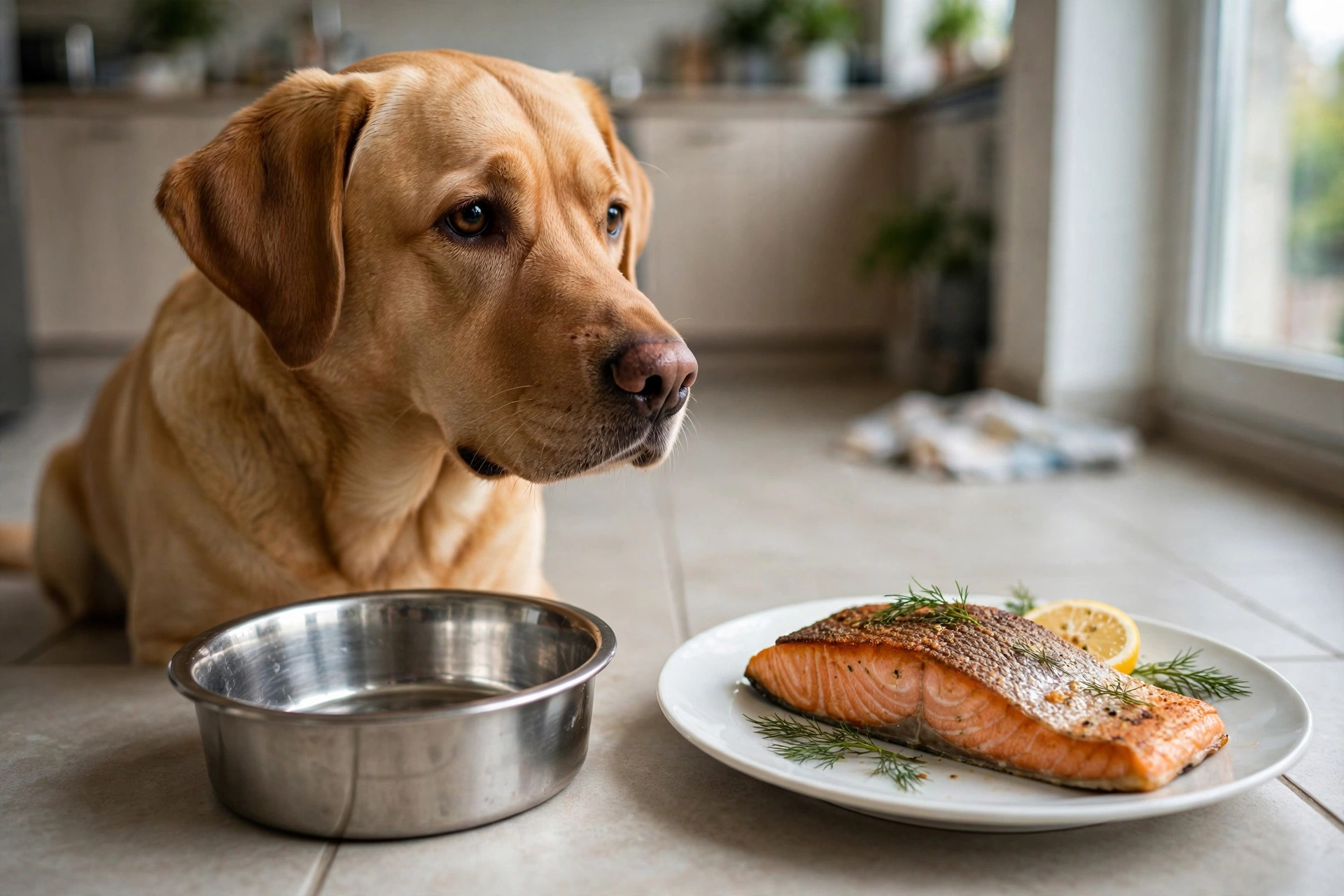

You are filleting salmon for dinner, the skin comes away in one leathery sheet, and a pair of eyes is suddenly fixed on you from across the kitchen. It seems a shame to bin something so packed with good oils. So, can dogs eat salmon skin?
Yes, dogs can eat salmon skin, with one non-negotiable condition: it has to be cooked, plain, and completely free of bones. Served that way, salmon skin is a nutritious little extra full of the omega-3 fats that keep coats glossy. Served raw, undercooked, or seasoned off your own plate, the same scrap can make a dog properly ill. The difference between a healthy treat and a vet visit sits entirely in how it is prepared.
Can dogs eat salmon skin? The short answer
Cooked salmon skin is safe for most healthy dogs. The American Kennel Club confirms that fully cooked salmon is fine for dogs, and the skin is simply part of the fish, with two catches. It is much richer and fattier than the flesh, so it belongs in treat territory rather than on the daily menu. And it must never reach your dog raw, for reasons covered properly below, because the raw version carries a risk that surprises a lot of owners.
Think of salmon skin the way you would think of a strip of bacon rind: a small flavored extra that dogs adore, best handed over in modest pieces on occasional days, not a food group. If your dog has a reason to eat a low-fat diet, the answer changes to a plain no, and there is a list of those dogs further down.
What are the benefits of salmon skin for dogs?
The skin is where a good share of the fish’s fat sits, and salmon fat is the useful kind. Here is what a small serving brings:
| Nutrient | What it does for your dog |
|---|---|
| Omega-3 fatty acids (EPA and DHA) | Support skin and coat health, ease dry, flaky skin, help joints stay comfortable, and back up brain and immune health |
| Protein | The skin carries protein and collagen alongside the flesh it came off, supporting muscles and healthy skin |
| B vitamins and vitamin D | Help with energy production, bones, and the immune system |
| Selenium and potassium | Antioxidant support and normal muscle function |
Owners usually notice the coat first. A dog getting a little oily fish in the week tends to shine, and the worst of the winter dandruff often settles down. Dogs with itchy, allergy-prone skin are the ones vets most often point toward omega-3s, whether that comes from food like this or a fish oil supplement. The joint angle matters for older dogs too: anything that gently supports comfortable movement in a senior dog is worth having in the rotation.
Just keep the scale of the claim honest. A thumb-sized piece of salmon skin once or twice a week is a helpful top-up, not a treatment. It supports a healthy dog; it does not fix skin disease on its own.
What are the rules for serving salmon skin safely?
Five rules cover every way this treat goes wrong. Follow them and salmon skin is an easy yes.
1. Cook it all the way through. Bake, grill, steam, or pan-cook the skin until it is firm and crisp and cooked right through, with no raw, jelly-like patches left. Crisp is not just nicer to eat. Thorough cooking is what kills the parasites and bacteria raw fish can carry, and a crisp piece is easier for a dog to chew properly instead of gulping a rubbery sheet in one go.
2. Serve it plain. Completely plain. No salt, no garlic powder, no onion, no spice rubs, no lemon butter, no marinade. Garlic and onion are genuinely toxic to dogs, and the salty, buttery skin off a restaurant fillet is seasoned for you, not for him. If the skin came off a fillet that was already seasoned, it is not dog food. Cook his piece separately, or skip it this time.
3. Strip out every bone. The skin itself has no bones, but skin torn off a fillet often brings pin bones with it. Cooked fish bones are brittle, they splinter, and they can lodge in a throat or gut. Run your fingers over the piece slowly before it goes anywhere near the bowl, and pull anything that feels like a needle.
4. Cut it into sensible pieces. A whole sheet of skin invites a dog to swallow it in one ambitious gulp. Snip it into strips or bite-size squares with kitchen scissors. Small pieces also make portion control much easier, which matters with a food this rich.
5. Keep the scales and the source in mind. Most salmon skin from the store is scaled and fine to feed once cooked. If you are dealing with a whole fish you caught or bought intact, scrape the scales off before cooking. And buy fish you would happily eat yourself, from a source you trust, stored properly and cooked fresh.
One more thing worth saying: smoked salmon skin is out. Smoked salmon is loaded with salt and often garlic and other flavorings, and the smoking process is not the same as cooking a piece of fish through for your dog. The same goes for the skin off sushi-grade raw salmon, which is raw by definition. Neither belongs in the bowl.
Why is raw salmon so dangerous for dogs?
This is the part of the article to read twice, because raw salmon carries a hazard most owners have never heard of: salmon poisoning disease.
Some salmon and other fish from the Pacific Northwest, the rivers and coastal waters of western North America, carry a tiny parasitic fluke. That fluke can itself be infected with a bacterium called Neorickettsia helminthoeca. When a dog eats the raw fish, skin and all, the bacterium can set off a serious illness. The AKC is blunt about how serious: untreated, this disease is frequently fatal, while dogs who get veterinary treatment early have a far better outlook. It is a strange, region-specific risk, which is why it catches people out. A dog can scavenge a raw fish carcass off a riverbank on holiday and be in real trouble a week later.
Signs usually appear within about five to seven days of eating the raw fish, and they look like this:
- Fever, often one of the first signs. Our guide on how to tell if a dog has a fever shows you what to check at home
- Vomiting and diarrhea, which can become severe. The advice in what to give a dog for diarrhea covers first steps, but suspected salmon poisoning needs a vet, not home care
- Swollen lymph nodes, which you may feel as lumps under the jaw or in front of the shoulders
- Going off food, low energy, and looking plainly miserable
Raw fish carries the usual bacterial risks on top of that, the sort that cause straightforward food poisoning in dogs and in the people handling it. None of this applies to properly cooked salmon, because thorough cooking kills both the fluke and the bacterium. That is the whole point of rule one. Cooked is safe, raw is a gamble with terrible odds in the wrong part of the world.
How much salmon skin can a dog eat?
Salmon skin is rich, so portions stay small. Vets use a general rule that treats and extras should make up no more than about a tenth of a dog’s daily calories, and fatty skin eats into that allowance fast. As a rough guide for cooked, plain, boneless skin, cut into pieces:
| Dog size | Rough portion per serving | How often |
|---|---|---|
| Small (under 10 kg) | A piece or two, about a tablespoon of small bits | Once or twice a week at most |
| Medium (10–25 kg) | A small strip, roughly 1–2 tablespoons of pieces | Once or twice a week |
| Large (over 25 kg) | A larger strip, around 2–3 tablespoons of pieces | Once or twice a week |
Treat those numbers as a ceiling, not a target, and start smaller than the table says the first time. A dog who has never had oily fish can get a loose stool from enthusiasm alone, yours or his. Offer a few pieces, wait a day, and check what comes out the other end before making it a habit.
Calorie-wise, remember the skin is the fattiest part of the fish. If salmon skin becomes a twice-weekly routine, trim a little something elsewhere, especially for a dog who is already carrying a spare tire. And if your dog is on a measured prescription diet, ask your vet before adding anything this rich, because extras can quietly unbalance the whole plan.
Which dogs should skip salmon skin?
For a few dogs, the kind answer is to keep the skin for the compost and hand over a carrot instead:
- Dogs who have had pancreatitis, or who are prone to it. The pancreas and sudden loads of fat are a bad mix, and rich extras are a classic trigger for a flare-up. Miniature Schnauzers and other breeds prone to the condition should give fatty skin a wide berth.
- Dogs on a strict low-fat diet, including dogs managing weight under vet supervision and dogs with certain gut conditions. The skin works directly against the diet’s whole purpose.
- Dogs who need to lose weight. They can have a taste, genuinely just a taste, but a regular portion of the fattiest part of an oily fish is not helping anyone’s waistline.
- Dogs with a known fish allergy or a sensitive stomach. Fish allergies are uncommon but real. If salmon is new to your dog, the first serving should be tiny, with an eye on itching, ear scratching, vomiting, or diarrhea over the next day. Any of those, and salmon comes off the menu.
Puppies sit in the grey zone. A tiny piece of cooked, plain skin will not harm a puppy, but puppy stomachs upset easily and puppy diets are balanced for growth, so keep it rare and small, and never give a puppy raw fish in any form.
What should you do if your dog eats raw salmon?
It happens: a fillet slides off the counter, or your dog finds something wonderful on a riverbank. Do not panic, and do not wait for symptoms to make the decision for you.
Call your vet the same day and tell them exactly what was eaten, how much, and where the fish came from. Raw salmon from Pacific Northwest waters is the high-risk scenario, and your vet may want to see the dog straight away or talk you through what to watch for over the following week. PetMD’s guide to salmon for dogs covers the same warning signs vets take seriously. Fever, vomiting, diarrhea, swollen glands, or a dog going off his food within roughly a week of eating raw fish all mean: go in, now, and mention the raw salmon the moment you arrive. That one detail speeds up diagnosis more than any other, because salmon poisoning is easy to mistake for an ordinary stomach bug in its early days, and it is highly treatable when caught early and dangerous when it is not.
If it was a small lick of farmed salmon in your kitchen rather than a riverbank carcass, the risk is far lower, but the phone call is still worth making. Vets would much rather reassure you in five minutes than meet the dog a week later.
Conclusion
So, can dogs eat salmon skin? Cooked plain, boneless, and cut into small pieces, yes: it is a genuinely nutritious treat, heavy on the omega-3s that keep skin and coats in good order, and most dogs think it is the finest thing to leave a frying pan.
The line between treat and trouble is preparation. Raw salmon skin can carry salmon poisoning disease, seasoned skin carries salt and toxic flavorings a dog does not need, and rich skin in big portions will upset stomachs and waistlines alike. Cook it through, keep it plain, keep it small, and keep it occasional, and that scrap off the fillet becomes one of the better extras in your dog’s week.
Frequently asked questions
Can dogs eat salmon skin with the scales on?
They can, once it is cooked, and most salmon sold for people has already been scaled. Scales are not toxic; they are just tough and unappetizing, and a heavily scaled piece is harder for a dog to chew comfortably. If you are preparing a whole fish yourself, scrape the scales off before cooking, cook the skin until it is crisp, and cut it small. Your dog gets the same nutrition with a much easier mouthful.
Can dogs eat smoked salmon skin?
No, leave smoked salmon and its skin off the dog menu. Smoked salmon is very salty, and it is often flavored with garlic, onion, sugar, and spices that do not belong in a dog. The smoking process also is not the same as cooking a piece of salmon through in your kitchen, which is the step that makes salmon safe. If you want your dog to have the salmon experience, cook a small plain piece fresh. It takes ten minutes and removes all the guesswork.
How often can dogs eat salmon skin?
Once or twice a week is plenty for most dogs, in the small portions in the table above. Think of it as a scheduled extra, like a Sunday treat, not a daily topper. Daily feeding adds up fast with a food this fatty, and the likely results are a soft stool, a slowly expanding waistline, or, in a dog who is prone to it, a pancreas flare-up that nobody wanted. Occasional and small beats generous and often, every time.
Can puppies eat salmon skin?
A puppy can have a tiny piece of cooked, plain, boneless salmon skin as an occasional treat, and many puppies go mad for it. Keep it genuinely tiny, because young stomachs are easily upset by rich food and a bout of diarrhea is a bigger deal in a small puppy than in an adult. Never give a puppy raw salmon or raw salmon skin in any amount; the salmon poisoning risk applies to puppies exactly as it does to adults, and puppies dehydrate faster when they are ill.
My dog stole raw salmon skin off the counter. Should I worry?
Do not panic, but do make the call. Phone your vet, explain what was eaten and where the fish came from, and follow their advice. A small amount of farmed salmon swiped in a kitchen is a much lower-risk event than raw wild fish from Pacific Northwest rivers, but only your vet can weigh that properly. Then watch your dog for about a week for fever, vomiting, diarrhea, swollen glands, or going off food, and get him seen immediately if any of those show up, mentioning the raw salmon as soon as you walk in.
Related Articles



[…] Can Dogs Eat Salmon Skin? Benefits, Risks and How to Serve It Safely […]