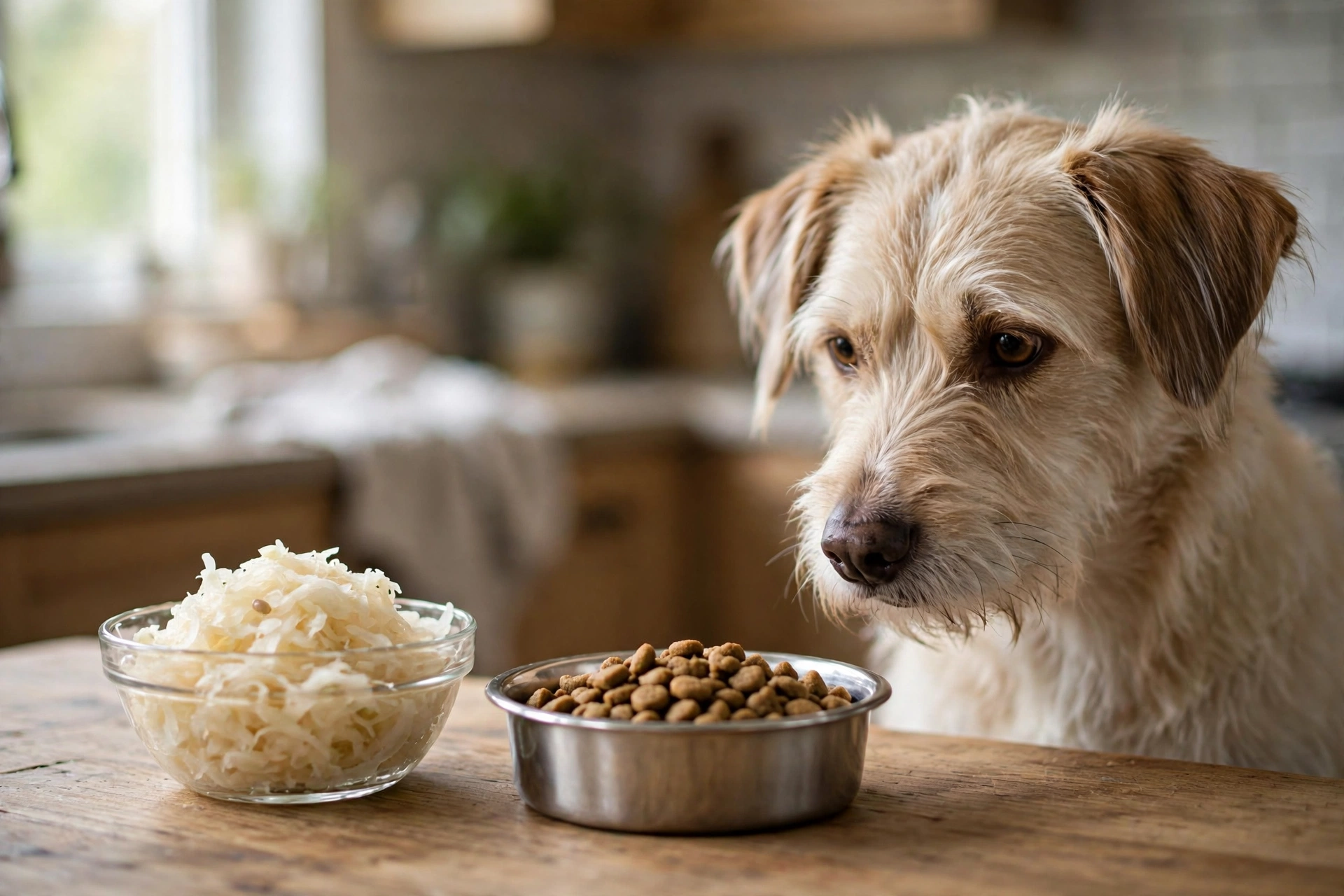

It usually starts at a barbecue. A forkful of sauerkraut slides off somebody’s hot dog, lands on the patio, and your dog inhales it before you can even say his name. Or you’re standing at the fridge, jar in hand, reading about fermented foods and gut health, and you start wondering whether that works for the dog too.
So, can dogs eat sauerkraut? Yes, most dogs can, and plain sauerkraut in small amounts can be genuinely good for them. The fiber and live cultures from fermentation support digestion, and it’s low in calories. The conditions matter, though: it has to be the plain kind, rinsed, and served in spoonfuls rather than bowlfuls. Sauerkraut done wrong is a salty, gassy mistake.
Can dogs eat sauerkraut? The short answer
Yes, with three conditions attached. The sauerkraut must be plain, with nothing added beyond cabbage and salt. It should be rinsed so your dog isn’t taking in all that brine. And it stays in treat territory: a spoonful mixed into dinner a few times a week, not a new food group.
Do those three things and sauerkraut is a perfectly reasonable extra for a healthy dog. Dogs have been eating fermented scraps alongside people for a very long time, and a little tangy cabbage is far from the strangest thing on that list.
What is sauerkraut, exactly?
Sauerkraut is cabbage that has been finely shredded, salted and left to ferment. During fermentation, naturally occurring lactic acid bacteria get to work, eating the cabbage’s sugars and producing the sour flavor, along with the soft, slightly silky texture. No vinegar is needed. The bacteria make the tang themselves.
That process changes the nutritional picture a little. Sauerkraut is still basically cabbage, so it brings fiber, vitamin C, vitamin K and next to no calories, roughly 20 to 25 calories in a whole cup. But the fermentation adds one thing fresh cabbage doesn’t have: live bacterial cultures, as long as the sauerkraut hasn’t been heat-treated afterwards.
That last point explains the two kinds you’ll meet in a shop:
- Raw or refrigerated sauerkraut is sold cold, usually near the deli or the pickles, and still contains live cultures. This is the kind with the gut-friendly reputation.
- Shelf-stable sauerkraut, the cans and jars in the regular aisles, has been pasteurized or canned with heat. It’s perfectly safe for a dog, but the heat kills the live bacteria, so you’re mostly left with fiber and vitamins.
For your dog, either kind works as an occasional food. Just don’t pay premium “raw and alive” prices expecting a medical effect. The benefits are gentle ones.
Why might sauerkraut be good for dogs?
The case for it comes down to three things.
Gut-friendly bacteria. A dog’s digestive tract runs on an enormous population of microbes, and those microbes influence far more than digestion, including the immune system. PetMD’s guide to probiotics for dogs notes that fermented vegetables like sauerkraut carry live cultures that may benefit some dogs. Keep expectations realistic: a spoonful of kraut is not a measured dose of anything, and a dog who needs gut support for a real problem will get more predictable help from a probiotic product made for dogs, with named strains and a stated dose. Think of sauerkraut as a helpful extra, not a treatment.
Fiber. Cabbage fiber feeds those gut bacteria and helps keep stools formed and regular. A little extra fiber suits a lot of dogs, especially the ones whose digestion runs a touch loose or a touch slow.
The cabbage itself. Underneath the tang, this is a vegetable vets are comfortable with. The American Kennel Club confirms cabbage is safe for dogs in moderation, low in calories and high in fiber, with vitamins C and K among its contents. Sauerkraut inherits those credentials, sodium aside.
There’s a bonus for dogs watching their weight. Because sauerkraut tastes strong and takes up space in the bowl for almost no calories, a spoonful makes a meal feel bigger and more interesting to a dog on a diet, which is more than can be said for most diet “extras.”
Which sauerkraut should you never give a dog?
This is where labels earn their keep. Plenty of the sauerkraut sold for people has been dressed up in ways that range from pointless for a dog to actively harmful.
| Type | Why it’s a no |
|---|---|
| Sauerkraut with caraway, juniper or other spices | Dogs gain nothing from the seasoning, and spice blends can hide things that don’t suit them |
| Sweetened “Bavarian style” sauerkraut | Added sugar your dog doesn’t need, sometimes apple and bacon fat too |
| Wine sauerkraut | Fermented or cooked with wine; alcohol in any form is off limits for dogs |
| Kraut cooked with onion, garlic or sausage | Onion and garlic damage dogs’ red blood cells; sausage adds fat and more salt |
| Kimchi and spicy ferments | Garlic, chili and spring onion make this a hard no, however healthy it is for you |
| The kraut from a hot dog stand or deli plate | Usually swimming in meat juices, onion and extra salt by the time it reaches a dog |
The safe jar has a boring label: cabbage, salt, maybe water. Two ingredients you recognize, nothing else. If the label reads like a recipe, put it back.
How do you serve sauerkraut to a dog safely?
A minute of preparation turns a salty side dish into a sensible dog treat.
Rinse it. Scoop out what you’re serving, put it in a sieve, and run it under the tap for ten or fifteen seconds, then let it drain well. You won’t wash the flavor or the goodness away, but a good deal of the surface salt and brine goes down the sink. Considering a cup of typical canned sauerkraut can carry somewhere around 900 milligrams of sodium, and your dog’s whole diet is already salted to his needs, this step is worth it.
Chop the strands. Long stringy pieces are awkward for small dogs and can come back up as quickly as they went down. A quick pass with kitchen scissors over the rinsed kraut makes it easy to mix through food.
Portion it by size. These are sensible amounts for a dog who already tolerates it, a few times a week:
| Dog size | First serving | Regular portion |
|---|---|---|
| Toy and small (up to 10 lb) | 1/2 teaspoon | 1 to 2 teaspoons |
| Small to medium (10–25 lb) | 1 teaspoon | Up to 1 tablespoon |
| Medium (25–50 lb) | 1 to 2 teaspoons | 1 to 2 tablespoons |
| Large (over 50 lb) | 1 tablespoon | 2 to 3 tablespoons |
Introduce it slowly. Start at the first-serving amount, wait a day, and look at what comes out the other end before going bigger. Fermented food and fiber together can produce gas and loose stools in a dog whose gut hasn’t met them before, and the slow route tells you exactly how much your individual dog is happy with.
Serve it simply. Stirred through the usual dinner is the classic. You can also freeze a spoonful in a silicone mold with a little water for a crunchy summer extra, or spread a thin layer inside a lick mat. Skip the frying pan: kraut cooked up with butter, bacon or onion stops being the food this article is talking about.
What are the risks of sauerkraut for dogs?
Gas, mostly. Cabbage has a well-earned reputation, and fermentation doesn’t entirely retire it. Expect some extra wind the first few times, especially in flat-faced breeds who swallow air with every meal anyway. If the gas comes with a rumbly tummy and soft stools, the portion was too ambitious. Halve it next time.
Salt. This is the risk with real teeth. Rinsing handles the everyday amounts, but sauerkraut should never become a daily mountain, and dogs who need to watch sodium for their kidneys or heart are better off without it altogether, rinsed or not.
Too much, too fast. A dog who raids a whole jar is likely to have a miserable evening of thirst, gas and diarrhea rather than a poisoning, but a small dog who eats a lot of it should be watched, and vomiting, trembling or wobbliness afterwards means a vet call, not a shrug.
There’s one more thing worth a calm mention: cabbage belongs to the family of vegetables containing goitrogens, compounds that can interfere with the thyroid in very large, regular amounts. A spoonful of sauerkraut a few times a week is nowhere near that territory, and it’s no reason to worry. If your dog already has a thyroid condition, though, ask your vet before making any cabbage-family food a habit.
Which dogs should skip sauerkraut altogether?
Leave the jar closed if your dog:
- Has kidney disease, heart disease, or is on a vet-prescribed low-sodium diet
- Eats a prescription diet that his vet doesn’t want extras added to
- Has a sensitive stomach, inflammatory bowel disease or a history of pancreatitis, unless your vet says otherwise
- Is a young puppy, whose digestive system is still settling and whose food is already balanced for growth
And a word on using sauerkraut as medicine: it isn’t one. If your dog has ongoing diarrhea, don’t reach for the kraut jar hoping the bacteria will sort it out. New foods can make a loose stool worse, and persistent diarrhea has a list of causes that need an actual diagnosis. Our guide on what to give a dog for diarrhea walks through what helps and when to stop home care, and vomiting that keeps coming back belongs in the same category, as covered in our look at why dogs throw up yellow. Book the vet instead.
Conclusion
Can dogs eat sauerkraut? Yes, and for most healthy dogs it’s a small, tangy bonus: a bit of fiber, a few vitamins, some live cultures, and barely any calories, all for the price of a spoonful. The version that earns those benefits is the plain jar, rinsed under the tap, chopped up and served in amounts that match the size of the dog in front of you.
Keep it occasional, keep it plain, and let your dog’s stomach cast the deciding vote. Some dogs adore the stuff from the first forkful. Others take one sniff and look at you like you’ve lost your mind. Both reactions are perfectly normal, and neither dog is missing out on anything essential. The jar in your fridge is a nice extra, never a necessity.
Frequently asked questions
Can puppies eat sauerkraut?
A weaned puppy who licks a tiny bit of plain, rinsed sauerkraut off your finger won’t come to harm, but there’s no real reason to offer it. Puppy stomachs are easily knocked off balance, and puppy food is already built to cover growth needs without fermented extras. If you want to try it with an older puppy, keep it to a pinch, once, and see how the next day’s stools look before offering more. When in doubt, wait until adulthood.
Does sauerkraut work like a probiotic for dogs?
Partly, and with a big asterisk. Raw, refrigerated sauerkraut does carry live cultures, and those bacteria can contribute to a healthy gut. But unlike a dog probiotic product, a jar of kraut doesn’t tell you which strains or how many you’re getting, and pasteurized shelf-stable sauerkraut has no live bacteria left at all. PetMD’s guidance lands in the same place: fermented foods may help some dogs, while a dog-specific probiotic is the more reliable route when there’s an actual digestive problem to fix.
Can dogs eat sauerkraut straight from the jar or can?
Not quite straight, no. Scoop out the portion, drain off the brine, give it that quick rinse under the tap and chop the long strands before it goes in the bowl. What you shouldn’t do is tip the jar’s liquid into the food. The brine holds most of the salt, and it’s the one part of the jar your dog genuinely doesn’t need.
What happens if my dog eats a lot of sauerkraut?
The likely outcome is an evening of impressive gas, a big drink of water and loose stools the next day. Make sure fresh water is down, skip the next serving, and things usually settle on their own. Because the salt load adds up in a big helping, a small dog who has eaten a lot deserves closer watching. Repeated vomiting, trembling, staggering or a dog who seems unwell in himself is the point where you stop watching and phone the vet.
Can dogs eat red sauerkraut or other fermented vegetables?
Plain fermented cabbage is fine in red as well as green; the color changes nothing that matters. Fermented carrots or green beans, made with nothing but vegetables and salt, are also reasonable in the same small amounts. The ones to keep away are the seasoned members of the family: kimchi with its garlic and chili, deli pickles loaded with salt and spices, and anything pickled with onion. When the label lists more than vegetables and salt, it isn’t for the dog.
Related Articles