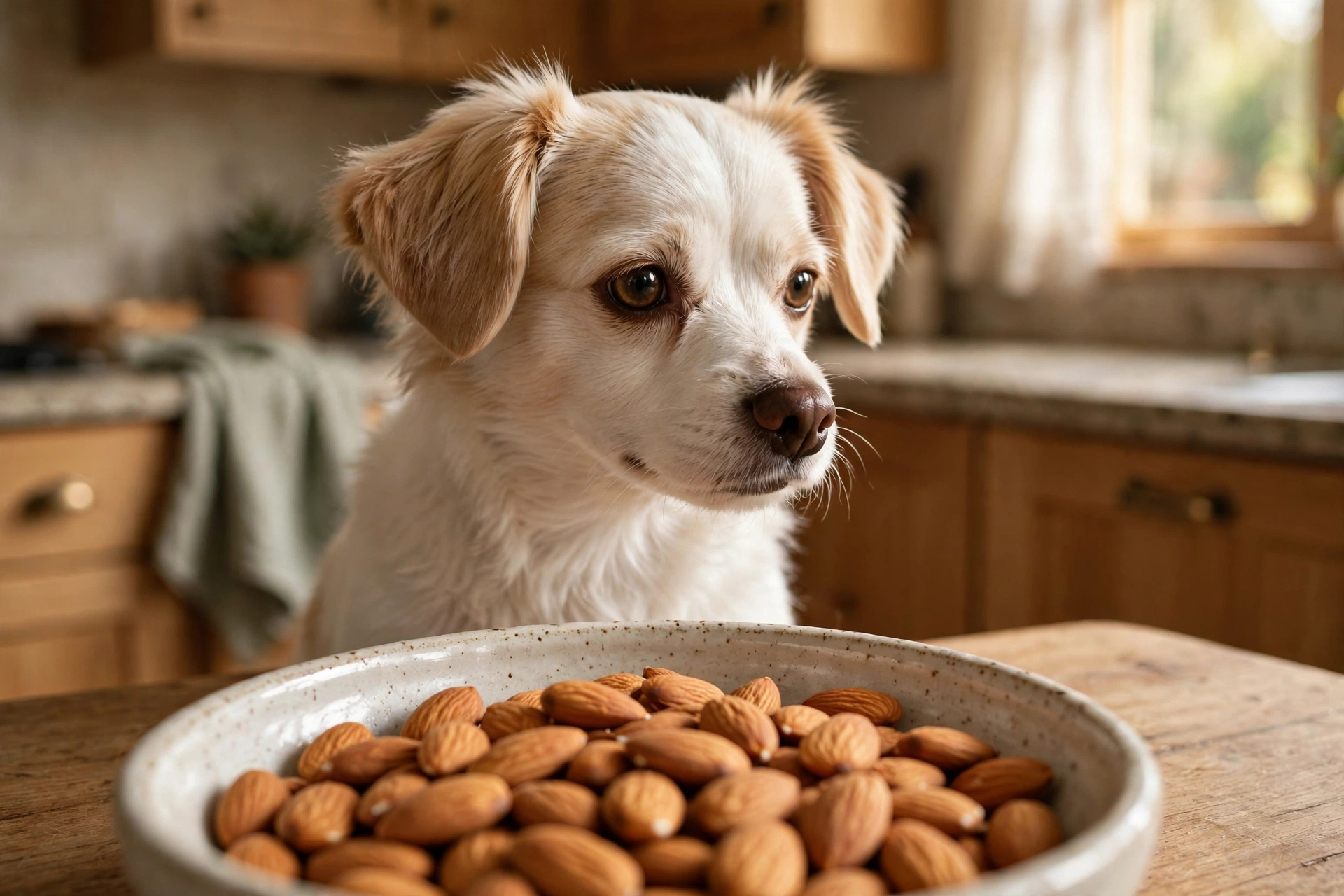

Almonds feel like one of the most innocent snacks in the house. No chocolate, no grapes, nothing on the famous “toxic to dogs” poster — just a plain, healthy nut. Meanwhile your dog is watching you eat them with the focus of a hawk.
So, are almonds bad for dogs? Yes, they are. Almonds won’t poison a dog the way macadamia nuts can, and the American Kennel Club’s answer to whether dogs can eat them is a flat no. They’re hard for dogs to digest, they’re loaded with fat, and their shape is a genuine hazard for smaller dogs. A couple of stolen almonds rarely turn into a crisis for a big dog, but as a snack you hand over on purpose, almonds are a bad deal. Here’s why, and what to do on the day your dog raids the bag anyway.
Are almonds bad for dogs? The short answer
Yes. The confusion around almonds comes from one word: toxic. The sweet almonds sold as snacks are not toxic to dogs — the ASPCA doesn’t list them as a poison, and vets draw a clear line between almonds and genuinely toxic nuts like macadamias and black walnuts. But “not poisonous” is doing a lot of heavy lifting in that sentence. Plenty of things that aren’t poison will still make a dog sick, and almonds manage it in three separate ways at once: they’re hard to digest, they’re very fatty, and they’re exactly the wrong size and shape for a dog’s throat.
PetMD’s vets land in the same place as the AKC: almonds aren’t toxic, but they can cause real health problems and should be avoided. Think of them less like a treat with a small risk attached, and more like a snack with no upside for the dog at all.
| What owners often assume | What vets actually say |
|---|---|
| Almonds are toxic to dogs | Sweet almonds aren’t poisonous; macadamia nuts are the toxic ones |
| Almonds are healthy, so they must be good for dogs | Healthy for people. Dogs digest them poorly and get stomach upsets |
| One almond can’t do any harm | Usually true for a large dog — a different story for a small dog, or a flavored almond |
Why are almonds so hard for dogs to digest?
Dogs are not careful chewers. Where you’d grind an almond into paste, most dogs crunch twice and swallow, and some barely crunch at all. What arrives in the stomach is hard chunks of a food a dog’s gut isn’t built to break down efficiently.
The result is the classic stomach-upset package: vomiting, diarrhea, wind that clears the room, a gurgling belly, and a dog who goes off his food and mopes around for a day. If your dog has helped himself to almonds and the diarrhea has started, our guide on what to give a dog for diarrhea walks through the bland-food approach that settles most mild cases at home.
Then there’s the fat. Roughly half an almond’s weight is fat, which is fine in a human trail mix and a lot for a dog’s pancreas to handle in one sitting. Fatty binges are one of the classic triggers for pancreatitis, an inflammation of the pancreas that ranges from a miserable few days to a life-threatening emergency. Some dogs are far more prone to it than others — Miniature Schnauzers are the breed vets name most often, and any dog who has had pancreatitis before, or who is carrying extra weight, has less room for error. A handful of almonds won’t trouble most dogs this way, but a raided bag, or almonds handed over daily as a “healthy treat,” is exactly how the trouble starts. Regular snacking brings the slower problem too: nuts are calorie bombs, and the weight creeps on quietly.
Can an almond choke a dog or block his gut?
This is the risk owners underestimate. An almond is smooth, hard and oval — roughly the diameter of a small dog’s windpipe, and slippery enough to slide down whole. Dogs don’t chew nuts into safe pieces the way we do, so an almond swallowed in one gulp can lodge in the esophagus or, worse, be inhaled toward the windpipe, particularly in small breeds. Anything that compromises breathing is an emergency, full stop.
Almonds that get past the throat can still cause trouble lower down. Several eaten at once can bunch up and obstruct the stomach or small intestine, and obstructions occasionally need surgery to clear. The AKC flags this as one of the main reasons almonds are a no for dogs, and it applies to big dogs too when the quantity is big enough — a Labrador who inhales half a bag hasn’t chewed any of them either.
Blockage signs build rather than explode: repeated vomiting, drooling, retching without bringing anything up, a sore or tense belly, no interest in food, and straining to pass stool — or no stool at all. If you see that pattern after a nut raid, don’t wait it out at home.
Why are flavored and salted almonds even worse?
Everything above was about the plain nut. The flavored versions in most kitchen cupboards add their own problems.
Salt is the big one. Packaged almonds are often heavily salted, and a salty binge drives thirst and water retention — a real concern for dogs with heart disease. In large enough amounts, excess salt becomes a poisoning risk in its own right.
Flavor coatings irritate the stomach with spices, and some are worse than irritating. Wasabi, barbecue and smoked seasonings upset most dogs, and anything seasoned with garlic or onion powder contains ingredients that are genuinely toxic to dogs. Then there are the sweet versions: chocolate-covered almonds wrap a mediocre snack in a truly dangerous one, and sugar-free coatings can contain xylitol, which is severely toxic to dogs. By the time a nut has been flavored, coated and candied, you’re no longer asking whether the almond is the problem. Something on it is.
What about bitter almonds and moldy almonds?
Two special cases deserve their own warning, because both are a step up from the ordinary stomach upset.
Bitter almonds are not the same nut. The almonds sold for snacking are sweet almonds. Bitter almonds — used overseas in some oils, extracts and supplements rather than sold as food — contain a compound that releases cyanide, and the ASPCA treats them as toxic. They taste intensely bitter, which puts most dogs off, but a dog who eats bitter almonds, or gets into a product made from them, needs a vet immediately. Cyanide interferes with how the body uses oxygen, and it doesn’t work slowly.
Moldy almonds are a hidden hazard. Nuts that have sat around too long, or been stored somewhere damp, can grow Aspergillus mold. That mold produces aflatoxins, which damage the liver: the PetMD guide to foods dogs must not eat groups moldy, spoiled foods among the household dangers for good reason, and moldy nuts and dairy are also linked to mycotoxins that cause tremors. The stale bag at the back of the cupboard is not a harmless dog treat waiting to happen. Bin it somewhere the dog can’t raid, and never toss moldy nuts into a garden or compost heap a dog can reach.
What should you do if your dog eats almonds?
Start with three quick questions: how many, what kind, and how big is the dog?
- One or two plain almonds, medium or large dog: Don’t panic. The AKC’s advice is to simply watch him. Most dogs in this situation show nothing at all, or a mild stomach upset that passes on its own.
- More than a few, or any almonds eaten by a small dog: Call your vet and describe what happened. Size changes the maths on choking, blockage and fat load all at once.
- Flavored, salted or chocolate-covered almonds, or a whole bag: Call your vet straight away and keep the packaging. The coating may matter more than the nut.
- Any symptoms at all: Skip the waiting and ring. A vet may decide to make the dog vomit if the almonds went down very recently, but that’s their call with proper equipment on hand — never try it yourself at home.
While you’re monitoring, keep water available, skip rich food, and don’t offer more snacks “to settle his stomach.” Plain and boring is the order of the day.
What symptoms should you watch for after a dog eats almonds?
Problems, when they come, tend to arrive on a rough schedule.
| When | What you might see | What to do |
|---|---|---|
| Straight away | Coughing, gagging, pawing at the mouth, struggling to swallow | Emergency vet if breathing is affected at all |
| Within a few hours | Vomiting, diarrhea, gas, drooling, going off food | Ring your vet if it’s repeated, or the dog is small or unwell |
| Over the next 1–3 days | Repeated vomiting, a hunched and painful belly, no stool, deep lethargy | Vet the same day — possible pancreatitis or blockage |
Keep an eye on the vomiting in particular. A single vomit after a dietary crime is common and usually the end of it. Vomiting that keeps coming, especially when it turns to yellow bile on an empty stomach, is a dog who needs examining — our article on why a dog throws up yellow explains what that colour change means. Pancreatitis signs can trail a fatty meal by a day or two, so a dog who seems fine on Saturday and is hunched, off his food and vomiting on Monday still needs the vet, and the almond raid is worth mentioning.
What can you give your dog instead of almonds?
If what your dog actually wants is to share snack time — and that’s usually what the staring is about — there are swaps that give him the moment without the risk.
| Instead of almonds, try | Why it’s the better deal |
|---|---|
| A small spoon of plain peanut butter | Dogs love it as much as any nut; check the label is xylitol-free, every time |
| A few plain, unsalted cashews or peanuts | Not toxic and softer than almonds, but still fatty — an occasional few, not a handful |
| Baby carrots or apple slices (no core or seeds) | Real crunch, tiny calories, no fat load |
| Blueberries or green beans | Easy, light, and most dogs treat them like treasure anyway |
| A lick of plain almond butter | The flavor without the whole-nut choking risk — only if it’s free of xylitol, salt and added sugar |
That last row answers a question owners ask a lot: almond butter isn’t toxic, and a lick used to hide a tablet is fine. It is, though, just as fatty as the whole nuts, so it’s a pill-disguising tool, not a daily treat.
Conclusion
Are almonds bad for dogs? Yes — not because they’re poison, but because they fail every other test. They’re hard to digest, they’re roughly half fat, they can choke a small dog or block a greedy one, and the flavored versions pile salt, spices and sometimes chocolate on top. Bitter almonds and moldy almonds are the two genuine emergencies hiding inside the same cupboard.
The good news is that dogs aren’t attached to almonds. They’re attached to sharing whatever you’re eating. Swap the nut for a carrot stick or a spoon of peanut butter and your dog will consider the trade a complete success — which, for his stomach, his pancreas and his throat, it absolutely is.
Frequently asked questions
Can one almond kill a dog?
No. A single sweet almond is not toxic, and a medium or large dog who steals one will almost certainly be fine. The one real danger in a single almond is mechanical: a small dog swallowing it whole can choke. So the smaller your dog, the more seriously you take even one almond — and if there’s any coughing or gagging, that’s an emergency vet visit, not a wait-and-see.
Are almonds toxic to dogs like macadamia nuts are?
No, and the difference matters. Macadamia nuts (and black walnuts) are genuinely toxic to dogs, causing weakness, tremors, vomiting and a raised temperature. Sweet almonds contain no such poison. They’re classed as harmful rather than toxic: the damage comes from poor digestion, fat and blockage risk. That’s reassuring after an accidental almond or two — and no excuse at all for feeding them deliberately.
Can dogs have almond butter or almond milk?
A lick of plain almond butter is fine for most dogs, as long as the label shows no xylitol, added salt or sugar — and only a lick, because it’s every bit as fatty as whole almonds. Almond milk is lower risk still: a little lapped up from a spill won’t hurt, but sweetened versions bring sugar a dog doesn’t need, and it offers nothing nutritionally. Neither should become a regular menu item.
What if my dog ate a whole bag of almonds?
Call your vet now rather than waiting for symptoms. A whole bag means a large fat load, a lot of salt if they were seasoned, and enough whole nuts to raise a real blockage risk — all worse if the dog is small. Take the packaging with you or photograph it, tell the vet roughly how many are missing, and then watch closely for vomiting, belly pain, lethargy and failure to pass stool over the next couple of days.
Are raw almonds worse for dogs than roasted ones?
There’s not much in it. Plain raw and plain dry-roasted almonds share the same core problems — hard to digest, high in fat, wrong shape. Roasted almonds from a packet are usually the worse buy in practice because they’re typically salted or oiled, adding problems the raw nut doesn’t have. Either way, the answer for a dog is the same: neither belongs in his bowl.
Related Articles