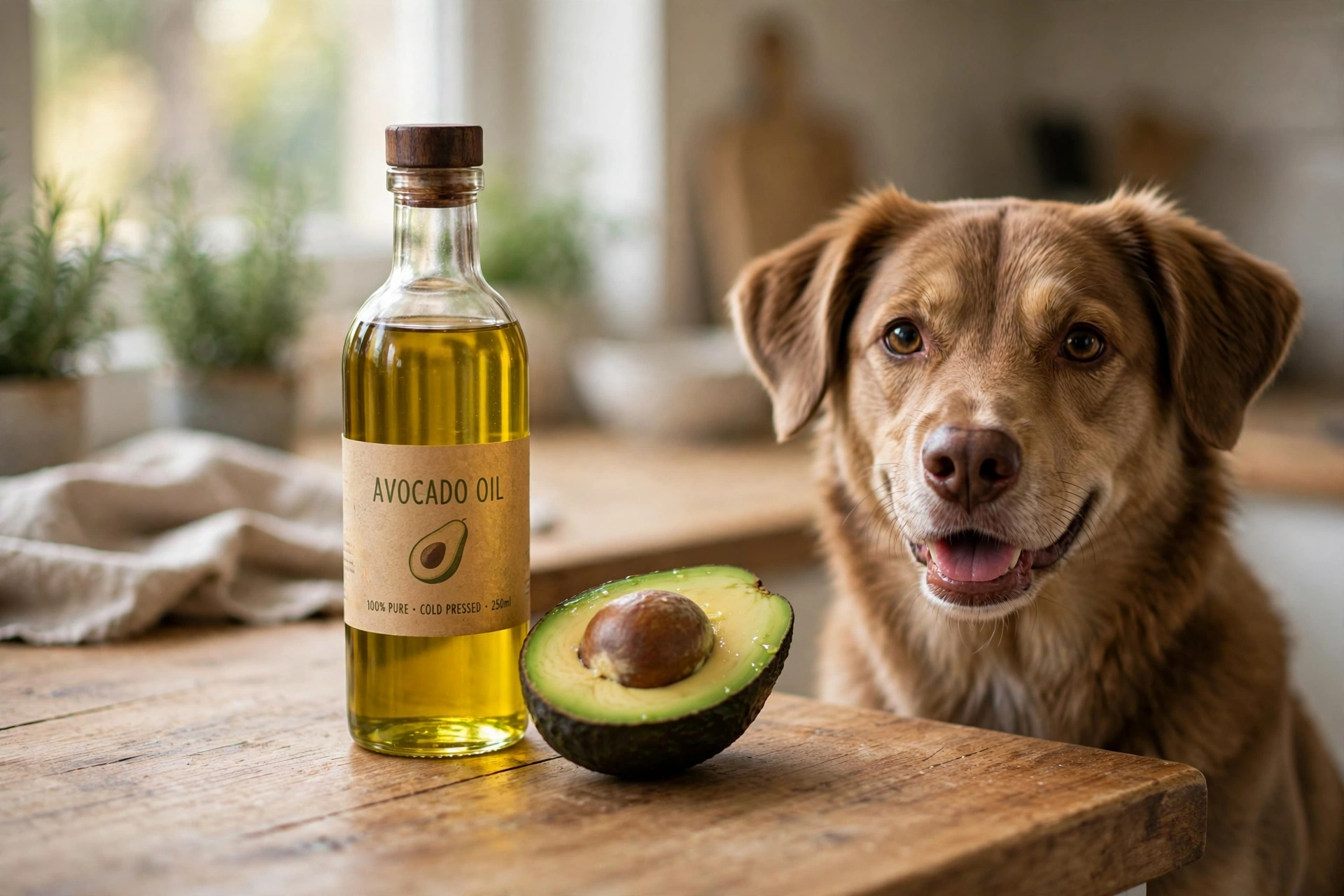

You’ve probably heard two opposite things about avocados and dogs. One camp says avocado is poison, full stop. The other points at the dog foods and skin sprays with avocado oil on the label and shrugs. So, can dogs have avocado oil?
Yes, in most cases they can. Avocado oil contains no persin, the compound that makes other parts of the avocado plant a problem, and it’s rich in the kind of healthy fats that support skin and coat. The catch isn’t toxicity. It’s that oil is pure fat, and pure fat has to be fed in teaspoon territory, not poured with a free hand.
Here’s the full picture: why the oil is different from the fruit, what it can actually do for your dog, how much to give, and which dogs are better off without it.
Can dogs have avocado oil? The short answer
Yes. Plain avocado oil is generally safe for healthy dogs in small amounts. The American Kennel Club confirms the oil carries no persin, so it isn’t toxic to dogs the way avocado leaves or skin can be. A dog who licks a bit off the floor or steals a taste from your salad bowl is not an emergency.
That said, “safe” and “pour it on every meal” are two different things. Avocado oil is roughly 120 calories a tablespoon, and those calories ride on top of a diet that’s already supposed to be complete. Used lightly, as a drizzle a few times a week or in small daily amounts, it can earn its place. Used carelessly, it’s a fast route to a round belly and a sore pancreas.
Why is avocado oil different from the rest of the avocado?
The worry around avocados comes from a compound called persin. It’s a natural fungicide the plant makes to protect itself, and it’s spread very unevenly through the plant:
| Part of the avocado | Persin level | Safe for dogs? |
|---|---|---|
| Leaves and bark | Highest | No, keep dogs away from the tree entirely |
| Pit (seed) | High, plus a choking and blockage risk | Never |
| Skin | High | No |
| Flesh | Low | Small amounts are tolerated by most dogs |
| Oil | None | Yes, in small amounts |
Birds and large farm animals are the ones persin hits hardest. Dogs are far more resistant, and the usual outcome of a dog eating avocado flesh is an upset stomach, vomiting or diarrhea from the sheer fat content rather than true poisoning. Still, the pit is a genuine danger for any dog: it’s exactly the right size and shape to get stuck in a throat or lodge in the gut, and that means surgery.
Avocado oil skips the whole problem because of how it’s made. The oil is pressed or refined out of the flesh, and the persin doesn’t come with it. What’s left is fat, vitamin E and very little else. That’s also why you’ll find avocado oil listed in commercial dog foods and coat products without any warning labels.
One version that is not fine: guacamole. It isn’t the avocado in it that worries vets most, it’s the onion and garlic mixed through it, and both of those can damage a dog’s red blood cells. Flavored cooking oils infused with garlic or chili belong in the same “not for the dog” category.
What are the benefits of avocado oil for dogs?
Avocado oil is mostly monounsaturated fat, dominated by oleic acid, the same fat that makes olive oil a kitchen favorite. It also carries vitamin E and small amounts of other fat-soluble nutrients. For a dog, that translates into a few practical things:
- Skin and coat support. Healthy fats help keep skin moisturized from the inside, and owners usually notice it first as a softer, glossier coat and less dry flakiness in winter.
- Help absorbing vitamins. Vitamins A, D, E and K need fat to be absorbed properly. A little oil over a meal that includes vegetables helps a dog actually use what he’s eating.
- A boost for picky eaters. A teaspoon drizzled over kibble makes dinner smell and taste richer. For the dog who wanders off from a half-finished bowl, that can be the difference between meals eaten and meals skipped.
- Concentrated energy. Working dogs, very active dogs and dogs who struggle to hold weight burn through calories fast, and a measured drizzle is an easy way to add some.
What avocado oil doesn’t have much of is omega-3. It contains a little of the plant form, ALA, but dogs convert that to the useful EPA and DHA forms poorly. That matters for the comparison section below: avocado oil is a skin-and-coat oil, salmon oil is the joint-and-inflammation oil.
How do you give avocado oil to your dog?
The simplest way is also the best one: drizzle it over your dog’s regular food and stir it in so it coats the kibble rather than pooling at the bottom of the bowl. You can also stir it into wet food, smear a thin layer on a lick mat, or use it in homemade baked treats, where it replaces part of the fat you’d use anyway.
Start smaller than you think you should. A brand-new fat source dropped into a diet at full amount is a classic recipe for loose stools, so begin at the starting amount below, hold it for a few days, and only step up if the poop stays normal.
| Dog size | Start with | Working up to |
|---|---|---|
| Toy and small (up to 10 lb) | A few drops | 1/4 to 1/2 teaspoon a day |
| Small to medium (10–25 lb) | 1/4 teaspoon | 1/2 to 1 teaspoon a day |
| Medium (25–50 lb) | 1/2 teaspoon | 1 to 2 teaspoons a day |
| Large (over 50 lb) | 1 teaspoon | 2 teaspoons to 1 tablespoon a day |
Two habits keep this sensible. First, count the oil as part of your dog’s food, not an extra on top. If the oil becomes a daily fixture, trim the kibble by a small handful to cover the calories. Second, watch the waistline over the first month. You should be able to feel ribs under a thin layer of fat. If the ribs start disappearing, the oil is the first thing to cut back.
Buying it is easy too. Plain is the whole rule: a bottle whose only ingredient is avocado oil, ideally cold-pressed or refined for cooking, with no garlic, onion, herb or chili infusions. Keep it in a dark cupboard, and give it a sniff now and then. Oil that’s gone rancid smells sharp and stale, and rancid oil goes in the trash, not the dog bowl.
What are the risks of avocado oil for dogs?
The risks all trace back to one word: fat.
Weight gain. Oil is the most calorie-dense thing in your kitchen. A tablespoon of avocado oil carries about as many calories as a small dog’s entire snack allowance for the day, and it takes weeks of “just a drizzle” to show up as a dog who no longer fits his harness. Slow, invisible, and completely avoidable if you measure.
Pancreatitis. The pancreas does the heavy lifting of digesting fat, and in dogs prone to pancreatitis a fatty addition can be the trigger for a flare. That’s a painful, potentially serious condition, and it’s the main reason the AKC advises checking with your vet first if your dog has had pancreatitis before or is already overweight. Miniature Schnauzers and dogs with high blood fats sit in the higher-risk group too.
Loose stools. Too much oil, or a sudden jump from none to plenty, commonly loosens the stool for a day or two. It usually settles once you drop back to a smaller amount, and our guide on what to give a dog for diarrhea covers what to feed while things firm up. Vomiting alongside it, or diarrhea that drags past a day, is a vet call rather than a wait-and-see.
The wrong bottle. Garlic-infused, chili and herb-blended oils are the trap in an otherwise safe cupboard. Dogs lick spills and beg at counters, so if a flavored oil goes into your cooking, keep the bowl and the dog in different postcodes until the dishes are done.
Avocado oil vs salmon oil vs coconut oil: which one wins?
These three get recommended side by side in almost every pet shop, and they’re not interchangeable. Here’s the honest comparison:
| Avocado oil | Salmon oil | Coconut oil | |
|---|---|---|---|
| Main fats | Monounsaturated (oleic acid) | Omega-3 EPA and DHA | Saturated, mostly MCTs |
| Best for | Skin, coat, picky eaters, adding calories | Joints, inflammation, heart, brain, itchy skin | Occasional skin and coat use |
| Persin or toxin concerns | None | None | None |
| Main watch-out | Calories and total fat | Can go rancid fast, fishy breath, quality varies | Calories, loose stools, vets are split on the benefits |
If your goal is a dog whose coat looks like he’s just left the groomer, avocado oil is a solid, affordable pick. If your goal is creaky joints, seasonal itching or an older dog’s brain, salmon oil is the stronger tool, because the AKC’s guide to fish oil for dogs points to EPA and DHA as the fatty acids that do that work, and dogs use them directly instead of converting them from plant sources.
Coconut oil is the one to be most measured about. PetMD’s vets flag that many of its claimed benefits rest on thin evidence, while the downsides — diarrhea, weight gain and pancreatitis risk — are the same fat problem in a different jar. None of the three is magic, and none should be fed by the spoonful.
When should you skip avocado oil and call the vet?
Some dogs should simply not have it. Skip the avocado oil, or at least get your vet’s green light first, if your dog:
- Has had pancreatitis, or has been told his blood fats run high
- Is overweight and already on a weight-loss plan
- Eats a prescription low-fat diet for a medical condition
- Has a stomach that reacts to every small diet change
And call the vet promptly if, after eating a lot of oil or fatty food, your dog starts vomiting repeatedly, goes off his food, hunches or stretches into the “prayer position” with his front end down and rear up, whines when his belly is touched, or seems suddenly tired and flat. Those are classic pancreatitis signs, and they pair with the warning signs in our guide on why your dog is throwing up yellow. Pancreatitis is one of those problems where early treatment makes a real difference, so don’t wait it out over a weekend.
Conclusion
So, can dogs have avocado oil? Yes. It’s the one part of the avocado with none of the persin problem, and in small, measured amounts it can genuinely help a dog’s skin, coat and appetite for dinner. The oil was never the risky bit of the avocado. The leaves, skin and pit are, along with the onion and garlic hiding in guacamole.
Treat it like any other rich extra: teaspoons, not glugs, introduced slowly, with the calories taken off somewhere else in the bowl. Do that, and avocado oil is a perfectly sensible thing to keep in the cupboard for your dog. Just keep the bottle of it somewhere the dog can’t reach. They like the taste rather more than is good for them.
Frequently asked questions
Is avocado oil toxic to dogs?
No. Avocado oil contains no persin, which is the compound behind the avocado warnings. Persin is concentrated in the leaves, bark, skin and pit of the avocado, and even there, dogs are much less sensitive to it than birds or farm animals. The oil is pressed from the flesh and refined, so what reaches the bottle is fat and vitamin E, not toxin. The pit is still a choking and blockage hazard, so the whole fruit stays off the menu.
How often can my dog have avocado oil?
For most healthy dogs, a small amount daily is fine as long as it fits inside their calorie needs, and plenty of owners use it a few times a week instead. The deciding factors are your dog’s weight and waistline, not the calendar. If he’s gaining, cut the frequency before you cut the amount, and if he only needs it to make kibble interesting, the days he turns his nose up are the days to use it.
Can puppies have avocado oil?
A tiny taste won’t hurt a weaned puppy, but there’s rarely a need. Puppy food is already formulated with the fat levels a growing dog needs, and extra oil mostly adds calories and a chance of runny poop at an age when tummies upset easily. If a vet has suggested oil for a puppy’s dry skin, follow their amount exactly. Otherwise, wait until your dog is on adult food and his stomach is a bit more forgiving.
Can I put avocado oil on my dog’s skin and coat?
You can, and some owners use a few drops rubbed between their palms and smoothed over a dry, flaky coat. Two things to expect: your dog will try to lick it off, which effectively turns it into food, so count it toward what he’s eaten, and a heavy hand leaves a greasy dog and greasy furniture. A small amount worked in before a bath, then rinsed, gives the softening effect without the slip-and-slide afterwards.
Can dogs eat avocado flesh instead of the oil?
Small amounts of ripe flesh are generally tolerated by dogs, and the AKC suggests capping it at roughly a teaspoon per 10 pounds of body weight. It’s high in fat, though, and it comes with the job of keeping the skin and pit well away from your dog. The oil is simply the tidier option: no waste, no pit to guard, and an amount you can measure with a spoon. Dogs who’ve had pancreatitis should skip both forms.
Related Articles