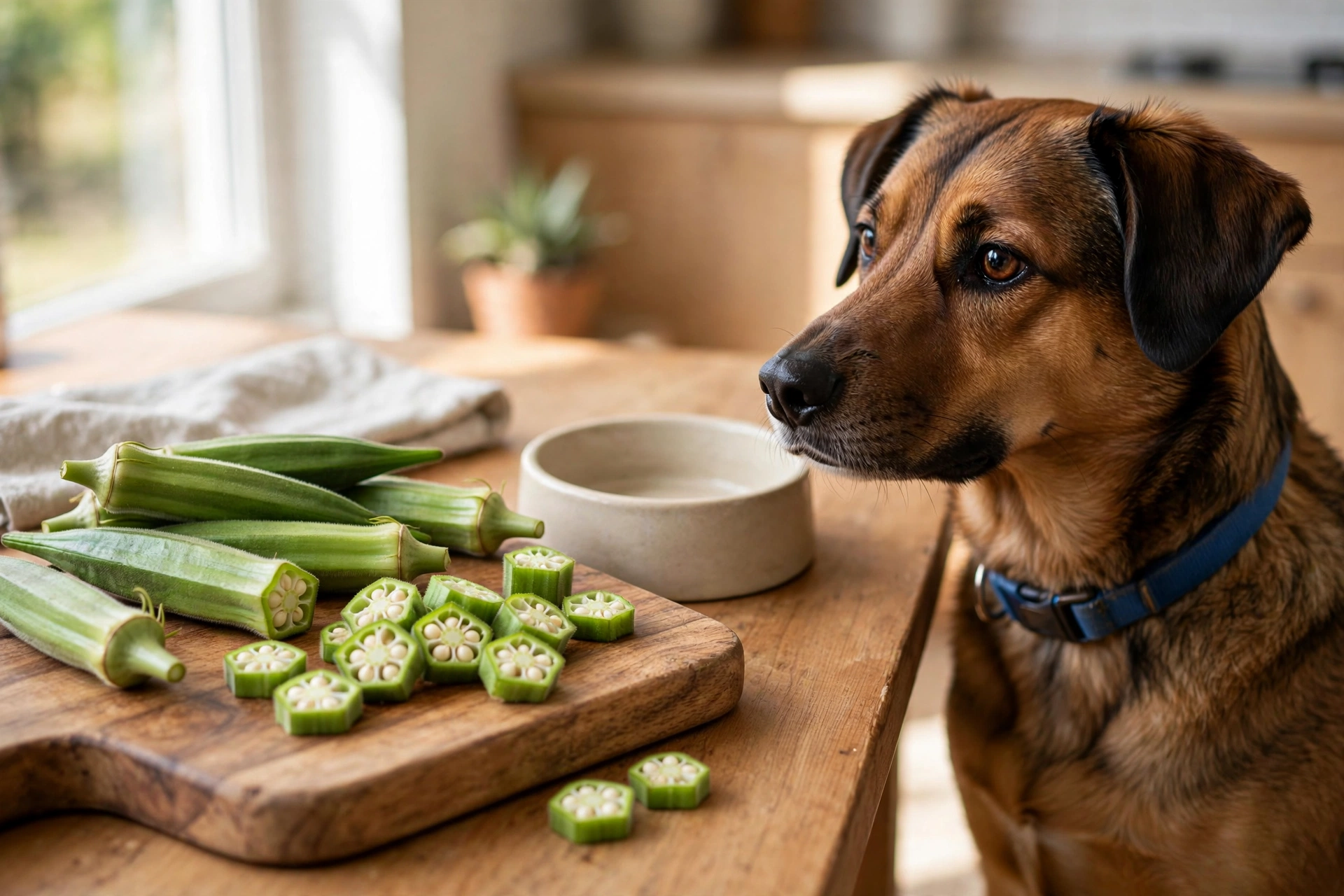

If you’ve ever cooked okra while a dog sat at your feet doing his best starving act, you’ve probably asked the question: can dogs eat okra? Yes, they can. Plain okra is a safe vegetable for dogs, it’s not on the ASPCA’s toxic plant list, and it brings some genuinely useful nutrition to the bowl — fiber, folate, vitamins C and K, magnesium and potassium, all for very few calories.
The catch is in the preparation. The okra your dog can eat is the plain stuff, raw or lightly cooked, chopped into sensible pieces. The okra he can’t have is the kind most of us actually enjoy: fried, pickled, or slathered in seasoning. Here’s the full rundown on what okra does for a dog, how much to give, and the texture problem that makes some dogs walk away from it entirely.
What’s actually in okra?
Okra doesn’t get much attention in the dog world, partly because half the humans in the house won’t eat it either. Nutritionally, though, it holds its own against the vegetables owners usually reach for. A rough guide to what’s in 100 grams of raw okra — that’s about a cup of sliced pods:
| Nutrient | Rough amount | Why it matters for your dog |
|---|---|---|
| Calories | About 33 | Very low — okra fills space in the bowl without filling your dog out |
| Fiber | About 3 grams | Supports digestion and helps a dog feel full on fewer calories |
| Folate | A solid share of the daily picture | Supports cell growth and blood health; especially relevant for breeding dogs |
| Vitamin C | About 23 mg | An antioxidant; dogs make their own, but a dietary top-up does no harm |
| Vitamin K | About 31 micrograms | Plays a role in normal blood clotting and bone health |
| Magnesium and potassium | Meaningful amounts | Support muscles, nerves and fluid balance |
Two honest footnotes. First, no dog eating a complete, balanced dog food needs okra — his dinner already covers his vitamins. Okra’s real value is as a treat that isn’t junk: something crunchy and interesting that won’t undo his waistline. Second, the fiber is a double-edged sword. A little helps digestion along; a lot produces the kind of gas that clears a room. Portion size is where okra is won or lost, and we’ll get to that below.
Should okra for dogs be raw or cooked?
Both work, and the better choice mostly depends on your dog.
Raw okra is crisp, mild and easy. Wash the pods, trim off the stem end, and slice them into coins. Plenty of dogs take a raw slice as happily as a piece of carrot, and raw is the version with the least slime, which matters more than you’d think — the slime section below explains why. Raw slices also make handy low-calorie training treats for dogs who work for food of any description.
Cooked okra is softer and easier on a stomach that’s new to it. Steam it or boil it briefly, until it’s just tender, and serve it plain — no butter, no oil, no salt, no garlic powder, nothing from the spice rack. Steaming keeps more of the nutrients in the pod than boiling it to death in a big pot of water. Let it cool properly before it goes anywhere near your dog; dogs are not patient about hot food and a scalded mouth is a silly injury.
What about frozen okra from the supermarket bag? That’s fine too, and often cheaper. Thaw it, check the bag says nothing but okra (no sauce, no seasoning blend), and chop it up the same way.
Whatever form you choose, introduce it the way you’d introduce any new food: a couple of slices the first day, then watch what comes out the other end over the next 24 hours. A dog whose stomach handles it well can have it as a regular in the treat rotation.
Which kinds of okra should dogs never get?
This is the section that matters most, because the okra on your own plate is usually dressed up in ways that range from unhelpful to dangerous.
| Form | Verdict | Why |
|---|---|---|
| Plain raw, steamed or boiled okra | Fine | Nothing added, easy to portion, easy to digest |
| Fried okra | Skip it | Batter plus hot oil means a lot of fat; fatty food is a known trigger for pancreatitis, and the batter often carries salt and seasoning |
| Pickled okra | Skip it | Pickling brine is salty and acidic, and many recipes include garlic — which is genuinely toxic to dogs — along with chillies and spices |
| Okra in gumbo or stew | Skip it | Traditional recipes start with onion and garlic, both toxic to dogs, and are usually rich and salty besides |
| Canned okra | Mostly skip it | Often packed with a lot of sodium; if it’s all you have, rinse it well and treat it as a one-off |
| Okra cooked with butter, bacon or stock cubes | Skip it | Fat and salt again, and stock products frequently contain onion powder |
The pattern is easy to remember: the plainer it is, the safer it is. If you’d describe the dish with an adjective — crispy, spicy, tangy, smoky — it’s your dinner, not the dog’s.
The American Kennel Club’s guide to human foods dogs can and can’t eat makes the same general point about sharing from your own plate: even safe ingredients stop being a good idea once they’ve been cooked the human way, and treats and extras of any kind should stay under about 10% of a dog’s daily food.
How much okra can a dog eat?
Think of okra as a treat, not a food group. That 10% guideline above is the ceiling for all extras combined, and okra should only ever be a small part of it. Practical amounts look like this:
| Dog size | Example breeds | Amount per serving |
|---|---|---|
| Small (under 10 kg) | Chihuahua, Yorkshire Terrier, Dachshund | 1–2 slices, or about a quarter of a pod, chopped small |
| Medium (10–25 kg) | Beagle, Border Collie, Cocker Spaniel | 2–4 slices, or about half a pod |
| Large (over 25 kg) | Labrador, German Shepherd, Golden Retriever | 1–2 whole pods, chopped into coins |
A few times a week at those amounts is plenty. Chop it, always. A whole okra pod is a slippery, roundish object, and dogs who gulp rather than chew — which is most of them, given half a chance — can get a whole pod stuck. Slices can’t block an airway the way a whole pod can, and small dogs especially should never be handed a pod intact and left to figure it out.
One more portion note: okra contains calcium oxalates, as a lot of leafy and pod vegetables do. At treat-sized amounts that’s a non-issue for a healthy dog. But if your dog has ever had calcium oxalate bladder stones, or your vet has put kidney or bladder health on the watch list, ask the vet before making okra a habit. It costs you one question at the next checkup and removes the guesswork.
Why do some dogs refuse okra? The slime problem
Cut a cooked okra pod open and you’ll meet the mucilage — the slippery gel inside the pod that thickens soups and divides families. Dogs are split on it in exactly the same way people are. Some inhale okra in any form. Others take one bite of a steamed slice, get the slimy texture on their tongue, and give you a look of deep betrayal before spitting it onto the floor.
If your dog is in the second camp, a few things are worth trying before you give up:
- Serve it raw. Raw slices are crisp and barely slimy at all. This fixes the problem for most refusers.
- Chop it small and mix it in. A few coins stirred through his normal dinner disappear into the general enthusiasm for food.
- Freeze the slices. A frozen okra coin on a warm day is a crunchy little project, and frozen texture hides the gel almost completely.
- Don’t cook it for long. The longer okra cooks, the more gel it releases. A brief steam keeps it firmer than a long boil.
And if he still won’t touch it? Let it go. Okra is a nice extra, not a nutritional necessity, and there are plenty of dogs who will live long, smug, okra-free lives on green beans and carrot sticks instead.
Can okra upset a dog’s stomach?
It can, if the introduction is rushed or the portion gets ambitious. Okra’s fiber is the usual suspect: too much fiber, too fast, and you’ll see loose stools, extra gas, or a dog who’s a bit gurgly and sorry for himself for an evening. It passes. The fix is to go back to a smaller amount and build up over a week or so, or just accept that your dog’s stomach prefers its vegetables in smaller doses.
True allergic reactions to okra are rare, but with any new food it’s worth watching the first few times for itching, face rubbing, ear scratching or hives. If you see any of that, okra comes off the menu and, if the signs are more than mild, your vet gets a call.
A dog whose stomach gets genuinely upset — repeated vomiting, watery diarrhea, no interest in his normal food — needs more than a watch-and-wait approach. Our guide on what to give a dog for diarrhea covers the home care basics and the point at which diarrhea stops being a home problem and becomes a vet visit. For most dogs, though, okra trouble never gets past the windy stage.
Easy ways to serve okra to your dog
Once you’ve got a dog who likes it, okra earns its keep as one of the cheaper, lower-calorie treats in the fridge. A few ways owners actually use it:
- Kibble topper: a small handful of chopped raw or steamed okra stirred through dinner adds crunch and interest for a dog who’s gone lukewarm on his usual food.
- Training treats: raw coins are easy to carry, don’t crumble in your pocket like biscuits do, and won’t blow the calorie budget of a small dog in a long training session.
- Frozen summer treats: freeze slices on a tray and hand them out on hot afternoons. Crunchy, cold, and they take a minute to eat.
- Dehydrated okra chips: if you have a dehydrator or a low oven and some patience, plain dried okra slices make a shelf-stable, crunchy snack. Still no salt, still no seasoning.
- Filler for hungry dogs: a dog on a weight-loss plan who acts betrayed by his smaller dinner portions can be fooled, a little, by vegetables like okra bulked into the bowl. The fiber helps him feel fed.
Conclusion
So, can dogs eat okra? Yes — plain okra, raw or lightly cooked, chopped into slices, in treat-sized amounts. It’s low in calories, decent in fiber and vitamins, and safe enough that it doesn’t appear on the ASPCA’s toxic list. Just keep the fried, pickled and seasoned versions on your side of the table, chop whole pods so they can’t be gulped down intact, and start small so the fiber doesn’t make its presence known all evening.
Not every dog will love it, and the slime will lose you a few. That’s fine. Feeding a dog a vegetable he enjoys at 30-odd calories a serving beats another handful of biscuits — and if yours turns out to be one of the okra enthusiasts, you’ve found one of the cheapest treats going.
Frequently asked questions
Can dogs eat okra every day?
A small amount daily won’t hurt a healthy dog, but there’s no reason to make it a daily fixture. A few servings a week keeps it in treat territory, leaves room for variety, and keeps the fiber level where his stomach is comfortable. Variety matters with extras — rotate okra with other safe vegetables like green beans, carrot and cucumber rather than leaning on one.
Can puppies eat okra?
Yes, once they’re weaned and eating solid food well, a tiny piece of chopped, plain okra is fine for most puppies. Keep it very small — puppy stomachs are easily tipped over by new foods, and a puppy’s serving is a slice or two, not a pod. Chop it finer than you would for an adult, because puppies are champion gulpers, and skip it entirely for very young puppies who are still mostly on their puppy food routine.
Can dogs eat the seeds inside okra?
Yes. Unlike some fruits, where the seeds are the dangerous part, okra seeds are soft, small and digestible, and they go down with the rest of the pod. There’s no need to scoop them out. The parts to remove are the tough stem end and any woody tip on an overgrown pod — those are more about texture and choke risk than toxicity.
Is frozen okra okay for dogs?
It is, as long as it’s just okra. Plain frozen pods or slices, thawed or served frozen in small pieces, are a perfectly good option and often the most economical one. Read the bag before you buy: some frozen vegetable products come with butter sauce, seasoning blends or salt already on them, and those versions stay off the dog’s menu.
What if my dog ate a whole pod, stem and all?
Don’t panic. A whole raw pod is not toxic, and in a medium or large dog it will almost certainly pass through uneventfully, possibly after a gurgly evening. The real concerns are choking at the moment of eating — which you’d have seen straight away — and a stomach upset from a sudden load of fiber. Watch him for the rest of the day, make sure he’s drinking and eating normally, and call your vet if he’s repeatedly sick, straining, or off his food the next day.
Related Articles



[…] Can Dogs Eat Okra? Yes — Here’s How to Serve It Safely […]
[…] Can Dogs Eat Okra? Yes — Here’s How to Serve It Safely […]