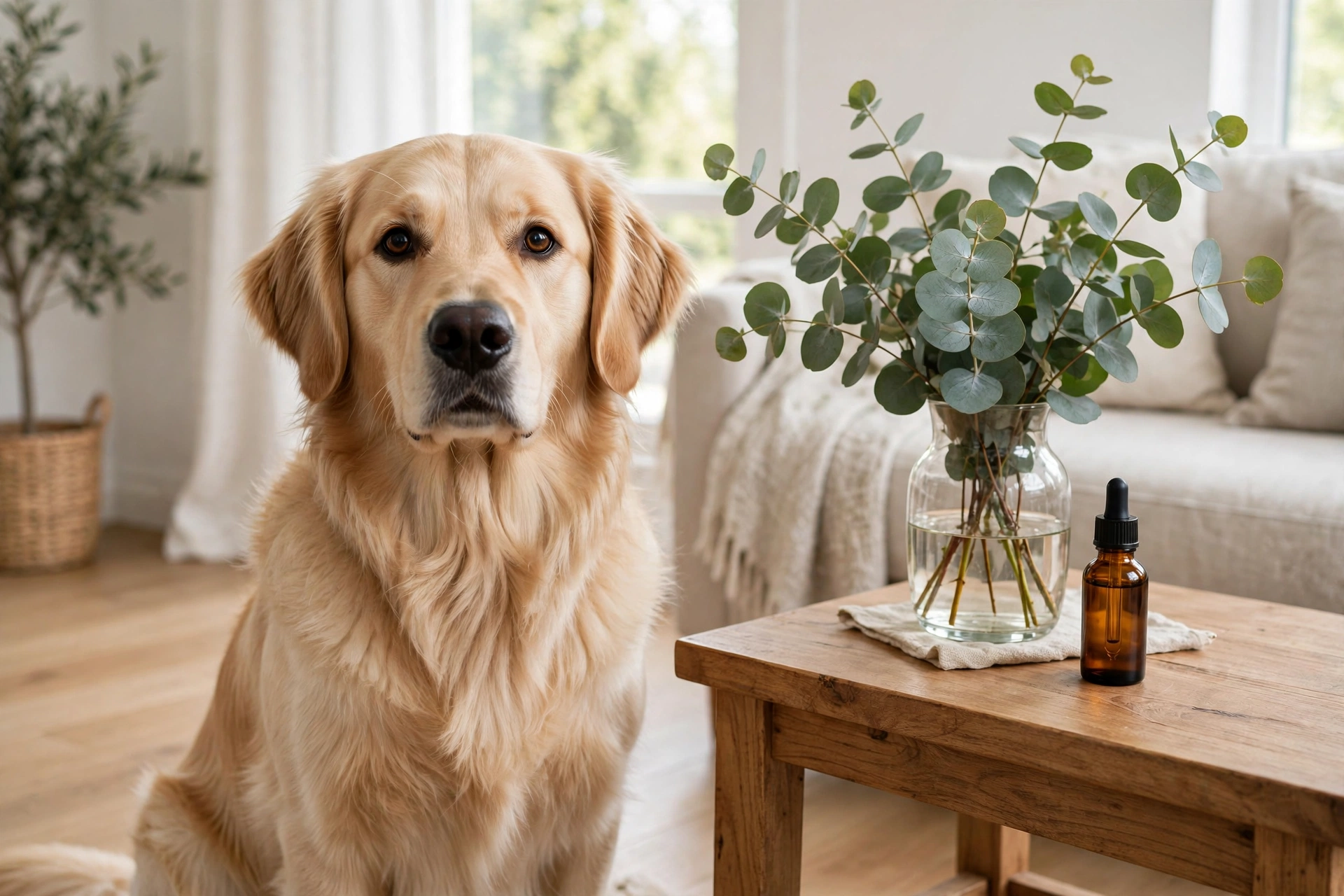

Eucalyptus is everywhere at the moment. It hangs in bunches over shower heads, stands in tall vases in living rooms, and bubbles away in diffusers that promise a home that smells like a spa. If a dog shares that home, a fair question follows: is eucalyptus safe for dogs?
The short answer is no. Eucalyptus sits on the ASPCA’s list of plants that are toxic to dogs, and the essential oil made from it is the most concentrated, riskiest form of all. That doesn’t mean a vase on a high shelf is an emergency waiting to happen. It does mean the leaves, the oil and the diffuser all need treating with respect, because a dog experiences them very differently from the way you do.
Is eucalyptus safe for dogs? The short answer
No, it isn’t. The ASPCA’s toxic plants database lists eucalyptus as toxic to dogs, cats and horses, and names the culprit clearly: the essential oils in the plant, chiefly a compound called eucalyptol. According to the ASPCA, a dog that eats eucalyptus can develop drooling, vomiting, diarrhea, depression and weakness.
How sick a dog gets depends on two things: how much got in, and how concentrated it was. Those two factors split eucalyptus into very different levels of risk:
| Form | Where you’ll find it | Risk to dogs |
|---|---|---|
| Fresh or dried leaves | Shower bunches, wreaths, vases, potted plants | Toxic if eaten; chewing can also irritate the mouth |
| Essential oil | Small bottles for diffusers, cleaning mixes, chest rubs | The most concentrated form; dangerous if licked, swallowed or put on skin |
| Active diffuser | Ultrasonic and nebulizing diffusers | Sprays fine oil droplets that can land on the coat and be licked off, or be breathed in |
| Passive diffuser | Reed diffusers, scented candles | No droplets sprayed, but the strong scent can irritate airways, and spilled oil is a real hazard |
| Finished pet products | Some dog shampoos and sprays with tiny diluted amounts | Far lower risk, but read the label and stop if your dog reacts |
Notice where the danger concentrates. A dog would have to chew a fair mouthful of leaves to get seriously ill. A few licks of bottled oil can deliver the same compounds in a fraction of the time, because that little bottle holds the distilled essence of a great many leaves.
Why is eucalyptus toxic to dogs?
Eucalyptol is what gives eucalyptus its sharp, medicinal, clear-your-sinuses smell. In people, used properly, it’s the active feel-good ingredient in chest rubs and cough sweets. A dog’s body handles it differently.
Swallowed, eucalyptol irritates the stomach and gut, which is where the drooling, vomiting and diarrhea come from. Absorbed in larger amounts, it can affect the nervous system, producing the wobbliness, tremors and, in severe cases, seizures that the Pet Poison Helpline lists among the signs of essential oil poisoning in dogs. The liver has to process and clear these compounds, which is one reason size matters so much. The same lap of spilled oil is a far bigger dose for a 3-kilo Chihuahua than for a 35-kilo Labrador, and puppies, elderly dogs and dogs with liver problems have the least margin for error.
Cats, for the record, are more sensitive still — they lack some of the liver enzymes needed to break these compounds down.
What is the difference between the plant, the oil and a diffuser?
These three get lumped together in most conversations, and they really shouldn’t be. The right precautions depend on which one you’re dealing with.
The plant itself. Fresh eucalyptus carries its oils inside the leaves, so the hazard is a dog chewing and swallowing them. Dried eucalyptus is not a safe workaround. The bunches sold for showers and wreaths still contain eucalyptol, and drying does nothing to remove it. Dry leaves also drop. A bunch over the shower head sheds the odd leaf onto the bathroom floor, right at nose height for a dog who likes to supervise bath time.
The essential oil. This is the form that causes the serious cases. Bottled eucalyptus oil is close to 100% concentrated plant compounds, and it should never be put on a dog’s skin or coat, added to bath water, or used as a home flea treatment, whatever a social media post suggests. Dogs lick. Oil on fur is oil swallowed, and oil on skin can be absorbed as well as irritate. Keep bottles in a closed cabinet, wipe spills straight away, and treat a knocked-over bottle the way you’d treat spilled medicine.
Diffusers. The Pet Poison Helpline draws a useful line between the two types. Passive diffusers — reed sticks, candles, warmers — simply let the scent evaporate, so no oil droplets are sprayed into the air. Their main hazard is respiratory irritation from a strong smell, plus what happens if the dog knocks the thing over. Active diffusers — the ultrasonic and nebulizing kind — push a fine mist of oil droplets out into the room. Those droplets settle on surfaces, including your dog’s coat, and get licked off during grooming. If your dog already struggles with his airways, our guide to why your dog is breathing fast explains which breathing changes should never be ignored, and a mist-filled room is exactly the sort of trigger that can set a sensitive dog off.
What happens if a dog eats eucalyptus or licks the oil?
It helps to think in three scenarios, because the response to each one is different.
A chewed leaf or two. This is the most common incident and usually the mildest. Expect drooling, lip-smacking and a disgusted expression first, because the taste is bitter and the oils irritate the mouth. Vomiting or a loose stool may follow within hours. Many dogs stop at a nibble because it tastes awful.
Licked oil, or oil on the coat. This is a step up. Drooling and pawing at the mouth can start quickly, vomiting is common, and larger amounts can bring on wobbliness, tremors, low body temperature and, at the serious end, seizures. Don’t wait for the full list to appear before picking up the phone.
Breathing in strong vapor. Dogs stuck in a small, closed room with a diffuser running can develop watery eyes, sneezing, coughing and faster or noisier breathing. Owners sometimes assume a new cough like that means a cold — our breakdown of whether dogs can get colds covers the real thing — but if the cough started the same afternoon a diffuser did, the scent is the first suspect. Fresh air, diffuser off.
| Exposure | Signs to expect | How urgent |
|---|---|---|
| Nibbled a leaf | Drooling, lip-smacking, maybe vomiting or diarrhea | Call your vet for advice and keep a close eye on him |
| Licked spilled oil or oil on fur | Heavy drooling, pawing at the mouth, vomiting, wobbliness | Call your vet or a poison helpline straight away |
| Coughing or wheezing near a diffuser | Watery eyes, coughing, fast or laboured breathing | Fresh air immediately; vet the same day if it doesn’t settle fast |
Timing is worth knowing: mouth irritation and drooling can show up within minutes of licking oil, while stomach signs after eating leaves typically develop over the following few hours. “He seems fine so far” twenty minutes after eating a bunch of leaves is not the all-clear.
What should you do if your dog is exposed to eucalyptus?
Work through these in order.
- Get the dog away from the source. Out of the room, diffuser off, plant or bottle moved out of reach. Fresh air first if there’s any coughing or breathing change.
- Wash oil off skin and coat. If your dog has oil on his fur, a bath with lukewarm water and a mild dog shampoo or a little dish soap stops him grooming it off and swallowing it.
- Do not make him vomit. Oils can be inhaled into the lungs on the way back up and cause a nasty pneumonia on top of everything else. Inducing vomiting is a vet’s call, never a kitchen decision.
- Call for expert advice. Ring your own vet, or the ASPCA Animal Poison Control Center on (888) 426-4435 — a consultation fee may apply. Say what the product was, roughly how much is missing, and when it happened.
- Take the evidence with you. The bottle, a photo of the plant, or the product label tells the vet exactly what they’re dealing with. Guessing wastes time.
- Keep watching. Even a dog who seems to bounce back should be monitored for the rest of the day, because gut and nervous-system signs can trail behind the exposure.
There is no specific antidote for eucalyptus poisoning. Treatment is supportive — anti-nausea medication, fluids, and monitoring, with extra care if tremors or seizures develop — which is why an early phone call matters more than any home remedy. Tufts University’s veterinary school makes the same point in its guide to essential oil risks for pets: small and young animals get hit hardest.
Why do some products claim eucalyptus is fine for dogs?
This is where most of the confusion comes from, and it’s understandable confusion.
A finished pet product that lists eucalyptus low down its ingredients has been formulated and diluted to a tiny fraction of the strength in your diffuser bottle. The problem is rarely the word “eucalyptus” on a label. It’s concentration and control, and DIY mixtures give you neither.
“Natural” does a lot of misleading work here too. Eucalyptus oil is natural. So are plenty of things dogs shouldn’t eat. Human products bring extra hazards of their own, too — some cough and cold remedies contain xylitol, a sweetener that’s genuinely dangerous to dogs. Reason enough to keep the bathroom cabinet shut.
And a word about proximity, because owners worry about this: walking past a eucalyptus tree, or sniffing a vase across the room, is not poisoning. Dogs are harmed by eating the plant, licking the oil, or breathing concentrated vapor in an enclosed space. Keep those away from the dog, and ordinary life can carry on.
How can you get the fresh smell without the risk?
Honestly, the biggest source of “dog smell” in most houses is not the air. It’s the bedding, the sofa throw and the rug the dog has claimed. Wash those weekly and half the battle is won. For the rest:
- Air the house out. Twenty minutes of open windows beats any scented product and costs nothing.
- Use a stovetop simmer pot. Water with apple slices, cinnamon sticks and orange peel, kept at the lowest simmer while you’re in the kitchen, gives a warm, fresh smell with no concentrated oils floating around.
- Lean on baking soda. Sprinkled on rugs and soft furnishings, left for half an hour and vacuumed up, it lifts odors instead of masking them. Keep the dog out of the room until you’ve vacuumed.
- Store scent products like medicines. Oils and reed diffusers live in closed cabinets or on shelves a dog genuinely cannot reach, never on coffee tables at tail height.
- If your household insists on a diffuser, choose a passive one over an active mister, run it briefly in a ventilated room your dog can walk out of, and never in a closed car or small shut room. Skip it entirely for puppies, elderly dogs, and dogs with breathing or liver problems.
Or take the simplest route: retire the eucalyptus oil, and keep the plant only where it can be admired from a distance and never chewed.
When is eucalyptus exposure an emergency?
Skip the monitoring and go straight to a vet — or call a poison helpline while someone drives — if you see any of the following:
- Tremors, twitching or a seizure
- Wobbliness, as if the dog is drunk, or collapse
- Laboured, noisy or very fast breathing that doesn’t settle within minutes in fresh air
- Repeated vomiting, or vomiting with obvious weakness
- A puppy, a tiny breed, or a dog with liver or breathing problems who has licked oil, whatever the amount
With poisoning, dogs do best when their owners ring early, while the signs are still mild.
Conclusion
So, is eucalyptus safe for dogs? No. The plant is on the ASPCA’s toxic list, the essential oil is a concentrated version of the same hazard, and diffusers spread that hazard through the air and onto your dog’s coat. Most real-world incidents — a chewed leaf, a supervised sniff of a vase — end with drooling and a miserable afternoon rather than a disaster. The cases that turn serious almost always involve the bottled oil.
You don’t have to choose between a dog and a house that smells decent. You just have to keep the eucalyptus in the places a dog’s mouth, tongue and lungs never reach, and reach for the washing machine and an open window before you reach for the diffuser.
Frequently asked questions
Can dogs smell eucalyptus, or is even the scent dangerous?
Smelling eucalyptus from across a room is not, by itself, poisoning. The risk comes from eating the plant, licking the oil, or breathing concentrated vapor in a small enclosed space. That said, a dog’s nose is far more sensitive than yours, so if you see watery eyes, sneezing, coughing or your dog pointedly leaving the room, the scent is too strong for him even if it’s pleasant for you. Believe the dog.
Is dried eucalyptus safer than fresh eucalyptus for dogs?
No. Dried eucalyptus still contains eucalyptol, so a chewed wreath or shower bunch is still a toxic snack. Dried material brings one extra problem: it sheds. Fallen leaves on a bathroom or hallway floor are exactly where a curious dog will find them.
Can I use eucalyptus oil as a flea treatment for my dog?
Please don’t. Applying concentrated essential oils to a dog’s skin or coat is one of the most reliable routes to poisoning, because the dog will lick it off and absorb it through the skin at the same time. Use a proper vet-recommended flea preventive instead. It works better, it’s dosed for your dog’s weight, and it won’t land you in an emergency clinic.
What if my dog only licked one eucalyptus leaf?
A single taste usually ends with drooling, a disgusted face and possibly a mild stomach upset, because the flavor alone puts most dogs off going back for more. Call your vet, tell them what happened and how big your dog is, and watch him for the next few hours. Small dogs and puppies get less benefit of the doubt.
Are eucalyptus trees in the yard a problem for dogs?
Only if your dog eats what falls from them. The danger sits in the leaves and bark, not in standing near the tree. Pick up fallen leaves on the patio, discourage chewing on dropped branches, and fence off a young tree if your dog is a committed grazer. A dog who ignores the tree entirely can be left to ignore it.
Related Articles