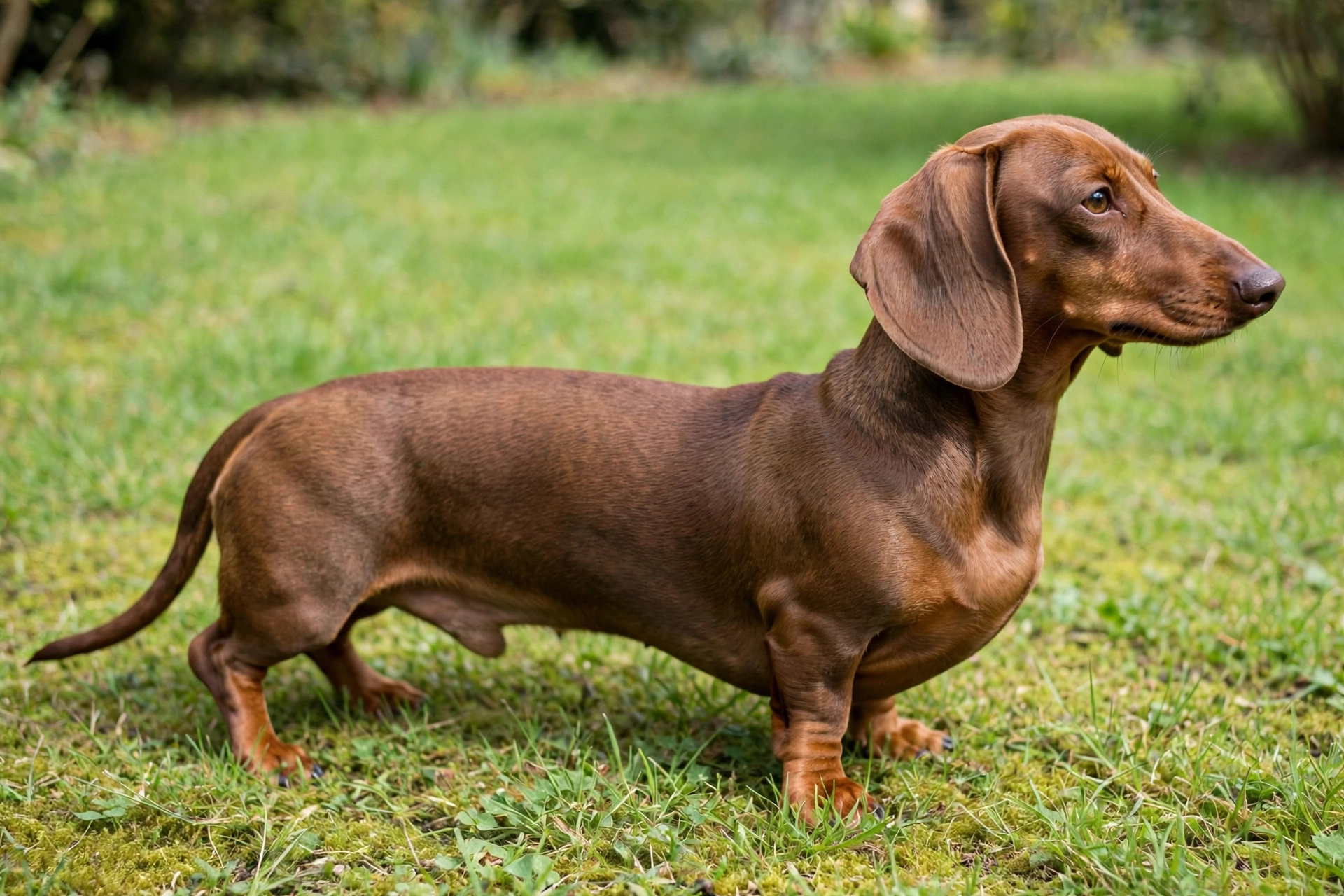

One day your Dachshund hops off the couch like he has done a thousand times, lands awkwardly, and yelps. By bedtime he is walking stiffly, back hunched, and he does not want his dinner. For a lot of owners, that is their first introduction to IVDD.
So what is IVDD in dogs? IVDD stands for intervertebral disc disease. It happens when one of the cushioning discs between the bones of the spine bulges or bursts and presses on the spinal cord. Depending on the pressure, the result ranges from a sore back to a dog who suddenly cannot walk. It is frightening, but it is also one of the most commonly treated spinal problems in dogs, and many dogs get back on their feet with the right care at the right time.
What is IVDD in dogs, exactly?
Picture the spine as a stack of bony blocks, the vertebrae, with a small cushion wedged between each pair. Every cushion, the intervertebral disc, has two parts: a tough, fibrous outer ring and a soft, jelly-like center. Together they act as shock absorbers, letting the back bend and twist while protecting the spinal cord above them.
Problems start when a disc ages and dries out. The soft center hardens, sometimes as early as the first year or two of life in prone breeds, and the cushion loses its bounce. From there, a disc can go wrong in two main ways, which PetMD describes as two types:
| Type I IVDD | Type II IVDD | |
|---|---|---|
| What happens | The hardened center bursts through the outer ring, often suddenly | The disc slowly bulges outward without fully rupturing |
| Typical dogs | Young to middle-aged short-legged, long-backed breeds | Older, larger dogs without the dwarf build |
| Onset | Fast, sometimes within hours | Gradual, over weeks or months |
| Usual signs | Sharp pain, yelping, sudden weakness or paralysis | Slowly worsening stiffness and wobbliness |
Because the spinal cord sits in a bony tunnel, it has nowhere to move when disc material pushes in. It gets pinched and bruised, and signals between the brain and legs get disrupted. Most cases happen in the middle of the back, which is why the hind legs take the hit. Neck discs are next most common and can affect all four legs; those dogs hold their head low and cry out when they try to turn it.
Which dogs are most at risk of IVDD?
Any dog can develop a disc problem, but the risk is heavily stacked toward the long-backed, short-legged breeds. These dogs are called chondrodystrophic: the leg bones stay short while the spine stays full length, and their discs harden far earlier than they should. That is why trouble often shows up in young or middle-aged dogs, not old ones. VCA Animal Hospitals lists the highest-incidence breeds as the Dachshund, Poodle, Pekingese, Lhasa Apso, German Shepherd, Doberman, Beagle, French Bulldog and Cocker Spaniel.
The Dachshund sits at the top of that list by a distance. Cornell’s College of Veterinary Medicine, citing American College of Veterinary Surgeons estimates, notes that Dachshunds alone account for a large share of all cases, often affected between three and six years of age. If you share your sofa with a sausage dog, this is the health problem to understand before you need to.
Other breeds regularly named include:
- Shih Tzus, Basset Hounds and Corgis, for the same long-spine build
- French Bulldogs, who combine the shape with a real enthusiasm for jumping off things
- Miniature and Toy Poodles and Beagles, with the same early disc hardening
- Larger breeds such as Labrador Retrievers and German Shepherds, more often with the slow Type II form in later life
What are the signs and stages of IVDD?
The earliest signs are easy to brush off, which is why they get missed. A dog in the first stage might simply seem “off”: skipping a meal, shivering for no reason, panting at rest, refusing stairs he has climbed for years. Dogs in pain often breathe faster and tremble, and our guide to why dogs breathe fast covers those signals in more detail. With a long-backed breed, treat that cluster as a back problem until proven otherwise.
Vets grade IVDD on a five-stage scale based on what the dog can still do. The grade drives the treatment decision:
| Stage | What you will see |
|---|---|
| Stage 1 | Back or neck pain only. Walks normally but may yelp, shiver, arch his back, hold his head down, or refuse to jump |
| Stage 2 | Weak and wobbly but still walking. Back legs may cross, splay out, or knuckle under so he walks on the tops of his paws |
| Stage 3 | Cannot stand or walk without help, but can still move the legs and wag the tail |
| Stage 4 | Paralyzed and cannot move the legs, but can still feel a firm pinch on the toes (deep pain sensation present) |
| Stage 5 | Paralyzed with no deep pain sensation at all. The most serious stage, and a true emergency |
Watch too for a sudden scream when picked up, a tight, tense belly, and dragging toenails that click on hard floors. Losing bladder control usually means stage 3 or beyond.
One warning worth hearing plainly: stages can move fast. A dog wobbly at breakfast can be unable to walk by evening. Vets would rather see ten overreactions than one dog left overnight to “see how he is in the morning.”
How do vets diagnose IVDD?
Diagnosis starts with hands, not machines. Your vet will run a neurological exam: watching your dog walk, checking reflexes, testing whether he knows where his paws are, feeling along the spine for the painful spot, and checking the crucial deep pain response in the toes. That exam shows roughly where the bad disc is and how severe the damage is.
Plain X-rays have limits here. They can rule out other problems, like a fracture, a bone tumor or a disc infection, but the discs and spinal cord barely show up on them. To see exactly which disc has ruptured and how much material is pressing on the cord, vets turn to advanced imaging: MRI is considered the best tool for looking at the spinal cord, and CT is a common alternative. Imaging usually means a referral hospital and a general anesthetic, so it is reserved for surgical candidates or unclear cases. If your dog cannot walk, expect this conversation to move fast.
Can IVDD be treated without surgery?
Yes, plenty of dogs are. Conservative treatment, meaning no operation, is usually the first route for stage 1 or 2 dogs who are in pain but still walking steadily, and an option for some more severe cases when surgery is not possible. Cornell’s guidance on intervertebral disc disease follows the same basic shape most vets use: rest, pain relief, and time.
The hard part is the rest. Conservative care typically means strict crate rest for four to six weeks, and “strict” is doing real work in that sentence:
- Your dog lives in a crate or small pen big enough to stand, turn and lie flat, and nowhere bigger
- He comes out only for short, on-leash toilet trips, ideally carried to the grass and back
- No stairs, no furniture, no playing, no “he seemed better, so we let him run.” A disc that feels better at week two is still healing, and one leap off the couch can undo the whole thing
Alongside rest, your vet will prescribe medication: an anti-inflammatory for the swelling around the cord, pain relief such as gabapentin, and sometimes a muscle relaxant for back spasms. Never raid your own medicine cabinet for this. Human painkillers are dangerous for dogs, and mixing drugs without your vet knowing can close off treatment options later. Our article on whether you can give a dog Benadryl shows how easily home dosing goes wrong.
The final piece is honest monitoring. If pain is not improving within a week, or your dog gets weaker at any point during crate rest, conservative care has failed and surgery needs discussing promptly.
When does a dog with IVDD need surgery?
Surgery enters the picture when the spinal cord is under serious pressure. Vets typically recommend it for dogs who cannot walk (stages 3 and 4), dogs at stage 5, dogs worsening despite rest and medication, and dogs who improve then relapse repeatedly. The most common operation is a hemilaminectomy: the surgeon removes a small window of bone from the vertebra and lifts out the disc material crushing the cord, giving it room to recover.
Timing matters most at the severe end. Dogs who still have deep pain sensation have the best outlook, and for dogs who have lost it, outcomes drop the longer the cord stays compressed. A stage 5 dog is a “drop everything” case: reach a surgical team as fast as you safely can, ideally the same day. It is not a small decision, so ask direct questions: What stage is my dog? What if we wait until tomorrow? What does recovery look like if this goes well, and if it does not?
What does recovery and home care look like?
Whether your dog had surgery or went the crate-rest route, most recovery happens at your house. The first weeks follow the strict rest pattern above. After that, movement rebuilds gradually, with short, slow leash walks that lengthen only as your vet or rehab therapist allows.
Practical changes that make a real difference:
- Ramps over jumps. Put a ramp at the couch and bed, or lift your dog properly every time: one hand under the chest, one under the rear, spine level. Block the stairs with a baby gate while you are at it.
- A harness, not a neck collar. A well-fitted harness spreads pulling forces across the chest instead of yanking on the neck and spine. For most IVDD dogs this is a permanent change.
- Weight control. Every extra pound is load on the healing spine. Ask your vet for a target weight, and be stubborn about treats.
- Grip underfoot. Slippery floors undo recovering dogs. Lay runners or rugs along his usual routes.
- Bladder help when needed. Dogs at the higher stages may not urinate on their own for a while. Your vet team can teach you to express the bladder by hand; it sounds daunting and becomes routine within days.
Many dogs also benefit from professional rehab once the vet clears it: controlled exercises, balance work, and hydrotherapy on an underwater treadmill, where the water supports the body while the legs relearn walking. Improvement can keep coming for months.
Can you prevent IVDD in the first place?
Partly, and it is better to hear that straight than to be sold a guarantee. IVDD in the high-risk breeds is largely written into their genes and shape. No diet, supplement or exercise plan hands a Dachshund a different spine. Genetic testing helps breeders, but not the dog already asleep on your rug.
What you can do is lower the strain on the discs he has:
- Keep him lean. This towers over everything else.
- Make jumping down from height a non-event: ramps, lifting, and a “no sofa launches” rule for visitors who think it is cute
- Use a harness for walks and keep exercise steady and sensible. Long walks are great; repeatedly leaping to snatch a toy from the air is the twisting, high-impact strain Cornell’s vets suggest cutting back on
- Act on the first signs. A dog seen at stage 1, sore but still walking, has by far the easiest road. Treat “quiet, hunched and off his food” as a same-day vet call
Prevention is stacking the odds, not beating them. If a disc does go, you want it to happen in a lean, fit dog whose owner spotted it early.
Conclusion
IVDD is what happens when a worn-out spinal disc bulges or bursts into the space where the spinal cord lives. It hits long-backed breeds like the Dachshund hardest, often in the prime of life, across five stages from back pain to paralysis with no feeling in the legs.
Treatment forks two ways: strict crate rest and medication for dogs still walking well, and surgery for dogs who cannot walk or keep getting worse, where speed genuinely changes the outcome. Either way, recovery is a home project of ramps, a harness, a sensible waistline and patience.
If you take one thing from this article, take this: with a breed built like a Dachshund, back pain is never a wait-and-see symptom. A same-day vet visit at stage 1 can be the difference between a crate, some pills and a full recovery, and an emergency operation at midnight.
Frequently asked questions
Is IVDD painful for dogs?
Yes, it can be painful, especially early on and whenever the problem is in the neck. A pinched, bruised spinal cord plus muscle spasm around it is a miserable combination. The cruel twist is that stage 5 dogs, who have lost deep pain sensation, may not cry out because the signals cannot get through. A quiet dog is not automatically a comfortable one, which is why pain relief matters at every stage.
Can a dog recover from IVDD without surgery?
Many can. Dogs in pain but still walking, and quite a few who are wobbly, recover well on strict crate rest and medication alone, provided the rest really is strict and they do not worsen along the way. Dogs who cannot walk face a tougher road without surgery, though recovery is not impossible. The deal-breaker is deep pain: once that is gone, surgery gives the best chance by far.
How long does it take a dog to recover from IVDD?
Expect weeks at a minimum. Conservative care means four to six weeks of crate rest before activity builds back up. After surgery, dogs spend a few days in the hospital, then face the same restricted weeks at home. Timelines run from about six weeks for a mild case to several months for a dog relearning to walk. Small weekly improvements are a good sign.
At what age do Dachshunds usually get IVDD?
Most often in young to middle adulthood. Cornell’s veterinary college notes that Dachshunds are commonly affected between three and six years of age, which surprises owners who file IVDD under “old dog problems.” Their discs harden in the first year or two of life, so the risk window opens early. Larger breeds with the slower Type II form usually show signs later, often past eight.
Can IVDD happen more than once?
Unfortunately, yes. The disc that ruptured was rarely the only worn one in that spine, and another can fail months or years later. Some dogs are treated two or three times in a lifetime. That is no reason to wrap your dog in cotton wool, but do keep the ramps, harness and waistline permanent after a first episode, and treat any new back pain as urgent from the first hour.
Related Articles