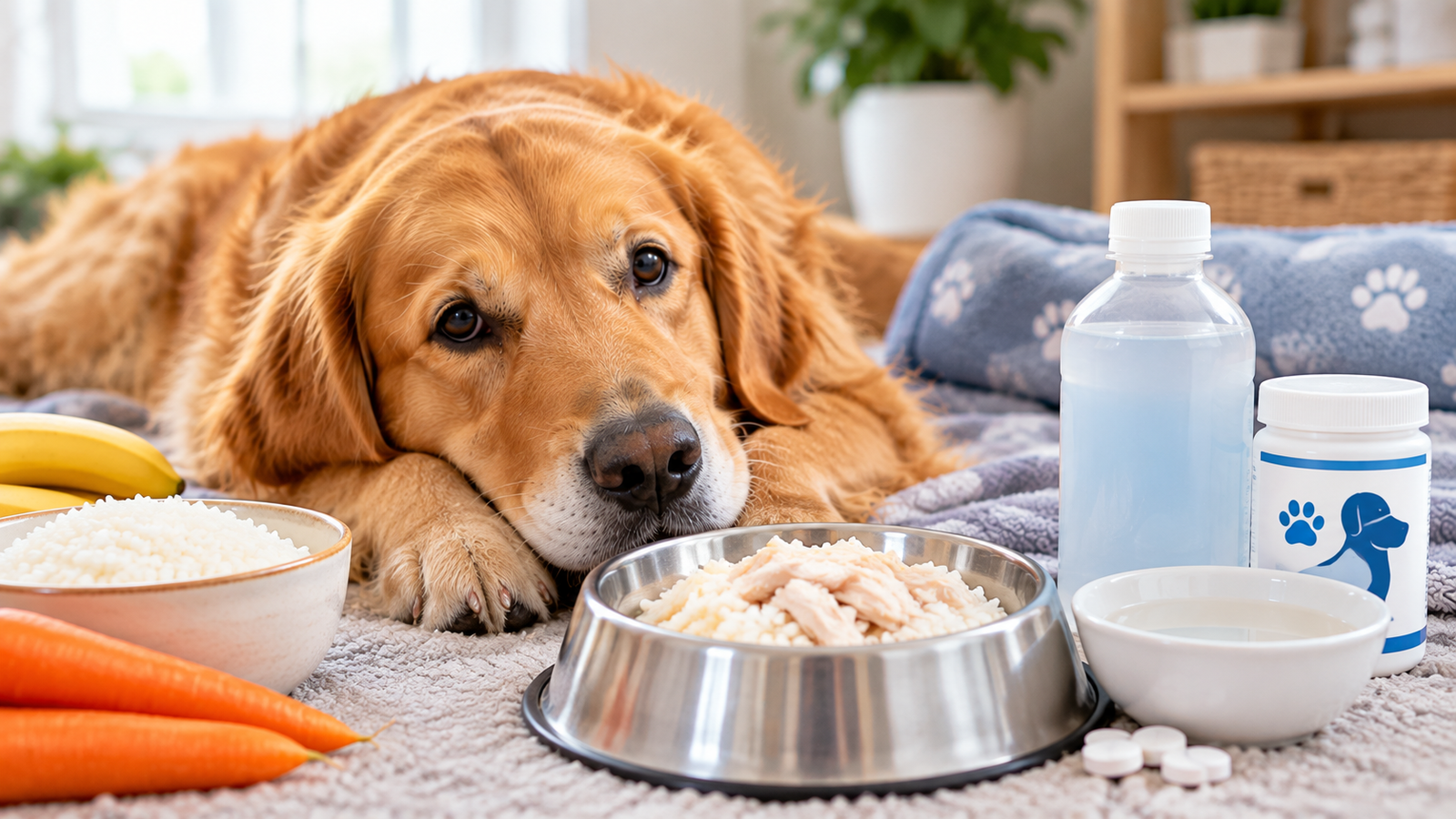

For a healthy adult dog with mild diarrhea, the safest things to give are fresh water, a short rest from food, and then small meals of plain boiled chicken and white rice. A spoonful of plain canned pumpkin and a vet-approved probiotic can help firm things up. Most mild cases settle within a day or two.
That plan fits one situation: an adult dog who still acts normal, still drinks, and has no other symptoms. Puppies, older dogs, and any dog that vomits or seems weak need a vet, not home care. Below you will find exactly what to give, how much, what to keep away from, and the signs that mean it is time to pick up the phone.
Is it safe to treat dog diarrhea at home?
Home care is safe when your dog is an adult, eats with interest, drinks water, and plays or rests as usual. One or two loose stools after a new treat or a stolen scrap often fit this picture. The cause is usually something simple, like a sudden food change, eating something odd, or stress from boarding or travel.
Home care is not safe for puppies, seniors, or dogs with a health problem such as kidney or heart disease. Puppies lose fluid fast, and diarrhea in a young dog can point to parvovirus or worms. Any dog that is vomiting, feverish, weak, or passing blood needs a vet the same day.
Quick rule: if your healthy adult dog is bright and drinking, start home care now. If anything on the red-flag list near the end of this article shows up, skip home care and call your vet.
What to give a dog with diarrhea at a glance
Here is the whole plan in one place. Each item is explained in the steps below.
| What to give | How much | For how long |
| Fresh water | Always available, offered often | Throughout |
| Rest from food | No food or treats | Up to 12 hours, healthy adults only |
| Chicken and rice | Equal parts, about 2 tablespoons per 10 lb per meal at first | 3 to 5 days |
| Plain canned pumpkin | 1 to 4 tablespoons mixed into a meal | Short term, for mild cases |
| Dog probiotic | Product and dose set by your vet | As your vet advises |
Step 1: Give water and a short rest from food
Water comes first. Diarrhea drains fluid quickly, and dehydration is the biggest short-term risk. Keep a full bowl out and refresh it often. If your dog drinks very little, offer small amounts every few minutes instead of a full bowl at once.
Dry or sticky gums, sunken eyes, and a very tired dog are signs of dehydration. Call your vet if you see them. Severe or long-lasting diarrhea can need fluids given by a vet.
A healthy adult dog can give its gut a break with a fast of up to 12 hours. That means no food and no treats, but water at all times. Do not fast puppies under three months old, senior dogs, or dogs with a health condition unless your vet tells you to. Their bodies cannot go without food safely.
Step 2: Feed a bland diet of chicken and rice
After the short rest, a bland diet gives the gut something gentle to work with. It is low in fat and easy to digest. The classic mix is boiled lean chicken and plain white rice, in equal parts. Boiled lean ground beef also works if your dog does not do well on chicken.
Chicken and rice work because both are easy to digest and low in fat. Plain white rice is gentler than brown rice, which has more fiber. Keep the portions small and the meals plain, so the gut is not asked to do too much at once.
Here is how to make and serve it:
- Boil skinless, boneless chicken breast in plain water until cooked through. Drain it, remove any fat, and shred it into small pieces.
- Cook plain white rice until it is soft. Add no salt, oil, butter, or seasoning to either one.
- Mix the chicken and rice 1 to 1 by volume, for example 1 cup of each. Let it cool to room temperature.
- On day one, start with about 2 tablespoons of the mix for every 10 pounds of body weight, offered every 2 to 3 hours. A 40-pound dog would get roughly half a cup per meal. Too little is better than too much.
- As the stool firms up, give bigger portions less often, until you are back to your dog’s normal number of meals.
- After 3 to 5 days, begin mixing in your dog’s regular food a little more each day. Most dogs are fully back on their usual diet in about a week.
A bland diet is not complete nutrition, so it is a short-term fix only. If your dog is allergic to chicken or rice, ask your vet about a prescription digestive diet instead. These are made to be gentle and balanced at the same time.
If your dog’s diarrhea started right after a food change, go back to the old food until stools are firm. Then switch again slowly over one to two weeks.
Can pumpkin help a dog with diarrhea?
Yes, plain canned pumpkin can help with mild diarrhea. It is rich in soluble fiber, which soaks up extra water in the gut and helps stool hold its shape.
Look for a can that lists pumpkin as the only ingredient. Do not use pumpkin pie filling. It has sugar and spices, and pie mixes can contain xylitol, which is toxic to dogs. The AKC’s guide to pumpkin for diarrhea suggests 1 to 4 tablespoons mixed into a meal. Start at the low end, because too much fiber can make things worse.
Pumpkin powder made for pets is another choice. Fresh cooked pumpkin works too, though it is less concentrated than canned. Whichever you pick, keep it plain, with no salt, sugar, or spices.
Pumpkin works best for mild cases. It is a helper, not a treatment for a dog that is sick.
Do probiotics help dogs with diarrhea?
They can. Probiotics are live bacteria that support the healthy mix of microbes in the gut, and that mix gets thrown off during diarrhea. A probiotic made for dogs is a sensible add-on to the bland diet.
Choose a veterinary product rather than a human supplement, since human products are not made or tested for dogs. Product quality varies a lot, so ask your vet which one to buy and how much to give. Your dog’s weight and age affect the right amount.
Plain yogurt with live cultures is another option, but only for dogs that handle dairy well. Skip any sweetened or flavored kind, because some contain xylitol.
What not to give a dog with diarrhea
Some of the most common kitchen cabinet fixes can do harm. Keep these off the list unless your vet tells you otherwise.
- Pepto-Bismol and Kaopectate. Both contain bismuth subsalicylate, which can be toxic to dogs in high doses. They should never be given to cats.
- Imodium (loperamide). Some dogs carry a gene change called MDR1, and for them loperamide can cause severe nerve and brain problems. It is most common in herding breeds such as Collies, Australian Shepherds, German Shepherds, and Shetland Sheepdogs. Most owners do not know their dog’s status. Loperamide can also make things worse when the diarrhea comes from a toxin, an infection, or a blockage, because it slows the gut down.
- Any other human medicine or supplement. Most human medicines do not help dogs with diarrhea, and some are harmful.
- Rich or fatty food. Skip table scraps, greasy meat, cheese, bones, and extra treats until stools are normal.
If you think your dog ate something it should not have, such as medicine, a sock, a toy, or a toxic plant, call your vet or an animal poison hotline right away instead of waiting.
How can you tell it is working?
Look for small, steady wins. Stools should get firmer and less frequent over the first day or two. Your dog should keep drinking, show interest in its meals, and have normal energy. A dog that is slowly improving is on the right track, even if stool is not perfect yet.
A step backward matters too. If stools get looser again, your dog stops eating, or new symptoms show up, stop the home plan and call your vet. Do not push through, because a setback can mean the cause is bigger than a simple upset stomach.
Simple care tips while your dog recovers
- Take your dog outside often, since urgent trips are common with diarrhea.
- Hold off on treats, chews, and new foods until stools have been normal for a day or two.
- Pick up stool right away and wash your hands afterward, because some causes, like parasites, can spread to other pets.
- Keep walks short and calm until your dog’s energy is back to normal.
Why do dogs get diarrhea in the first place?
Knowing the cause helps you judge how worried to be. The mild causes are the most common: eating garbage or an unusual food, switching diets too fast, or stress from a vet visit, boarding, or travel.
Other causes need a vet. These include intestinal parasites such as roundworms, hookworms, and whipworms, infections like parvovirus, food allergies, poisons, and long-term gut or organ disease. Diarrhea that keeps coming back over weeks is never normal, even if the dog seems happy.
When should you call the vet?
Call your vet if your dog’s diarrhea has lasted more than two days, or if it has not clearly improved within 48 hours of starting home care. Call sooner, and do not wait, if you see any of these:
- Blood in the stool, or black, tarry stool
- Vomiting along with the diarrhea
- Weakness, extreme tiredness, or a fever
- A swollen or painful belly
- No interest in food, or signs of dehydration
- Any diarrhea in a puppy
- Diarrhea in a senior dog or a dog with another health problem
Your vet may run a stool test, give fluids, prescribe a dewormer or an anti-diarrhea medicine, or suggest a prescription diet. Most dogs with simple diarrhea recover fully, and Cornell’s Riney Canine Health Center notes that many mild cases clear up with basic supportive care. The goal is to catch the cases that are not simple early.
It also helps to note a few details before you call: how long it has gone on, what the stool looks like, and what your dog ate lately. A photo of the stool is useful too.
Conclusion
Give a healthy adult dog with mild diarrhea plenty of fresh water, up to 12 hours without food, then small meals of boiled chicken and white rice for 3 to 5 days. Plain canned pumpkin and a vet-approved probiotic can help. Avoid Pepto-Bismol, Imodium, and rich food. A good result is firm stool within a day or two. If it lasts past two days, or blood, vomiting, or weakness appears, see your vet.
Frequently asked questions
Can I give my dog Pepto-Bismol or Imodium for diarrhea?
Not without asking your vet first. Pepto-Bismol and Kaopectate can be toxic to dogs in high doses, and Imodium can cause serious nerve problems in dogs with the MDR1 gene change. A bland diet and water are the safer first step.
How long does diarrhea last in dogs?
Mild diarrhea in a healthy adult dog usually clears within a day or two. If it lasts more than two days, or has not improved after 48 hours of home care, call your vet. Puppies should be seen sooner.
How long should I feed my dog chicken and rice?
Feed it for 3 to 5 days, until stools are firm. Then mix in your dog’s regular food a little more each day. Most dogs are back on their normal diet in about a week.
Should I stop feeding my dog when it has diarrhea?
A healthy adult dog can fast for up to 12 hours to rest the gut, with water available at all times. Puppies, senior dogs, and dogs with health problems should not fast unless their vet says so.
How much pumpkin can I give my dog for diarrhea?
Use plain canned pumpkin, not pie filling. The usual range is 1 to 4 tablespoons mixed into a meal. Start with a small amount, since too much fiber can upset the gut further.
Related Articles
How to Clean Dog Ears at Home: Safe Step-by-Step Guide
Can I Give My Dog Benadryl? Safe Dose and Risks

-
-
-
-
-
-
-
-
-
-
-
-
-
-
-
-
-
-
-
-
-
Show Comments[…] What to Give a Dog for Diarrhea: Safe Home Care & Vet Tips […]
[…] row deserves respect too. Plain digestive upsets follow stolen food often enough that our guide on what to give a dog for diarrhea covers home care for mild cases — but vomiting after a known bone is different. Treat it as a […]
[…] and diarrhea, which can become severe. The advice in what to give a dog for diarrhea covers first steps, but suspected salmon poisoning needs a vet, not home […]
[…] Offer water little and often, keep meals small and bland for a day or so, and our guide on what to give a dog for diarrhea covers the gentle home care that helps an upset stomach […]
[…] the room, and a dog who skips his next two meals because his stomach is complaining. Our guide on what to give a dog for diarrhea is the one to keep handy if a treat experiment ever goes that […]
[…] for a day. If your dog has helped himself to almonds and the diarrhea has started, our guide on what to give a dog for diarrhea walks through the bland-food approach that settles most mild cases at […]
[…] stool for a day or two. It usually settles once you drop back to a smaller amount, and our guide on what to give a dog for diarrhea covers what to feed while things firm up. Vomiting alongside it, or diarrhea that drags past a day, […]
[…] worse, and persistent diarrhea has a list of causes that need an actual diagnosis. Our guide on what to give a dog for diarrhea walks through what helps and when to stop home care, and vomiting that keeps coming back belongs in […]
[…] are rich, and a full portion on day one is the usual reason owners end up reading our guide on what to give a dog for diarrhea at midnight. Build up over two or three servings and almost every dog handles them […]
[…] is half a bowl of raisins. If your dog has diarrhea after raiding the cereal cupboard, our guide on what to give a dog for diarrhea covers home care, but with raisins involved, the vet call comes first, […]
[…] no interest in his normal food — needs more than a watch-and-wait approach. Our guide on what to give a dog for diarrhea covers the home care basics and the point at which diarrhea stops being a home problem and becomes […]
[…] reason sacs stop emptying on their own, so if loose poop is part of the picture, our guide on what to give a dog for diarrhea is worth a read alongside this one. Cornell’s veterinary guide to anal sac diseases covers […]
[…] sake, some weeks are just home weeks. If loose stools are the issue, our vet-approved rundown of what to give a dog for diarrhea covers home care while he […]
[…] They typically settle within a day once the basil stops. If loose stool sticks around, our guide on what to give a dog for diarrhea walks through safe home care and the point at which home care is not […]
[…] into an emergency vet run at midnight, and it is why our guides on why a dog throws up yellow and what to give a dog for diarrhea both push early vet calls. Thirst and overheating travel together, too — a dog panting hard in […]
[…] first signs that a dog got more herb than it needed. If that’s where you are, our guide on what to give a dog for diarrhea covers the home care basics while you keep an eye on […]
[…] the portion was too generous or the food is too rich for that particular dog, and our guide on what to give a dog for diarrhea will help you settle things down while you cut seeds from the menu for a […]
[…] fully settled, small, bland meals are the usual way back to normal feeding — our guide on what to give a dog for diarrhea covers the same gentle foods vets suggest for an irritated […]
[…] rush the introduction. If your dog does end up with an upset stomach after a new food, our guide on what to give a dog for diarrhea covers the bland, gentle feeding vets usually suggest while things […]
[…] a bit off” for weeks rather than days, giardia belongs on the list of suspects. Our guide on what to give a dog for diarrhea covers the home care side — but with giardia, home care alone won’t clear the parasite, […]
[…] Soft stools are worth mentioning too — they’re relevant to the glands, and our guide on what to give a dog for diarrhea covers that side of […]